From Immigrant to Officer
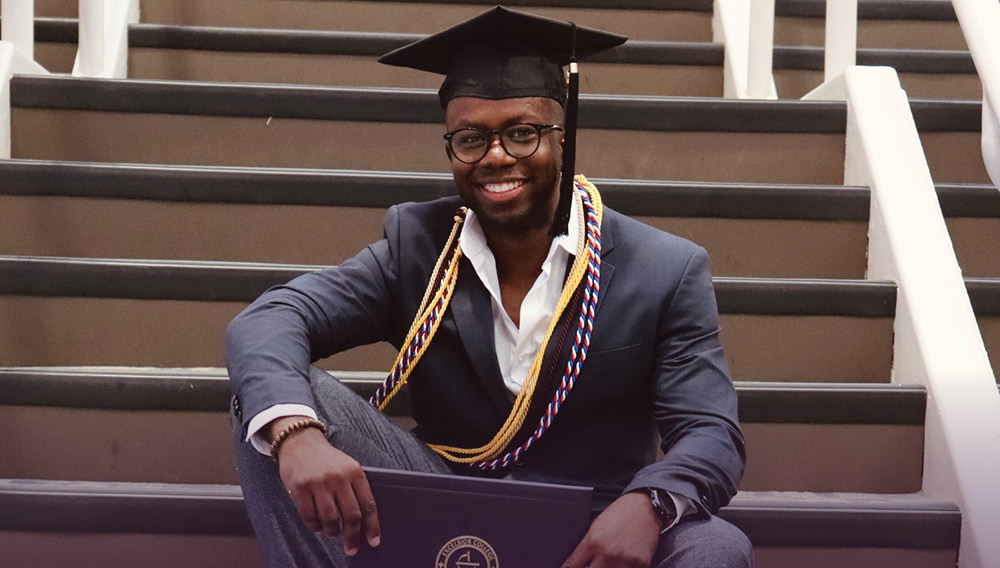
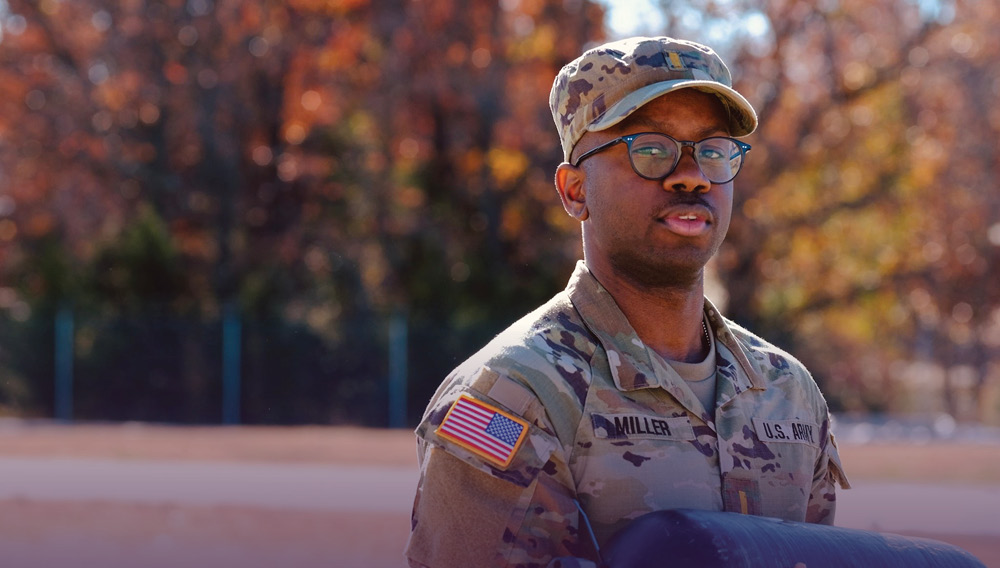
In 2013, when Jervaughn Miller was 18, his family emigrated from Jamaica to the United States in search of a better life. Miller’s parents believed that greater opportunities were in store for their son. “We didn’t have everything figured out, but they believed in the promise that hard work and dedication could lead to something better,” he says. Twelve years later, Miller is in the military, has three degrees, and works to contain hazardous materials. He’s proving the American dream isn’t just a fairy tale.
During his deployment to Guantánamo Bay, Cuba, from December 2017 to October 2018, Miller worked night shifts as a hospital corpsman. He spent most of his nights responding to medical emergencies and providing health care to his fellow service members. One evening, his chief gathered all the sailors outside the living quarters to explain his expectations of them. He also gave them an ultimatum: Either find a hobby or go back to school.
“I couldn’t do any hobbies or play any sports, so I chose school,” he says, remembering his parents’ belief that a better education and a better future were attainable in the United States. That belief was deeply personal to Miller and would stay with him throughout his military and educational career.
Miller needed to pick a major. He chose health care, in part due to his role as a hospital corpsman. However, his military duties made it difficult to take courses in person. So, instead of focusing on the clinical side of health care, he decided to focus on prevention, policy, and public health.
Those interests led him to Excelsior University (then College). The school’s education standards impressed him. While stationed at the Naval Support Activity Orlando base not long after his time in Guantánamo Bay, he completed his associate degree (2019) and bachelor’s degree (2021), both in health sciences, before starting work on his Master of Science in Health Sciences.
Learning While Leading
The curriculum of Excelsior’s health sciences programs supported his interest in public health. “The courses enlightened me of all the issues that our health care system is experiencing right now. It piqued my interest,” he says.
In 2022, after spending eight years in the Navy, Miller was commissioned as an officer in the U.S. Army. He decided to attend the Chemical, Biological, Radiological, and Nuclear (CBRN) Basic Officer Leadership Course to start focusing on public health concerns. It wasn’t easy; Miller took the course at the same time he was completing his master’s. It was no small task, but he pushed through and finished both programs in 2023.
As a CBRN officer, Miller leads a command defending against chemical and biological weapons, and weapons of mass destruction. “In essence, we try to detect, analyze, and mitigate any type of chemical, biological, or radiological threats,” he says. “If we have personnel or equipment that are contaminated, we are able to decontaminate them. … Many of us are also trained as hazmat technicians.”
As a reconnaissance platoon leader, Miller oversees what he calls a “mobile science lab on wheels.” This specialized military vehicle carries equipment that detects and analyzes hazardous agents in real time. If there’s a nuclear event or chemical spill, Miller and his colleagues drive in, collect samples, and determine what’s out there. Mini mobile labs allow them to test the air samples from safely inside their vehicles. Air is pulled in through ports, analyzed by detectors, and displayed on screens inside, giving the team immediate data. Although not usually necessary, if Miller and his team need to go outside, they wear required protective suits and masks.
Training for the Unthinkable
Most days aren’t spent in active crisis response, but Miller and his team are constantly training. Miller’s days begin at 6:30 a.m. with physical training, followed by working on vehicles and doing drills. He also has leadership duties such as managing soldiers, planning training for his 16-member platoon, and briefing senior officers.
Miller’s academic background directly supports his Army work. Excelsior’s courses in biology, environmental science, and even weather have practical applications in understanding how hazards spread. Leadership training has been equally important. “A few of my classes had a leadership aspect to it, like how to be a good leader, servant leader, so that kind of really helped me to be a good leader to my platoon and the orders that I’m giving,” he says.
With 11 years of service—eight in the Navy, three in the Army—Miller remains focused on his platoon, his higher education, and his mission of improving public health and safety. He credits Excelsior for his growth and where he is today.
The Road Ahead
But there’s a spark in Miller that pushes him to do more. He’s pursuing a doctoral degree in health care administration at Virginia University of Lynchburg. “Preventative medicine is my thing. I’m really big into holistic care, preventative medicine, using the wellness model … maybe creating some type of wellness program to help people better their health,” Miller says. He wants to teach, influence policy, and develop wellness programs to prevent public illness.
His Excelsior experience may have set him up for a career beyond the military, but it was his family who instilled in him the importance of never giving up. For as much as he values his achievements, he knows how much every milestone of his journey has meant to his parents. “Every degree I’ve earned has been a reflection not just of my personal drive but also of the sacrifices my family made to give me this chance,” he says.
Miller shows that it may be difficult, but with determination and hard work, the American dream is never far out of reach.