The Torch He Carries: Jatik Gibbs-Judd’s Poetic Story
The thread that weaves together every chapter of Jatik Gibbs-Judd’s life isn’t luck, circumstance, or even resilience—it’s writing. Poetry. Putting words on a page became the one steady action he could rely on, no matter how chaotic the world around him became.
Well before Gibbs-Judd served nearly 14 years in the U.S. Navy, before he became a radiological control technician at Los Alamos National Laboratory, and before he earned a BS in Nuclear Engineering Technology from Excelsior University, he was a child navigating instability. Born to a 13-year-old mother, he spent his early childhood moving between homelessness, relatives’ homes, and foster care. Stability was something Gibbs-Judd did not have.
What he did have, at age 10, was a notebook—and his first poem, “Pain.”
Writing was never assigned or encouraged; it was survival. The adults in his life were overwhelmed, exhausted, and stressed. “I never wanted to be the difficult child,” he said. “Writing allowed me someone to talk to when everyone else was too stressed to hear what I had to say.” Poetry was where he could place his fear and frustration without asking too much of anyone.
As adolescence brought new challenges, the instability continued. He eventually moved in with his father so he could finish high school in one place. He became the president of his senior class, but his high school years were not without challenges. Soon his father was in an unpredictable relationship, and Gibbs-Judd found himself facing homelessness again.
A Home in the Navy
Gibbs-Judd’s future was uncertain. “I didn’t want to be one of those people that stayed in college forever and was just bouncing around. So, I joined the Navy. To me, that was the best choice that I could possibly have, and it wasn’t necessarily the best reason for the choice, but it did ultimately save my life,” he recalls. The decision wasn’t glamorous; it was pragmatic. The military offered structure, income, and a guarantee he would never be homeless. “I get that, for most people, they have these big dreams of being like astronauts and things like that. That was not my dream. My dream was to not be homeless ever again,” Gibbs-Judd says.
Gibbs-Judd was with the Navy from 2008 to 2022 as a nuclear engineer. Yet even amid the discipline and demand of service, poetry stayed with him, quietly absorbing emotions he had trouble expressing aloud.
During an early deployment, Gibbs-Judd responded as a stretcher bearer to a violent incident involving mercenaries hijacked by Saudi Arabian pirates. As a nuclear engineer, he did not have experience responding to events in this role, but as he describes it, “if everything goes wrong, this is what you’re supposed to do; you have an assignment during that time that is separate from your actual, normal job.”
The resulting trauma embedded itself in his memory, often resurfacing years later as flashbacks and blackouts. “I realized that it did affect me, and so I ended up having to talk to somebody about it,” Gibbs-Judd explains. When he sought treatment for post-traumatic stress disorder and later medically retired, writing again became an anchor: a private space where he could make sense of what he had endured.
Picking Up the Torch
While stationed in Atlanta in a recruiting role as a nuclear coordinator, he returned to performing spoken-word poetry, gaining traction at local events like the Sweet Auburn Music Fest. “Writing has always been something that I could depend on, even in my darkest hours,” he says. Even as life grew complex—supporting his children with special needs, helping care for an elderly family member, and managing a full-time job—writing never disappeared. It waited patiently, ready whenever he needed it.
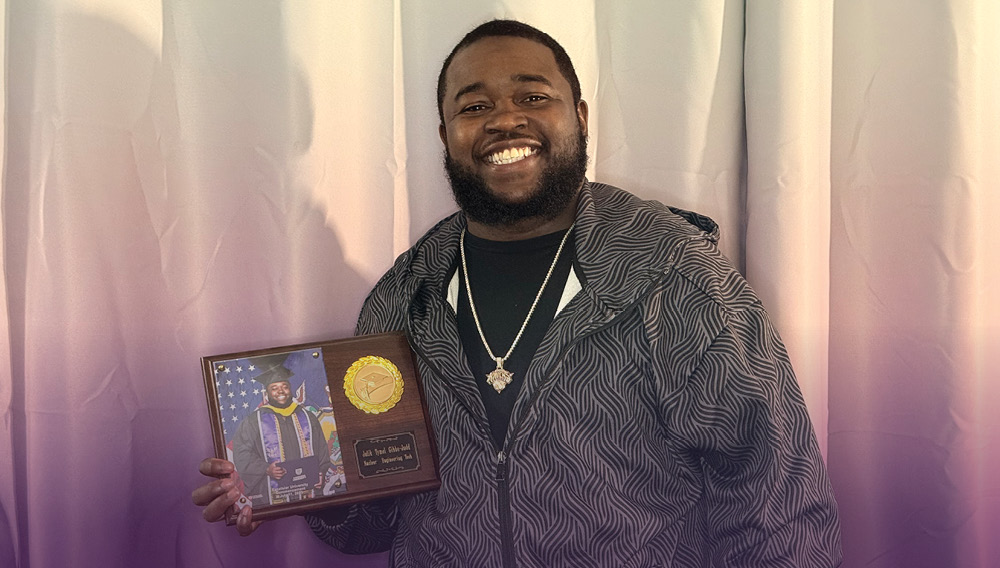
That same persistence helped him pursue higher education. For years he didn’t believe a degree was within reach. Discovering that Excelsior University aligned perfectly with his radiological control technician experience felt like a door finally opening, and he earned his bachelor’s degree in February 2025. At Commencement in July 2025, he was the graduate torch bearer and delivered a poem he wrote called “The Torch I Carry.” He explains that the poem is a testament to others that there is hope and that you don’t have to feel like you’re in the dark; you can make it through the tough times to accomplish your goals. “[We’re] using the torch as that kind of guiding light, almost like a lighthouse in the dark, where you’re stuck in the middle of the sea,” says Gibbs-Judd.
A Light for Those Still Lost to Save
Since 2022, Gibbs-Judd has worked at Los Alamos National Laboratory, starting as a radiological control technician, checking for potential radiation contamination in locations where specialized work needs to be done, and has recently been promoted to the role of building manager. He’s proud to say he has a stable home and can show his wife and kids—ages 13, 12, and 10—what hard work and determination can accomplish.
Poetry remains his constant companion. Sometimes, it takes the form of a performance, other times a scribbled line as a quiet reflection after a long day. It is the outlet that shaped him, the bridge between his past and present, and the steady hand that carries him forward.