
Nuclear Power as a Solution to AI’s Soaring Energy Needs
Key Takeaways
- S. data center electricity use was around 4.4% of total demand in 2023 and could climb to 6.7%–12% by 2028, according to the U.S. Department of Energy.
- Big Tech is signing long‑term nuclear energy agreements: Google/NextEra (Duane Arnold restart), Meta (Vistra/TerraPower/Oklo), and Microsoft/Constellation (Three Mile Island Unit 1) to secure 24/7 clean power.
- SMRs and microreactors offer modular, scalable power (≈1–20 megawatts for microreactors, ≈20–300+ megawatts for SMRs), aligning with large AI campus loads.
- Near‑term risks include timing mismatches (AI load grows in cycles of three to five years, while new nuclear energy can take longer), regulatory hurdles, and community concerns around siting and grid impacts.
- Software‑orchestrated AI workloads can make data centers flexible grid resources that reduce stress during peaks.
Artificial Intelligence’s Energy Problem
Artificial intelligence (AI) is expanding rapidly, and with it, global electricity consumption. Several major analyses project that data center electricity use could more than double by 2030, driven largely by AI workloads. According to the Lawrence Berkeley National Laboratory, U.S. data center consumption could grow from about 4.4% of national electricity in 2023 to 6.7%–12% by 2028. Utilities are now assessing whether projected AI load growth is realistic, with analysts noting that duplicate or speculative interconnection requests create uncertainty and could lead to costly over- or underbuilding. Local officials in multiple states have raised concerns as some proposed AI campuses request 100–400 megawatts of daily capacity—comparable to the electricity use of midsize cities.
Why Nuclear Energy Is Returning to the Conversation
Wind and solar energy are essential to decarbonization, but their intermittency makes it challenging to support AI systems requiring round-the-clock, high-reliability electricity. Research from Goldman Sachs indicates that nuclear energy offers a high-capacity-factor, carbon-free source capable of meeting AI’s 24/7 power needs. The U.S. Department of Energy notes that nuclear power facilities provide unmatched uptime and stability, making them well suited to digital infrastructure with strict reliability requirements.
Firm, clean power sources—especially nuclear—will be essential to maintaining grid reliability as AI-driven demand accelerates.

Big Tech Begins Direct Investment in Nuclear Energy
A clear shift is emerging across the energy and tech sectors: Major technology companies are no longer acting only as electricity consumers but are beginning to function as full partners in energy development. I saw this transition firsthand while attending the American Nuclear Society (ANS) annual meeting in the summer of 2024. Developers of advanced reactors emphasized their need for substantial capital to move projects forward, while data center representatives—facing unprecedented AI‑driven demand—expressed an urgent need for as much reliable power as they could secure.
When I attended another ANS meeting just six months later, the tone had changed noticeably. The conversations had moved from concepts and needs to concrete partnerships, as nuclear energy developers and AI‑driven data center operators openly discussed joint projects, coinvestment strategies, and long‑term power commitments. What had been parallel challenges only months earlier had rapidly evolved into coordinated solutions:
- Google & NextEra Energy are partnering to restart the 615-megawatt Duane Arnold nuclear power plant in Iowa by 2029, securing 24/7 carbon-free energy for Google’s AI and cloud operations.
- Meta has signed long-term deals with Vistra, TerraPower, and Oklo that could unlock up to 6.6 gigawatts of nuclear capacity by 2035 through a combination of existing reactors and next-generation designs.
- Microsoft is supporting the restart of Three Mile Island Unit 1 as Constellation Energy’s Crane Clean Energy Center, aiming to ensure firm, clean electricity for its AI-driven data center fleet.
By making long-term power purchase agreements, Big Tech is mitigating risk in nuclear projects and accelerating deployment timelines that would otherwise take far longer.
Small Modular Reactors (SMRs) and Next-Generation Designs
Small modular reactors are emerging as ideal partners for large-scale AI facilities. Whereas microreactors typically generate 1–20 megawatts, SMRs generally deliver 20–300 megawatts, aligning well with the demand profiles of AI campuses. And a Forbes Technology Council analysis notes that next-generation designs could deliver 50–500 megawatts per module, allowing scalability as AI load expands.
The DOE’s implementation of the Advanced Reactor Demonstration Program (ARDP) is directly shaping the landscape for SMRs and next-generation reactor designs by creating structured pathways that move promising technologies from concept to deployment. Through three coordinated tracks—full reactor demonstrations within seven years, targeted awards for risk reduction to resolve technical and regulatory gaps, and Advanced Reactor Concepts-20 (ARC-20) funding for innovative designs aiming for commercialization in the 2030s—the ARDP provides a development architecture well suited to the modular, scalable nature of SMRs and advanced systems. The program’s partnership with the National Reactor Innovation Center further supports this progress by offering test beds, siting resources, and national lab expertise needed to validate components, fuels, and integrated system performance.
Together, these implementation mechanisms accelerate the maturation of SMRs and advanced designs by reducing financial risk, enabling iterative testing, and strengthening domestic supply chains—all essential steps for deploying reactors capable of producing the potentially hundreds of megawatts of energy needed for next-generation digital and industrial infrastructure.
One of the most innovative approaches comes from Deep Fission, which is developing a 15-megawatt underground borehole reactor placed roughly one mile deep. This design leverages natural geologic pressure for passive safety while reducing construction costs by up to 80%. Recent financing rounds and digital infrastructure partnerships illustrate growing market confidence.
Timelines, Risks, and Community Considerations
AI-driven electricity demand is rising in cycles of three to five years, while licensing and constructing new reactors—especially first-of-a-kind SMRs—can take significantly longer. Analysts warn of a potential timing mismatch, which may increase reliance on natural gas generation in the short term.
Tech sector observers also note long-standing regulatory, financial, and public perception hurdles that continue to slow new nuclear energy deployment.
Community concerns are rising, as well. Activists and local governments across multiple states have questioned the siting, water use, and grid impacts of multigigawatt AI campuses, prompting developers to prioritize community engagement and transparency.
However, forward-looking grid studies show that data centers themselves can help stabilize the grid: AI workloads can be flexed in real time to reduce stress on transmission systems during peak events.
A STEM‑Trained Workforce: Critical to Both Sectors
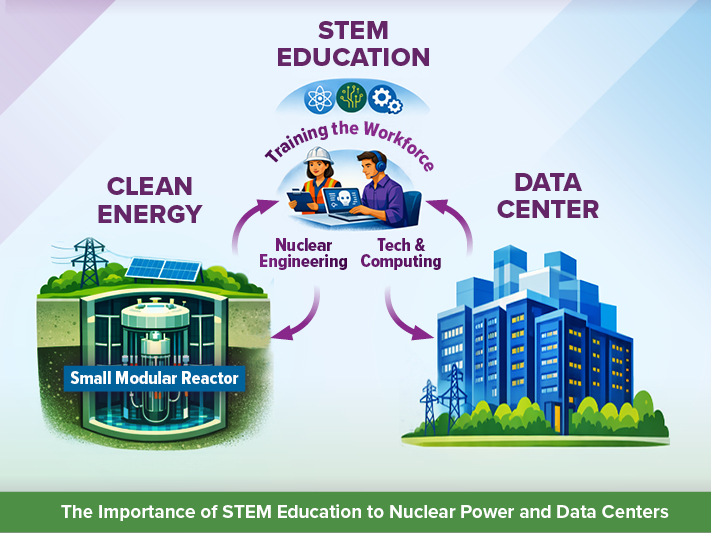
A thriving ecosystem integrating clean energy and artificial intelligence depends on people, not just technology. Nuclear power facilities require nuclear technicians, operators, and instrumentation and controls specialists; AI data centers require experts in cybersecurity, cloud engineering, and advanced computing.
Reports from MIT Energy Initiative and ACEEE stress that a robust STEM-educated workforce is essential to scaling both clean energy systems and AI data center operations.
STEM education is therefore not an “output” of these industries—it is the core enabler, powering both next-generation energy infrastructure and the digital systems that rely on it.
Bottom Line
AI is transforming reliable electricity from a background assumption into a strategic constraint and competitive advantage. In the near term, nuclear energy restarts and uprates offer the fastest path to more firm, clean power; in the medium term, SMRs and advanced reactors promise scalable solutions tailored to the demand of the AI era.
Success will require long-term investment, regulatory modernization, meaningful community partnership, and—critically—a STEM-trained workforce prepared to operate at the intersection of clean-energy engineering and AI computing.