
George H. Atkinson Center
Our world faces numerous rapidly deepening crises. At stake are no less than personal well-being, economic prosperity, institutional viability, and geopolitical stability. This exigency has been precipitated by the scientific and technological advances dominating the 21st century, the complex and transformational nature of which urgently require critical evaluations that translate to effective real-world policy decisions. Comprehensive assessments that adequately address society’s myriad challenges must span governmental, private sector, and public advocacy communities globally, and the results need to appropriately consider the long-term consequences of policy decisions that routinely only prioritize short-term benefits.
Complicating these crises is the profoundly pervasive cycle of institutional degradation and waning public faith in those institutions, creating a rapidly expanding vacuum of rational leadership. Indeed, the overarching, interconnected policies pertaining to these challenges critically rely on enhancing public trust in the scientific method and its outcomes that underpin the resultant recommendations. The timing of this systemic failure could not be worse, nor the stakes higher. The path forward demands well-established methodologies aggressively focusing on identifying evidence-based areas of consensus and actionable next steps applicable to real-world challenges.
GHA Center Mission
Optimize sustained generational commitments to identify and implement rational societal policies and real-world, actionable decisions derived from critical evaluations of evidence-based scientific and technological information.
The George H. Atkinson (GHA) Center at Excelsior University emphasizes the accurate communication of critical analyses of credible scientific information and rational technological options with those who make, influence, and/or apply national and international scientific and technological decisions and policy.
The GHA Center continues legacies and methods pioneered by the Institute on Science for Global Policy (ISGP). For more than 17 years, the ISGP provided opportunities for stakeholders, decision-makers, and subject matter experts in science, technology, and public policy to critically debate and aggressively examine their respective positions and priorities. The GHA Center’s goal is to facilitate mutual understanding of diverse perspectives and priorities via open, candid debates and evidence-based caucuses concerning some of the most challenging issues now facing global society: energy transitions; environmental sustainability; personal and public health practices; agriculture, food, and water security; governmental and institutional viability; enhanced public trust in the scientific method and evidence-based recommendations; private sector and individual security; and geopolitical stability writ large.
The GHA Center is not an advocacy organization. It builds on the internationally respected ISGP reputation for not expressing, advocating, or promoting any specific policy position. Instead, the GHA Center organizes conferences, events, and educational opportunities in neutral, egalitarian, and no-attribution environments to foster candid, productive debates and caucuses. Invited participants represent diverse, often contradictory, perspectives and priorities from economically, demographically, culturally, geographically, and politically diverse communities, empowered to identify evidence-based options on which to base practical policies and actions.
Financially supported by domestic, national, and international governmental, private sector, and educational organizations, and by philanthropic foundations and individuals, the GHA Center functions independently of any specific perspective or priority held by its funders. Outcomes from the GHA Center’s programs remain consistent with its commitment not to lobby on any issue.
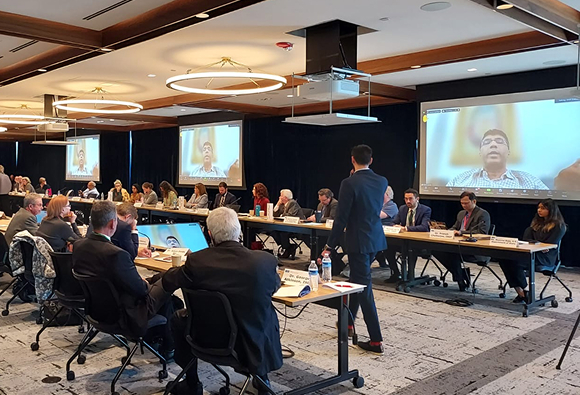
The George H. Atkinson Center at Excelsior University builds on ISGP principles and methodologies that have garnered international endorsements as practical pathways for policies and actions focused on currently recognized and transformative societal challenges.
Current GHA Center Programs
Programs feature invitation-only events conducted in not-for-attribution (Chatham House Rule) environments emphasizing the identification of areas of consensus and actionable next steps directly impacting real-world challenges. Structured on extensive confidential interviews, comprehensive analyses, and consultations with internationally recognized experts and interlocutors, the GHA Center’s programs are forums of informed debates and extended caucuses focused on formulating actionable decisions that merit sustained societal endorsement and support. Senior leadership from across government, private sector, public advocacy, and philanthropic communities worldwide are convened by the GHA Center to immediately consider how the actionable next steps emerging from its programs can be implemented to confront pressing and reasonably anticipated global challenges.
The GHA Center is currently focusing on developing and implementing the Global Emerging and Persistent Infectious Diseases (GEPID) — Europe Program and the Renaissance in Nuclear Energy (RNE) Program. The GEPID — Europe Program is anticipated to convene in Stockholm, Sweden, with the Karolinska Institute, focusing on scientific, biomedical, and technological advancements, and in Venice, Italy, at the Giorgio Cini Foundation, focusing on public health governance, communication, and trust. The RNE Program is anticipated to focus on nuclear energy and its impact on economic and environmental sustainability and public trust, with venues planned to be convened in the United States.
The George H. Atkinson Center’s programs launch innovative educational curricula and methodologies for current and emerging leaders emphasizing the critical need for aggressively negotiated, evidence-based, nonpolitical decisions to global challenges.

Karolinska Institute — Stockholm, Sweden

NATO Headquarters — Brussels, Belgium

Bloomberg Center, Johns Hopkins University — Washington, D.C.

Giorgio Cini Foundation — Venice, Italy
GHA Center programs aggressively critique scientific and technological advances impacting personal well‑being, environmental sustainability, economic prosperity, institutional viability, and geopolitical stability.
Board of Advisors
Dr. George Atkinson, Chair
George Atkinson founded the Institute on Science for Global Policy (ISGP) in 2008 and serves as the executive director. He is a professor emeritus of chemistry, biochemistry, and optical science at the University of Arizona, where he served as the head of the Department of Chemistry. He was the founder of Innovative Laser Corporation, serving the semiconductor industry. Atkinson has served in various roles as a science adviser within the U.S. federal government, including as the science and technology adviser to the secretary of state (STAS) for both Colin Powell and Condoleezza Rice.
Dr. Janet Bingham
Bingham is the former president of the George Mason University (GMU) Foundation and vice president of advancement and alumni relations. GMU is the largest research university in Virginia. Previously, she was president and CEO of the Huntsman Cancer Foundation, in Salt Lake City, Utah.
Fred Downey
Downey’s career includes 24 years in the U.S. Army, including Pentagon postings as assistant to the director of net assessments at the Office of the Secretary of Defense and strategy team chief for the Strategic Plans and Policy Directorate of the Department of the Army Staff. He is a former U.S. Army strategist and longtime defense and international affairs expert on Capitol Hill. He was vice president of national security at Aerospace Industries Association.
Dr. Linda Duffy
Duffy recently retired as a U.S. federal government senior scientist administrator in the Department of Health and Human Services, National Institutes of Health, at the National Center for Complementary and Integrative Health, where she currently serves as a postretirement special volunteer to the director. Prior to her distinguished career in the federal government, she served in a dual capacity as scientific director of the Women and Children’s Health Research Foundation and as a distinguished professor emerita with former joint appointments in the departments of pediatrics, epidemiology, and microbial pathogenesis at the University at Buffalo.
Retired Admiral Thomas Fargo
Fargo became the chairman of Hawaiian Electric Industries (HEI) in May 2020. HEI is the parent company for Hawaiian Electric Company, American Savings Bank, and Pacific Current. He previously served for nine years as the chairman of Huntington Ingalls Industries, the largest military shipbuilder in the United States, and chairman of USAA until August 2021. Following a distinguished career serving in the U.S. Navy and the Department of Defense, Fargo transitioned to corporate leadership in March 2005 as president of Trex Enterprises, a privately held high-technology company. In April 2008, he became a managing director of J.F. Lehman & Company, with principal responsibilities as president and CEO of HSF Holdings/Hawaii Superferry.
Dr. Tom Fingar
Fingar is a Shorenstein APARC Fellow in the Freeman Spogli Institute for International Studies at Stanford University. He was the inaugural Oksenberg-Rohlen Distinguished Fellow from 2010 through 2015 and the Payne Distinguished Lecturer at Stanford in 2009. From 2005 through 2008, he served as the first deputy director of national intelligence for analysis and, concurrently, as chairman of the National Intelligence Council. Fingar served previously as assistant secretary of the State Department’s Bureau of Intelligence and Research (2000–2001 and 2004–2005), principal deputy assistant secretary (2001–2003), deputy assistant secretary for analysis (1994–2000), director of the Office of Analysis for East Asia and the Pacific (1989–1994), and chief of the China Division (1986–1989).
Dr. Claire Fraser
Fraser is the professor emerita and founding director of the Institute for Genome Sciences at the University of Maryland School of Medicine, in Baltimore, Maryland, where she holds joint faculty appointments in the departments of Medicine and Microbiology and Immunology. Until 2007, she was president and director of the Institute for Genomic Research, in Rockville, Maryland, and participated in the early phases of the Human Genome Project.
Dr. George Korch
Korch is currently the president of GeoBIO LLC, a consulting entity established to provide advice and expertise in biodefense, medical countermeasure development, and public health policy, and is the former director of Battelle National Biodefense Institute’s National Biodefense Analysis and Countermeasures Center, a government biodefense research laboratory created by the Department of Homeland Security. Before joining BNBI in December 2018, he served for several years as the science adviser to the assistant secretary of preparedness and response for the Department of Health and Human Services.
Dr. David Moran
Moran is president of Technology International Partnerships LLC and a former publisher of “American Scientist” and the “Chronicle of the New Researcher,” issued by Sigma Xi, The Scientific Research Society. He has served as president of the National Technology Transfer Center; director of Industrial Advanced Development & Industrial Outreach, Advanced Technology, Office of Naval Research; program element administrator for nuclear propulsion, R&D, Naval Material Command; director, David Taylor Institute; and assistant technical director, director of research, and technology director, Naval Ship R&D Center.
Ambassador Tom Pickering
Pickering is vice chairman of Hills & Company, international consultants. He co-chaired a State Department-sponsored panel investigating the September 2012 attack on the U.S. diplomatic mission in Benghazi, Libya. He also served as U.S. ambassador to the United Nations in New York, the Russian Federation, India, Israel, El Salvador, Nigeria, and Jordan, with additional assignments in Zanzibar and Dar es Salaam, Tanzania.
Tom Quinlan
Quinlan has specialized expertise in rebranding traditional businesses and pivoting physical content into the digital space by leveraging digital marketing, data analytics, business intelligence, and data management solutions. He is currently the CEO and president of R.R. Donnelley & Sons Company and has served as chairman and CEO of LSC Communications, executive vice president of operations and business integration at Moore Wallace, and senior vice president and treasurer of World Color Press.
Dr. Eugene Sander
Sander served as the 20th president of the University of Arizona (UA), stepping down in 2012. He was formerly the vice provost and dean of UA’s College of Agriculture and Life Sciences. He also served as UA executive vice president and provost, vice president for University Outreach, director of the Agricultural Experiment Station, and acting director of the Cooperative Extension Service. Prior to his move to Arizona, Sander served as the deputy chancellor for biotechnology development, director of the Institute of Biosciences and Technology, and head of the Department of Biochemistry and Biophysics for the Texas A&M University system.
Dr. David Schejbal
Schejbal is president of Excelsior University. He previously served as vice president and chief of digital learning at Marquette University. From 2007 to 2018, he was dean of continuing education, outreach, and e-learning at the University of Wisconsin-Extension. Prior positions included associate provost at the University of Illinois Urbana-Champaign and associate dean at Northwestern University.
Dr. Maria Velissariou
Velissariou is a Fortune 100 R&D executive with diverse global experience driving vision and strategy, innovation, and advocacy in high-impact corporate and nonprofit organizations. She served as the global corporate R&D VP and CSO for Mars. Before Mars, Velissariou held senior leadership positions including CSTO at the Institute of Food Technologists and VP global nutrition R&D and VP Quaker Foods North America R&D at PepsiCo. Additionally, she served in various roles at Kraft Foods and Dow Corning Europe.
