
The Past, Present, and Future of Nuclear Technology
Nuclear technology has always felt futuristic—even in 1789 when Martin Klaproth discovered uranium. The German chemist named the brand-new element after Uranus, which just eight years prior had captivated the scientific community as the first planet to be discovered by telescope. While scientists of that era understood uranium had special properties, knowledge hadn’t advanced enough to harness its power. It wasn’t until the late 19th century that the world saw the genesis of nuclear technology as we know it today with the advent of X-rays and Marie and Pierre Curie’s work on the phenomenon they named radioactivity.
By 1938, the process of nuclear fission had been discovered, and less than a decade later, the United States was fully in the Atomic Age, a period of rapid nuclear innovation following World War II. Advancements in energy and the increasing visibility of nuclear weapons development captured the public’s imagination with interpretations of isotopes and atoms appearing in everything from fashion to architecture, becoming a lasting part of the country’s midcentury visual vocabulary.
Nuclear technology and its uses haven’t stopped evolving since, and today, nuclear scientists and engineers are still looking toward the future and developing newer, safer ways to harness nuclear power and shape our world.
Brief History and Current State of Nuclear Technology
The history of nuclear technology spans from the late-19th-century discovery of radioactivity to the development of nuclear weapons in the mid-20th century to its more peaceful present-day use in sustainable energy generation. Explore a timeline of nuclear milestones to learn more.
1895: Wilhelm Conrad Röntgen uses electromagnetic radiation to create the first known X-ray image—his wife’s hand.
1911: Marie Curie wins the Nobel Prize in Chemistry for her work isolating the element radium.
1938: Otto Hahn and Fritz Strassmann discover the process of nuclear fission using uranium.
1942: Enrico Fermi achieves the first controlled nuclear chain reaction.
1945: As part of the Manhattan project, the first atomic device is tested at Alamogordo, New Mexico. Not long after, the U.S. drops atomic bombs on Hiroshima and Nagasaki, Japan.
1951: The first nuclear reactor to produce electricity designed and operated by Argonne National Laboratory goes live. It powers four light bulbs.
1954: The U.S. Navy launches the first nuclear-powered submarine, the USS Nautilus.
1979: The Three Mile Island nuclear power plant partially melts down near Harrisburg, Pennsylvania.
1986: A reactor explodes at the nuclear power plant at Chernobyl, Ukraine, causing a fire and lasting damage—and intensifying distrust of nuclear power.
1992: The United States conducts its last underground nuclear weapons test, and a temporary moratorium is imposed on future weapons testing.
1994: The Nuclear Regulatory Commission issues final design approval for the first two of four advanced nuclear power plant designs.
2001: The U.S National Energy Plan includes a significant role for nuclear power in meeting energy demand and reducing air pollution.
2024: U.S. utilities operated 94 nuclear reactors with a total net generating capacity of nearly 97 gigawatts. Nuclear power accounts for approximately 19% of U.S. electricity generation.

The Future of Nuclear Energy and Tech
The future of nuclear energy is rife with opportunities for nuclear technologies that are cleaner and more efficient. Here are three new advancements worth looking forward to.
Nuclear Power and AI
Artificial intelligence (AI) is the latest innovation dominating daily life as well as existential conversations about ethics, humanity, and the future of work. However, a hidden cost of AI technology is the environment. The computer servers that power large-scale AI models need massive amounts of energy to run the processing speeds required. Today, the majority of that energy comes from burning fossil fuels, but nuclear power has quickly risen as a feasible solution to make AI more sustainable. MIT Technology Review posits that this new alliance between nuclear and AI would be mutually beneficial if the stakeholders can make the timing work. Big Tech power players like Google and Microsoft need a long-term source of reliable energy, and nuclear companies need the infusion of capital to fuel reactor upkeep and innovation.
Smaller and Faster Reactors
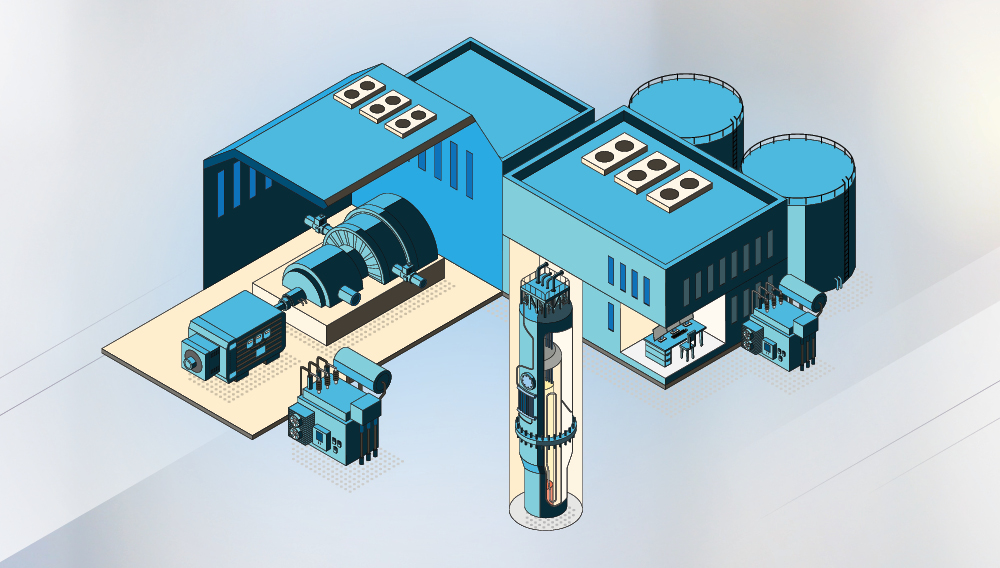
In the future, nuclear power will look different. Small modular reactors (SMRs) are designed to be simpler than traditional reactors and typically don’t feature the large, curved towers historically associated with nuclear reactors. Though small in size, the benefits of SMRs are numerous. These next-generation reactors are less expensive to build, safer because their smaller parts aren’t subject to the same pressures of larger reactors, and more flexible because their modular constructions allow them to be moved.
Nuclear Fusion?
Currently, all nuclear energy is produced by fission, a process that splits large atoms to generate heat. Nuclear fusion, by contrast, is where two lighter atomic nuclei combine to form a single, heavier nucleus, releasing a massive amount of energy. This is the same reaction that powers the heat generated by the sun and other stars. Nuclear fusion holds immense promise as a safer, endlessly renewable energy source, and fusion waste is primarily helium and minimally radioactive neutrons instead of the more toxic radioactive by-products that nuclear fission produces.
Fusion energy has long been the white whale of the nuclear scientific community. We’ve understood how the fusion process works since the 1930s, but while the sun naturally has the gravity for these nuclear collisions to occur, on Earth we need to artificially engineer an environment that is hot enough and pressurized enough to create the same reaction. This is why sustainable nuclear fusion has been so hard to achieve.
Is nuclear fusion our energy future? The International Energy Forum estimates viable commercial use could still be decades away, but science is getting closer each year as our engineering capacity advances.
Shape the Future of Nuclear Technology with Excelsior
Does nuclear technology have you feeling energized? If you want to get more hands-on in the nuclear industry, Excelsior University’s BS in Nuclear Engineering Technology program prepares you with the practical training, experienced faculty, and industry connections you need. Our 100% online program is accredited by the Engineering Technology Accreditation Commission of ABET and features cutting-edge training simulators so you can be ready for the next generation of clean-energy careers.
Learn what you can do with an NET degree from Excelsior University and start powering your own future in nuclear technology. For even more industry info, read Excelsior’s other nuclear blog posts to debunk some common myths about nuclear energy and discover how nuclear energy is going carbon neutral.