
How to ATS-Proof Your Resume

If you’ve been applying for jobs and not hearing back, your resume may not be making it past the first review. In many cases, that review happens before a hiring manager ever sees your name. Understanding how applicant tracking systems work is one of the most important resume tips you can apply. When you know how your resume is being evaluated, you can present your experience clearly, use language intentionally, and position yourself more strategically.
What Is an ATS?
An ATS, or applicant tracking system, is software employers use to collect, organize, and sort job applications. Instead of manually reviewing every resume from the start, organizations rely on these systems to manage volume efficiently. Although applicant tracking systems were once more common among large corporations, organizations of many sizes now use them. Their purpose is not necessarily to eliminate candidates immediately, but to categorize applications and highlight those that most closely align with the job description.
What Do Applicant Tracking Systems Look For?
Although each ATS is different, most are programmed to scan resumes for alignment with the job posting. They recognize structured sections, specific terminology, and consistent formatting.
This means clarity matters. The way you label sections, describe responsibilities, and present skills influences how your information is categorized within the system.
Most applicant tracking systems look for:
- Skills that match the job description
- Relevant terminology used in the posting
- Job titles and level of responsibility
- Education, certifications, and credentials
- Clear section headings, such as Work Experience and Education
- Accurate spelling and consistent formatting
Keywords should only be used when they reflect real experience. The strongest resumes use language to validate what you have actually done, not to suggest qualifications that are not there.

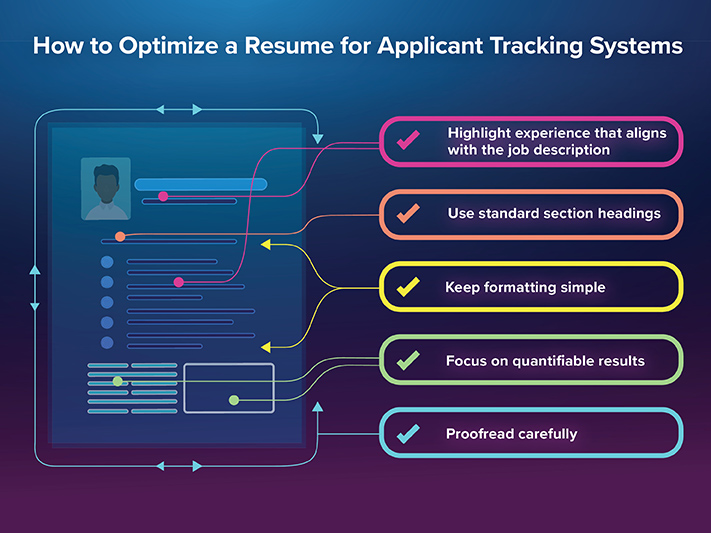
5 ATS-Friendly Resume Tips to Help You Stand Out
Optimizing your resume does not require complicated design. In fact, simplicity works in your favor. These resume tips focus on alignment, structure, and accuracy so your qualifications are recognized by both applicant tracking systems and hiring managers.
Resume Tip 1: Align with the Job Description
Review the job posting carefully and identify the skills and responsibilities that genuinely match your background. Use the same terminology when it accurately reflects your experience. If you have led projects, say that. If you have not, do not force language into your resume. Tools like Jobscan can help you see where your resume aligns, but no tool replaces thinking carefully about your experience and tailoring your resume with intention.
Resume Tip 2: Use Standard Section Headings
Applicant tracking systems are designed to recognize common headings such as Work Experience, Education, and Skills. Creative titles may confuse the system and cause information to be miscategorized. Keeping your structure straightforward ensures your resume is parsed correctly and organized in a way a hiring manager can easily review.
Resume Tip 3: Keep Formatting Simple
Avoid text boxes, graphics, multiple columns, and unusual fonts. Many ATS platforms cannot read complex designs accurately. A clean single-column format with standard bullet points improves readability and helps ensure that your information is captured correctly.
Resume Tip 4: Focus on Results
Instead of listing responsibilities alone, highlight measurable outcomes. Quantifiable results such as improved efficiency, increased enrollment, or reduced processing time demonstrate impact. Results strengthen your resume for both applicant tracking systems and hiring managers because they show evidence, not just activity.
Resume Tip 5: Proofread Carefully
Spelling errors and inconsistent terminology can prevent important skills from being recognized. Review your resume thoroughly before submitting it. Reading it aloud or asking a trusted colleague to review it can help catch mistakes that software and hiring managers will notice.
3 Pitfalls to Avoid
Just as important as knowing what to include is understanding what can weaken a resume. These common mistakes can limit how effectively your application performs within an applicant tracking system.
Pitfall 1: Using Graphics or Images
Visual elements such as logos, icons, or charts may look polished, but most applicant tracking systems cannot interpret them. If critical information is embedded in a graphic, it may not be processed at all. Keep essential content in text format.
Pitfall 2: Overusing Keywords
Including keywords without demonstrated experience can create problems later in the hiring process. Repetition alone does not strengthen your application. Use terminology strategically and only when it accurately reflects your background.
Pitfall 3: Ignoring Instructions
Employers may specify preferred file types or formatting guidelines. Failing to follow directions can create unnecessary barriers. Review application instructions carefully before submitting your resume.
Your Resume Is Only One Part of the Strategy
Optimizing your resume for an ATS is important, but it isn’t the only factor in securing an interview. Networking, thoughtful follow-up, and connecting with professionals inside an organization can increase your chances. When possible, consider identifying someone within the company who can offer insight into the role. Your resume opens the door; professional outreach and relationship building often help you move through it.
Start Your (Next) Career with Excelsior
A strong resume matters, but expanding your knowledge and skills can also increase your opportunities. For more than 50 years, Excelsior University has helped working adults earn degrees through flexible programs designed to fit real life.
Whether you’re looking to start a career in a new field or strengthen your position in your current one, Excelsior offers more than 40 flexible, career-focused programs. Students have access to comprehensive Career Readiness resources that support resume development, interview preparation, and professional growth.
Whether you’re considering going back to school or exploring different areas of study, the right education can strengthen your qualifications and position you more competitively in today’s job market.