
Mechanical Engineering Innovations in Aerospace Technology
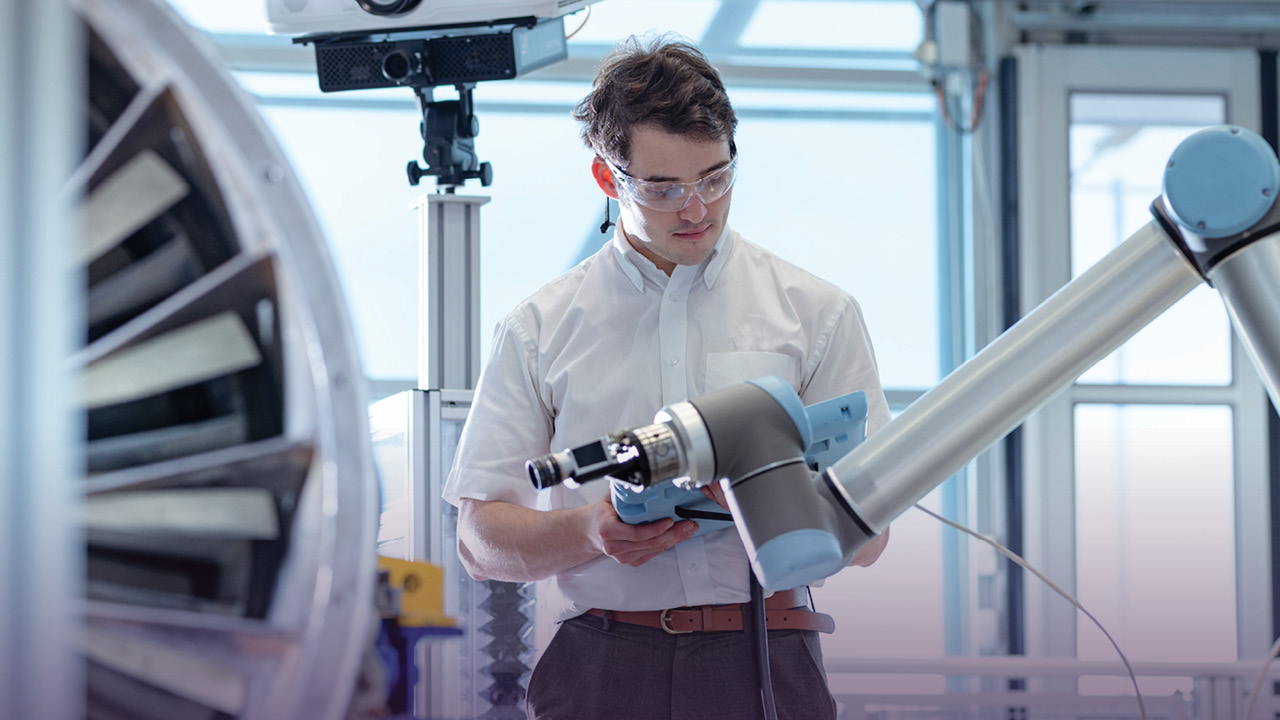
Mechanical engineering technology drives much of the cutting-edge innovation in aerospace today. Making materials lighter and stronger, improving the efficiency of engines, designing vehicles that are faster and safer, and creating more precise manufacturing systems are just some examples of where new ideas and applications are having the greatest impact.
If you’re interested in a career in aerospace technology, you’ll need an education that covers these areas. The field is evolving quickly, transforming smart materials, advanced propulsion systems, robotics, and how aircraft and space vehicles are designed, produced, and maintained. It’s vital to choose a mechanical engineering degree program that keeps pace with the speed and scope of innovations in aerospace technology.
Recent Innovations in Aerospace Technology
Working in the field of mechanical engineering technology means you’ll play a key role in improving the speed, efficiency, sustainability, and safety of air- and spacecraft, along with systems for manufacturing that are defining the future of aerospace technology.
Propulsion Systems
Electrically powered motors, hybrid engines, and cutting-edge propulsion like ion-based thrusters hold the promise of lower fuel consumption and lower emissions. In space specifically, ion systems that use electrically charged and accelerated gases are opening opportunities for deep-space exploration. These systems can operate over longer distances, using relatively little fuel. Other areas of innovation in propulsion include new battery technologies and lighter-weight materials.

Additive Manufacturing (3D Printing)
Creating objects by adding layer after layer of material, according to digital designs, is a way to quickly produce lightweight and precise components. Most people know additive manufacturing as 3D printing. In aerospace, 3D printing is attractive because it can be used to create pieces and devices with complex designs quickly while improving manufacturing efficiency and lowering costs. Innovations in this area involve materials, processes, and components like aircraft and rocket parts.
Supersonic Flight
Flying faster than the speed of sound transformed civilian travel as well as the capabilities of military aircraft. Physical challenges and costs, however, limited what was possible in previous technology generations. Today, technologies that minimize sonic boom shock waves make supersonic flights more practical in more areas. For space travel, faster speeds make it possible to explore longer distances. Mechanical engineering technology is at work to make quieter and more fuel-efficient designs while improving safety. Aerodynamics, lightweight composites, and advances in engines are driving this new era of supersonic travel.
Reusable Rockets
One-use rockets are expensive, are bad for the environment, and slow the pace of launches. Launch systems that can be used, recovered, refurbished, and launched again will cut costs and speed up the tempo of sending objects into space. Reusable rockets can increase the number and frequency of satellite launches, open more opportunities for research in space, and create a viable commercial space industry. Innovations in guidance controls, landing operations, and more durable materials that can withstand multiple reentries are all areas where engineers are investing time and money.
Space Systems and Satellite Innovation
Space systems are increasingly used for communication, navigation, weather forecasting, and even precision agriculture. Besides beaming back to Earth, some satellites are supporting deep-space exploration, free of the Earth’s force and atmosphere. Satellites today are smaller, lighter, more durable, and more powerful as engineers use new materials, onboard computing, and advanced thrusters. Satellites are now deployed in networks for greater coverage, with redundancy for improved resilience. Mechanical engineering technology advances are driving innovation across all these areas.
Innovation Starts at Excelsior
Demand for talented and skilled professionals in the aerospace field is strong. The industry needs mechanical engineers and technologists who can solve tough problems, adapt as technology changes, and drive innovation. Acquiring and sharpening necessary skills requires the right education, with a degree that provides a solid grounding in the areas that matter in aerospace.
Excelsior University’s Bachelor of Science in Mechanical Engineering Technology program gives students practical knowledge in manufacturing, mechanical systems, materials, engineering design, and quality control. Students gain technical knowledge along with problem-solving and leadership skills. Offered online, the program gives working professionals the flexibility to balance current responsibilities with the ability to open doors to expanded opportunities.
The next generation of engineering innovation, particularly innovations in aerospace, are making what seemed like science fiction yesterday into a tangible reality today. With your mechanical engineering technology degree, you can work at the forefront of this evolving field. With your mechanical engineering technology degree, you can work at the forefront of this evolving field.