Rarely Idle: Kylie Ackerman’s Journey to Student Advocacy
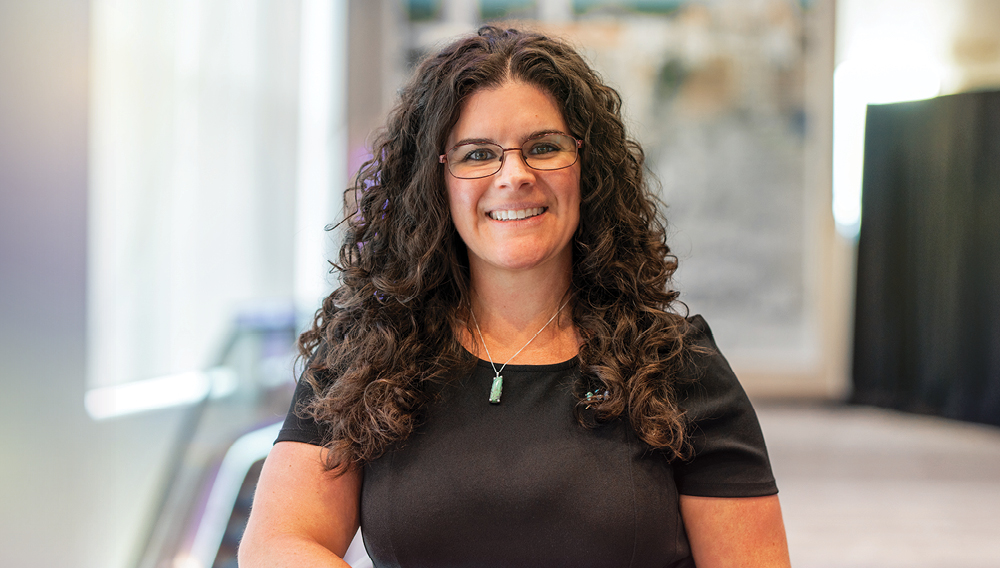
On any given day, Kylie Ackerman’s life looks a lot like the lives of many Excelsior nursing students. The Excelsior faculty member could be studying at her desk for her doctoral degree; taking her 7-year-old son to afternoon jujitsu, baseball, or basketball practice; squeezing in a couple sets of weightlifting for herself; or answering student messages and grading assignments.
“I’m rarely idle,” she says. “There’s always something happening.”
She understands having a busy life is something many people share, and she brings it to her teaching approach at Excelsior University. Her flexibility and emphasis on student advocacy are shaped by a wide diversity of career experiences.
A Winding Path to Nursing Education
Ackerman’s nursing career began far from the traditional hospital floor. She started as an infusion nurse in a holistic practice and from there moved briefly into rheumatology, gaining knowledge in disease management. When the practice she worked at closed, she faced an unexpected pivot point. Ackerman decided to pursue what had long been her goal—working in the operating room.
Ackerman transitioned to robotic surgery and eventually became the charge nurse for the robotic surgery program while also working in other operating rooms, including cardiothoracic surgery. The role required constant prioritization.
“Managing the complex needs of the robotics suite, including staffing, surgeons, and anesthesia, while delivering patient-centered care to often anxious patients, taught me to prioritize effectively, with the patient always at the forefront,” she recalls.
At the time, she didn’t realize how much those skills in coordination, communication, triage, and composure would shape her future as an educator.
Ackerman began her master’s degree in nursing education at Excelsior University in 2015, after she learned of the school’s partnership with her employer. At the same time, she decided to change from the OR to outpatient care, a change that allowed her more time to concentrate on her studies. She also focused her master’s Capstone project on an orientation program for outpatient offices.
“When I presented to the stakeholders at the organization, I was able to create an ambulatory nurse educator role position that I assumed upon degree completion,” she says. “That position still lives on today because of my Capstone project!”
She became the registered nurse for cardiothoracic surgery and eventually covered a wide range of ambulatory practices, including breast surgery, primary care, neurosurgery, and neurology.
Finding Her Place at Excelsior
Ackerman describes her experience in the nursing education master’s program as deeply affirming. “[The faculty] support and encouragement made me want to be like them,” she says.
She worked as an ambulatory nurse educator after she earned her Master of Science in Nursing Education in 2018, and then when she saw a faculty opening at Excelsior posted in 2019, she applied immediately. Even while teaching at Excelsior, she wasn’t done learning. She went on to earn a Master of Science in Nursing Informatics in 2024.
Ackerman’s favorite part about teaching at Excelsior is the nursing students themselves. “What I love most about teaching for Excelsior is the opportunity to support motivated, often working nurses and adult learners who bring rich life and clinical experiences into the classroom,” says Ackerman.
Empowering Nursing Students Through Advocacy
Some of the most formative experiences in Ackerman’s career came from unexpected places. She learned multitasking, emotional intelligence, and professionalism under pressure while waitressing during nursing school. Her time in robotic surgery taught her how to balance complex systems while staying grounded in patient-centered care.
Today, she draws on those same skills as she balances the needs of students, departments, and the University—keeping the learner at the center, just like the patient.
Ackerman’s primary focus at Excelsior is the Associate in Applied Science in Nursing program, where she teaches and oversees the final course, Nursing Capstone: Advanced Clinical Practicum. Her approach blends evidence-based practice with active learning strategies: case studies, realistic clinical scenarios, guided discussions, and reflective activities that encourage nursing students to apply concepts to their own experiences.
“The courses I oversee are designed to be creative, informative, and engaging by intentionally blending real-world application with active learning strategies,” she explains.
In her teaching, she frequently uses an example from when she worked in the cardiothoracic surgery office while pursuing her master’s. In her role, she often answered telephone calls from patients after their procedures. She remembers during one call a patient explained he didn’t feel right.
“I immediately told him to go to the nearest ER, as I suspected a pulmonary embolism,” Ackerman explains. “I notified the surgeon, who thought I was crazy, but I ended up being right, and he had a huge clot requiring additional surgery. This is a great example of the [NCSBN] Clinical Judgment Measurement Model, so I like to bring it up, as subjective and objective cues are critical to consider when caring for patients.”
Her commitment to the student learning experience has led to her earning a faculty award for innovation for two consecutive years, in 2024 and in 2025. She employs innovative, data-driven teaching strategies to enhance student persistence. For instance, she incorporates varied learning modalities, including structured video reflections, to support different learning styles while maintaining clear expectations. She has also created impactful resources, like a mini-podcast for “on-the-go” learning, and has led research investigating the effect of virtual animal observation on students’ test-taking anxiety.
Ackerman practices empathetic teaching, supporting student growth. She can quickly pivot and prioritize their needs, including responding to messages, grading, and providing feedback in a timely manner.
She encourages her nursing students to reach out with requests for extensions so they can submit their best work—and even suggests that they propose their own assignment due dates. “This teaches them to advocate for themselves,” Ackerman explains. “I truly believe that if you can’t advocate for yourself, you cannot advocate for a patient.”