The Energy That Propels Faculty Member Richard Cole
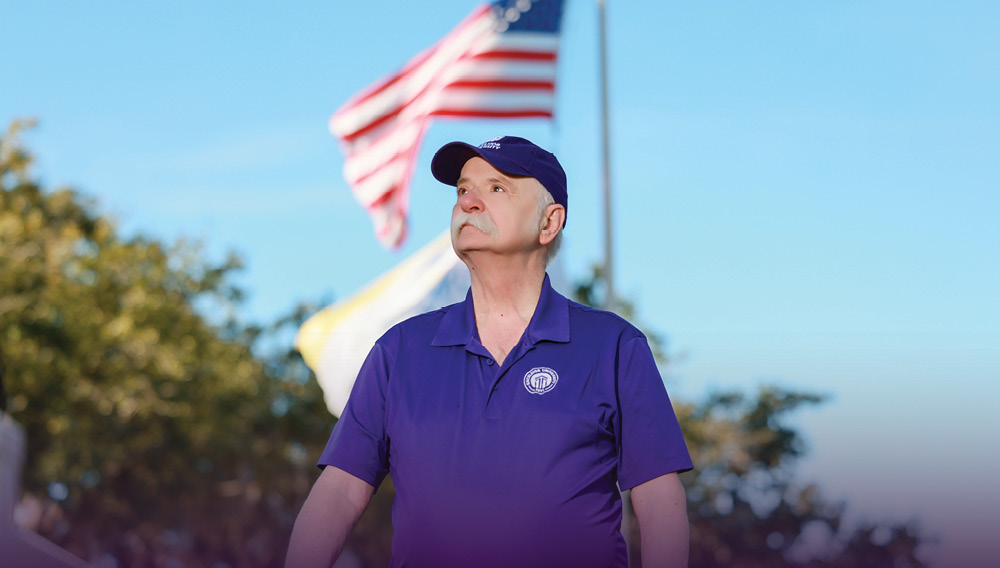
Richard Cole’s career has been defined by not only his technical expertise but also his lifelong commitment to helping others learn and succeed. From a one-room schoolhouse in rural Iowa to submarine operations in the U.S. Navy to the online classrooms of Excelsior University, Cole’s choices reflect his commitment to teaching.
At Excelsior, Cole teaches courses in the Bachelor of Science in Nuclear Engineering Technology, Bachelor of Professional Studies in Information Technology Management, and Bachelor of Professional Studies in Technology Management programs, including Capstone courses. Many of his students are active-duty sailors or Navy veterans whose backgrounds mirror his own. Cole earned his degree from Excelsior while on active duty, as well. Their shared experience enables Cole to connect with students on a deeper level and guide them through the next phase of their careers.
“I see this as my opportunity, both as an alumnus and a teacher, to help them advance in their careers—either in the service or when they go on,” he explains. “Pretty much the same thing that I did.”
After retiring from the Navy, Cole transitioned into commercial nuclear power, working at utilities like Exelon (Constellation), NextEra Energy, and Duke, and at plants in Iowa, Illinois, and South Carolina, followed by years in consulting at companies like the PPL Corporation, Luminant, Fluor, Xcel Energy, and INPO. When he joined Excelsior University as faculty in 2017—after serving on the Nuclear Engineering Technology Industry Advisory Committee—he saw it as both a career opportunity and a chance to give back to the institution that supported his own education.
Education Amid Service
Cole spent 1976–1997 with the Navy’s nuclear power program, operating and maintaining submarine reactors. His job required precision, discipline, and a strong focus on safety. During these years, Cole and his wife moved frequently, raising four children born in four different states. Despite the demands of military life, education remained constant.
Cole earned his bachelor’s degree in 1983 through the Regents External Degree Program (now Excelsior University). Regents was the right choice for Cole, accepting his many credits from previous schools and the Naval Nuclear Propulsion Program. He then earned a master’s degree in trade and industrial education in 1993 and a doctorate in adult and career education in 1996.
Cole’s interest in teaching, however, began long before his time at Excelsior. His early education was in a one-room country schoolhouse. When he was in seventh or eighth grade, he began helping the younger students with their studies. “When my own classwork was done, I did things like work with them in reading, phonics flash cards, and other tools to help them in their beginning education,” Cole says. “It was fun for me at that time.”
Cole discovered that he genuinely enjoyed helping others reach milestones. The experience stayed with him. Years later, after completing training at the Navy’s Nuclear Propulsion Training Unit in Idaho, Cole remained as a staff trainer—an opportunity that solidified teaching as his calling.
“I found I really enjoyed helping others attain their goals,” he says. “I stayed in one form or another of training … in the Navy.” Even near the end of his naval career, Cole taught college-level courses offered on military bases, balancing instruction with full-time service, graduate studies, and family life.
Teaching for the Real World
Cole’s teaching philosophy emphasizes practical knowledge and usage. In the BS in Nuclear Engineering Technology program, students use a pressurized water reactor simulator like one found in commercial nuclear plants. The simulator allows students to see how changes in how heat is produced and moved can affect an operating system. Cole says, “It gives them a very good grounding, I think, in what [the situation is] going to be like later on. … They can see how their theoretical knowledge is put to application.”
Also important to Cole is helping students understand that in nuclear operations, the primary mission is not power generation but public safety. “There’s nothing in their license they get from the Nuclear Regulatory Commission that says they’ll make electricity,” he notes. “What it says is they’ll operate a reactor safely to protect the public.” That focus on responsibility, ethics, and courage—speaking up when something doesn’t seem right—is important in Cole’s teachings.
Cole also encourages students to think beyond traditional career paths by highlighting the versatility of nuclear training. Graduates can find opportunities in power generation as well as in data centers, cybersecurity, robotics, medical technology, national laboratories, and even space exploration. Cole notes the transferability of the skills he helps impart to students. “[Students are] getting that background, you know, and they may be IT specialists, but … we’re continuously reimagining our programs so we can keep up and make sure we are meeting the needs of the future.”
Although Cole helps students enter careers in technology, his involvement in the Excelsior community extends beyond the courses he teaches. Cole is an active alumnus and regularly participates in Excelsior events, including speaking with prospective students and employers at Excelsior’s site in St. Petersburg, Florida. He also gives back to his broader community as a member of the Sons of the American Revolution, where he helps coordinate awards for outstanding Junior ROTC students at local high schools to recognize leadership and service in the next generation.
At the heart of everything Cole does is a simple motivation: helping others reach their goals. For him, teaching is not just a profession; it’s a lifelong commitment to sharing knowledge, opening doors, and ensuring that those who follow are prepared to succeed. Cole sums up his philosophy with the following: “The difference [is to] build a relationship with students while they’re doing asynchronous online [learning]. … The main thing is still to keep the focus on the students.”