
DBA vs. PhD: What’s the Difference?

Have you ever looked at the letters that come after someone’s name and wondered what differentiates a DBA from a PhD? Well, you’re likely not alone. At first glance, both degrees represent the highest level of achievement, and both require you to conduct extensive research. Not to mention, both can open doors to meaningful leadership opportunities. But what’s the difference? If you’re considering a doctoral degree but aren’t sure which to pursue, understanding the difference between a DBA and PhD can help you determine the path that aligns best with your goals.
What Is a DBA?
Geared toward accomplished managers and executives, a Doctor of Business Administration is a business-oriented doctorate program that provides the skills necessary to solve real-world problems. A DBA can be beneficial to business professionals who have not finished growing in their fields. It requires leaders to research, analyze data and evidence, identify patterns, challenge the status quo, and communicate ideas in ways that result in better decision-making.

What Is a PhD in Business?
A Doctor of Philosophy in Business is a research-based degree designed for individuals looking to obtain careers in academia or research-based industries. It focuses mainly on research and theory, and since its core focus areas are finance, accounting, marketing, etc., it trains students to research new management and business theories. Individuals may choose to pursue a PhD in Business Administration, a PhD in Business Management, a PhD in Business, or another business-oriented doctoral program.
What Is the Difference Between a PhD and a DBA?
The main difference between a DBA and a PhD in Business is that a Doctor of Business Administration is a professional degree, whereas a Doctor of Philosophy is an academic degree. The DBA is focused on using practical applications and solving real-world problems; the PhD is primarily aimed at expanding academic knowledge and contributing to scholarly discussions. Let’s dive a bit deeper into what makes them different and which one is more suited to your goals.
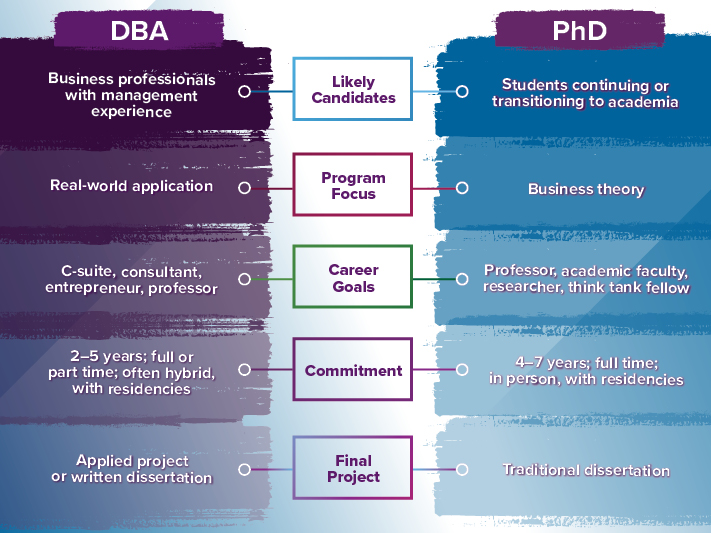
DBA vs. PhD: Focus and Curriculum
A Doctor of Business Administration is what’s considered an experiential degree, which means that much of your studies will be applying your research to your professional work. You can choose to concentrate in areas like health care, finance, cybersecurity, marketing, leadership strategy, and more. Most DBA programs also include in-person residences where you can work with your peers, get feedback on your research, and meet with faculty. These programs end with a dissertation project that includes using your research methods to solve practical business problems. You should be prepared to defend these projects before expert panels, and your work may even be published.
Alternatively, a PhD program includes seminars, independent research, and oftentimes teaching or being a research assistant. This is important to help students learn how academic knowledge is produced, taught, and ultimately published. During a PhD program, you may take several exams before moving into your dissertation phase. Students in a PhD program are expected to make a theoretical contribution to their field, which means challenging or refining given scholarly knowledge.
DBA vs. PhD: Career Goals
Depending on your career goals, a DBA and a PhD can lead you in different directions. Many DBA graduates go on to advance within industries such as business, health care, finance, technology, government, and nonprofit leadership, where they use their knowledge to lead organizational change, evaluate strategy, and solve complex business challenges. DBA career paths often lead to executive-level positions, including CEO, CFO, or COO, with the U.S. Bureau of Labor Statistics reporting the median annual salary of chief executives at $206,420. DBA alumni may become management consultants who advise organizations on strategy, become executive educators or scholar-practitioners, or teach business concepts in academic settings where industry experience is valued.
A PhD is an appropriate choice for someone whose career goals lie within the academic community. These graduates are prepared to pursue careers focused on research, teaching, scholarship, and the creation and sharing of knowledge. You can usually find PhD graduates in jobs at universities, business schools, think tanks, research institutions, and other places that require analytical expertise. Some may produce research that helps inform policy, industry, or strategic decision-making, and they may consistently research and publish their scholarly work. Others may pursue becoming department chairs of institutions. Doctoral degree holders can see usual median weekly earnings of $2,278, according to the BLS.
DBA vs. PhD: Format and Time Commitment
DBA programs tend to be more flexible, as they are designed for experienced professionals who want to advance their careers while continuing to work full time. A lot of these programs can be completed on a part-time basis in three to five years. Although a DBA emphasizes the practical application of existing theories rather than creating new ones, the program still requires significant research skills, strong writing abilities, and a defense of your dissertation.
PhD programs are generally more academically intensive and time-consuming, often requiring four to seven years of study and a full-time commitment. Most programs begin with approximately two years of coursework in research methodology, statistics, and theory development, followed by several years dedicated to original research and dissertation work. Many PhD programs also require residency and full-time attendance at the college or university. Earning a PhD is a demanding but rewarding path for those pursuing careers in academia and research.
Which Business Doctorate Is Right for Your Goals?
Choosing between a Doctor of Business Administration and a Doctor of Philosophy in Business ultimately comes down to your career goals. If you want to come up with new theories, conduct scholarly research, and pursue a full-time career in academia as a researcher or tenure-track professor, a PhD is likely the better fit for you. However, if your goal is to advance into executive leadership, solve real-world business challenges, and influence organizational strategy, a DBA is probably the better choice.
It should be noted that you can also teach with a DBA. Many DBA graduates serve as adjunct professors, executive educators, and faculty members at colleges and universities. For professionals who want to continue leading in business while also sharing their knowledge in the classroom, a DBA offers a powerful combination of academic rigor and career flexibility.
Excelsior University’s DBA Program
Excelsior University’s Doctor of Business Administration program is designed for experienced professionals, including executives, industry specialists, and military leaders who want to elevate their leadership and expertise without taking time away from their careers. The 60-credit program combines eight-week online courses with two immersive in-person residencies in Albany, New York, and/or St. Petersburg, Florida, and offers the flexibility to complete the degree in as little as two years. You can choose from two concentrations from seven in-demand areas and select either of two dissertation options: a considered solution for an organization, using design science principles, or a three-paper research model.
Designed specifically for working professionals, the program offers multiple start dates, flexible pacing options, and a transparent pathway to completion that respects both students’ ambitions and their busy lives. If you’re ready to change your industry, talk to an admissions counselor today about enrolling in Excelsior’s Doctor of Business Administration program.