Ever Upward: Brian Pervis and the Power of Teaching
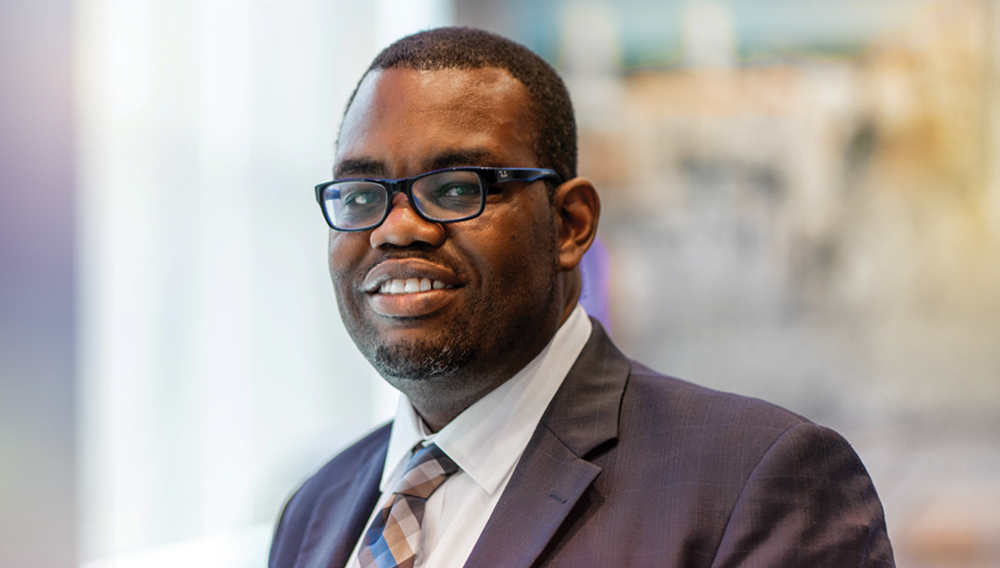
During his capstone project in his master’s program, Brian Pervis realized something important: Education, when done well, has a lasting impact on direct practice. “That’s when I realized I wanted to teach,” he says. “Not just content—but confidence, competence, and critical thinking.”
In January 2022, Pervis joined Excelsior University as a part-time faculty member, then transitioned to full-time teaching, and now serves as a department chair in the School of Nursing. Now in his fifth year, he oversees several important associate nursing courses that hundreds of students take each year.
Pervis earned his Associate of Science in Nursing in 2009 and passed the NCLEX-RN to become a registered nurse on his first attempt. Leveraging transfer credit from his associate degree, he also earned a Bachelor of Science in Liberal Arts with Excelsior in 2009, followed by a Master of Science in Nursing Education in 2011. The journey to becoming a department chair began more than 20 years ago when he became an emergency medical technician at his mother’s suggestion.
Called to Education
He enjoyed the fast-paced atmosphere of being an EMT and helping others, but he wanted to pursue a different career. So, he became a licensed practical nurse in 2001 and began working for various health care networks in New Haven, Connecticut. Still, the urge to learn and grow nagged at Pervis. A visiting representative of Excelsior University—then College—to Pervis’ workplace convinced him to “give it a shot.” Three degrees later, Pervis not only supervises but also teaches several nursing courses, like NUR 104 and NUR 105.
“The part that I like about teaching … is the students,” he says. “They’re trying to get better and better themselves—LPN students that are going up to become RNs … [and then] going further to get their Bachelor of Science in Nursing. We’re also seeing paramedics that are transitioning to becoming nurses.” He adds that it becomes personal when students reach out to thank him for his mentorship and teaching.
That connection is especially evident during Commencement ceremonies, which Pervis describes as his favorite moments of the year. In a mostly asynchronous learning environment, Commencement is where virtual relationships become personal. “When you see students, they say, ‘Hey, you’re Dr. Pervis.’ It’s that personal connection. And they’re so thankful. They’re so grateful,” he says.
Having attended multiple Commencement ceremonies as a student, he also understands the excitement. “It gives me butterflies,” he admits. “I know what they’re going through. I know how meaningful this is.”
Adult learners, Pervis also notes, often juggle work, family, and school, so he says it’s important to believe you can get to that finishing line. In fact, he says, dedication is a defining trait of successful Excelsior students. He tells his own: “Be dedicated to your studies. Don’t take the shortcut. Take the long way. … Students who are truly dedicated, that show up every day, they put the work in—you’re going to leave Excelsior better than [how] you came in.”
Meeting Students Where They Are
Pervis’ deep understanding of the adult learning experience has helped him reimagine how clinical and laboratory skills are taught in the distance-learning model. For instance, in the nursing lab courses, students demonstrate skills such as head-to-toe assessments or IV administration by recording themselves practicing on consenting family members or friends. Faculty members then provide detailed feedback aligned with structured rubrics.
“We don’t see too many people doing that right now because it meets the student where they’re at,” explains Pervis. “It allows the students [to perform] in the comfort of their home.”
Pervis’ commitment to teaching also shapes how he views higher education’s future. For instance, the use of artificial intelligence continues to expand, and today’s students must learn how to responsibly interact with it. “It’s more about responsible AI use because health care systems are using AI,” Pervis says. “And if we don’t adapt to that, our students are going to be behind. So we have to kind of understand that and kind of gear ourselves towards that.”
Needing to adapt is why Pervis believes lifelong learning is essential, not optional. “We have to get better. We have to adapt to the changes. So, you have to be a lifelong learner.”
Preparing the Next Generation of Nurses
Believing in lifelong learning means putting ideas into action, and Pervis takes that message straight to students. Recently, Camille Dumont, associate director for Career Readiness at Excelsior University, featured Pervis in a Career Café—an interactive webinar connecting students and alumni with career resources and professionals across industries.
During the session, Pervis challenged attendees to think intentionally about their futures. “What kind of nurse do you want to be remembered as?” he asked. “Do you want to be this nurse or that kind of nurse? So, just answer that question. It’s going to help you determine your career path.”
Pervis talked about how nursing careers are layered and that growth requires planning, humility, resilience, and a commitment to lifelong learning. He touched on how depth matters more than speed; it’s important not to rush your development. Pervis also discussed how success in nursing also means building your reputation thoughtfully, exploring entrepreneurship strategically, and protecting your well-being.
Pervis reminds students that learning is not confined to degrees earned or titles achieved. It is a mindset and a belief that growth is always possible. And with education, you can transform not only your career but also lives. “[Students] are going to be the future leaders. My job is going to be gone,” he reflects. “So, dedicate yourself to your studies and everything that you’re doing. … You can make an impact on education, society, and your family—and just change it right the way you want to see it be changed.”