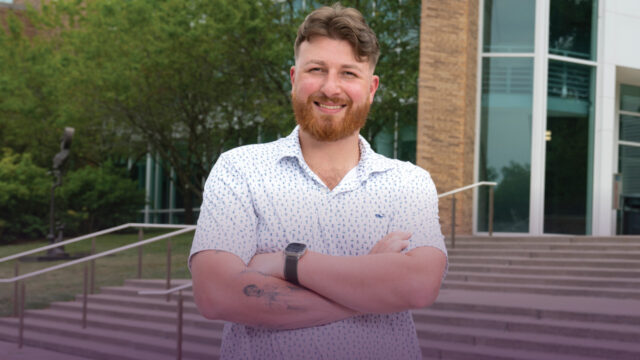
How I Used My Criminal Justice Degree to Turn Around a Police Department
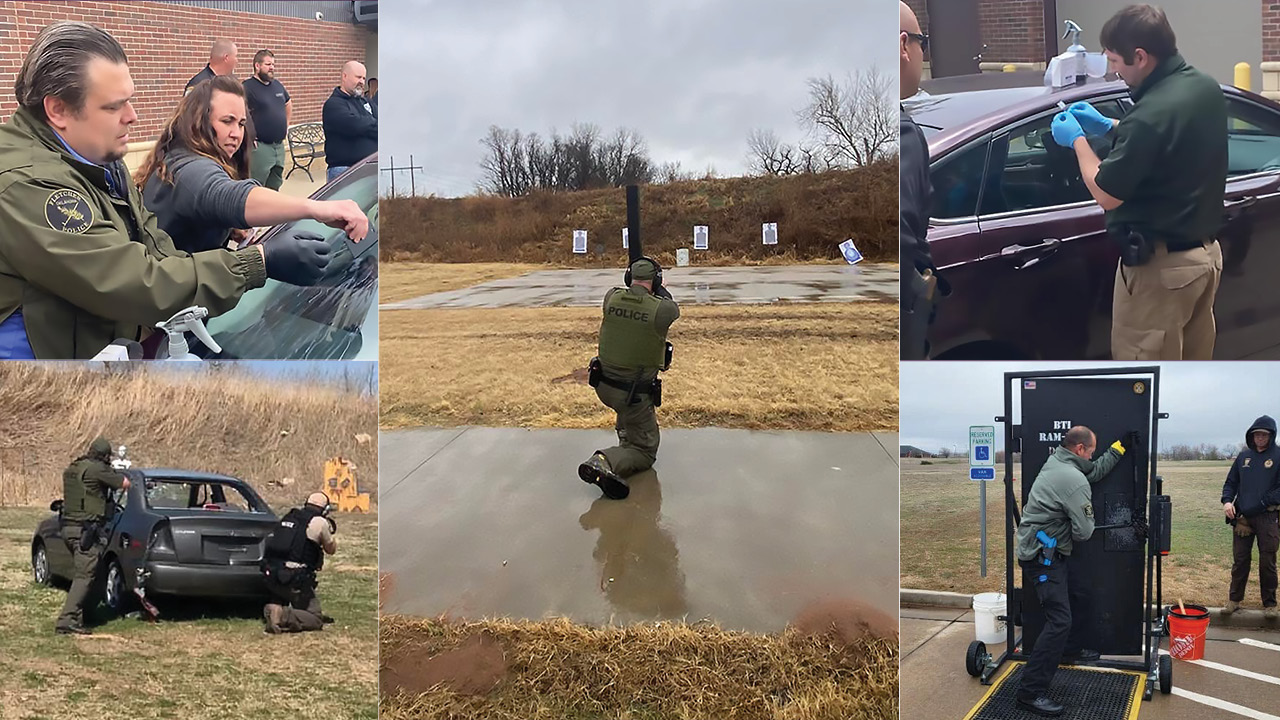
In 2017, when I became the chief of police in Fletcher, Oklahoma, the department was at a crossroads.
The problems were not abstract. The Oklahoma Council on Law Enforcement Education and Training was monitoring the department, officers were under misconduct investigations, public trust was low, and our policy manual was badly out of date. At one point, closing the department and contracting with the county sheriff’s office was a real possibility.
It quickly became clear that the job was about more than answering calls or conducting investigations. Fletcher needed us to rebuild the department itself. I stopped looking at each problem in isolation. Leadership, policy, accountability, culture, training, liability, and administration all had to reinforce one another if the department was going to recover.
My education gave me a way to connect those pieces and the confidence to begin the work.
Today, the Fletcher PD is a fundamentally different organization. We rewrote our policies from the ground up and worked with Lexipol to develop an approach that became a prototype for small agencies in the program.
We have attained verified agency status through the Oklahoma Law Enforcement Accreditation Program and are scheduled to complete agency certification in January 2027, completing the gold standard of voluntary accreditation in Oklahoma. Our officers have received local, state, and national awards. The department has become a trusted partner with state-level agencies, collaborated with agencies across state lines, and participated in multiagency and multijurisdictional investigations, including cases that received national attention.
More importantly, our department is trusted by our citizens and is now a source of pride for our small community. Much of that work began with my education.

A Career Defined by Service
My public safety career took shape long before I became a police chief.
I served as a U.S. Navy Hospital Corpsman, including front-line combat operations during the 2003 Iraq invasion. The Navy gave me an early understanding of responsibility, teamwork, discipline, and service. Those principles continued to shape how I approached leadership after leaving active duty in 2008.
After the Navy, I began my civilian career at the Comanche County Detention Center. I had earned a Bachelor of Science in Liberal Arts, with an emphasis in Health Science Technology, from Excelsior University, and that education helped me find my footing in a new kind of public-safety work.
I started as a detention officer, moved into the medical department, and eventually became its supervisor. Drawing on both my education and experience, I overhauled the medical operation. Over time, it became a respected, award-winning part of the detention center.
That experience established a pattern I would follow throughout my civilian career: Join an organization, identify where it could improve, and do the work required to build something better. I carried that experience with me when I entered law enforcement full time in 2010 and, seven years later, became Fletcher’s chief of police.
Two years after accepting the position, I returned to Excelsior to pursue a Master of Science in Criminal Justice.
By then, I knew experience alone was not enough. It could keep the department operating, but it could not give us everything we needed to grow and thrive. I had read numerous articles about small agencies across the United States shutting down in record numbers, and the possibility of closure stayed with me. I needed to understand law enforcement from the perspective of an executive responsible for an entire organization. As a working chief and the father of a young daughter, I also needed a program with the flexibility and support to help me succeed in my new role, and I knew Excelsior could provide it.
What I Learned in Excelsior’s MS in Criminal Justice Program
Jason DeLonais delivers the student speech at Excelsior University Commencement 2023.
Excelsior helped me translate my military training into practical, transferable skills I could carry into civilian public safety. My bachelor’s degree strengthened that foundation, giving me the academic knowledge to complement my practical experience.
My master’s degree in criminal justice took that progression a step further. It connected my practical law enforcement experience with the theory, research, strategic planning, and organizational principles behind effective criminal justice administration.
That shift changed how I saw the job. I no longer thought only about the next call, case, or shift; I learned to think like an executive about the organization’s health and the profession’s future. That broader perspective became the foundation for what I learned in Excelsior University’s MS in Criminal Justice program, taking shape through coursework that connected leadership, organizational strategy, and criminal justice practice.
MS in Criminal Justice Courses That Changed Everything
The value of Excelsior’s Master of Science in Criminal Justice program is in its interdisciplinary approach. My coursework went beyond traditional criminal justice topics and gave me tools I could apply directly to running a police department.
An Interdisciplinary Approach to Ethical Leadership: This required course gave me a stronger framework for understanding leadership as an organizational responsibility. At Fletcher PD, that meant building expectations, accountability, and ethical decision-making into the department’s culture.
Strategic Talent Management in a Complex World: The curriculum in this interdisciplinary course gave me another perspective that became particularly useful in a small agency. Recruiting, developing, retaining, and positioning employees are strategic decisions, especially when an agency lacks the staffing depth of a large department. That thinking shaped how I approached professional development and created opportunities for our officers to grow.
Data Driven Decision Making: Listed in the catalog as an “interdisciplinary approach to research methods,” this course taught me to look beyond assumptions and use information to identify problems and evaluate solutions. That approach became useful in operations, training, organizational assessment, and measuring progress.
Other courses provided equally practical tools. Legal and Constitutional Law Issues in Criminal Justice strengthened my understanding of the legal framework surrounding police operations. The Pillars of Criminal Justice helped me examine policing within the larger justice system, while Mental Health Issues in Criminal Justice and Human Trafficking expanded my understanding of complex issues officers encounter in the field.
The MCJ Capstone brought those lessons together. By then, I was applying criminal justice administration concepts to the problems of the police department I led.
 Jason DeLonais holding alumni torch at Excelsior University Commencement 2026.
Classroom Lessons, Real-World Applications
The real test came when I carried those lessons out of the classroom and back to the department.
What mattered most was how quickly the curriculum connected to the work waiting for me back in Fletcher. I could study an idea and then, sometimes the very next day, see where it fit inside the department.
The coursework became most useful when I had to make decisions with real consequences. It helped me address the accountability and culture problems already on my desk, develop officers despite the constraints of a small agency, identify deficiencies, set priorities, and determine whether our changes were working.
The clearest example was turning policy into practice, particularly when we rebuilt the department’s policy system. Working with Lexipol, we developed an approach that became a prototype for small agencies in its program. Turning the new policies into daily practice required us to align law, organizational structure, accountability, training, and implementation—work my graduate education had prepared me to approach holistically.
I carried those same principles into the rest of the department’s work, including accreditation and our officers’ professional development.
The lasting lesson was that leadership decisions do not remain confined to one part of an organization. A change in policy affects training, supervision, accountability, and ultimately the service a department provides its community.
My Career Since Earning a Master’s Degree in Criminal Justice
As the department grew stronger, my master’s degree also opened new paths for my own development as a law enforcement executive, including some of the most competitive executive training opportunities in American law enforcement.
I was accepted to and completed Northwestern University’s School of Police Staff & Command and the FBI National Command Course. The Oklahoma State Bureau of Investigation also accepted my application to their Agents Academy. Fewer than 1% of law enforcement executives nationwide attend these programs, making those opportunities especially meaningful for an executive from a tiny town in southwestern Oklahoma.
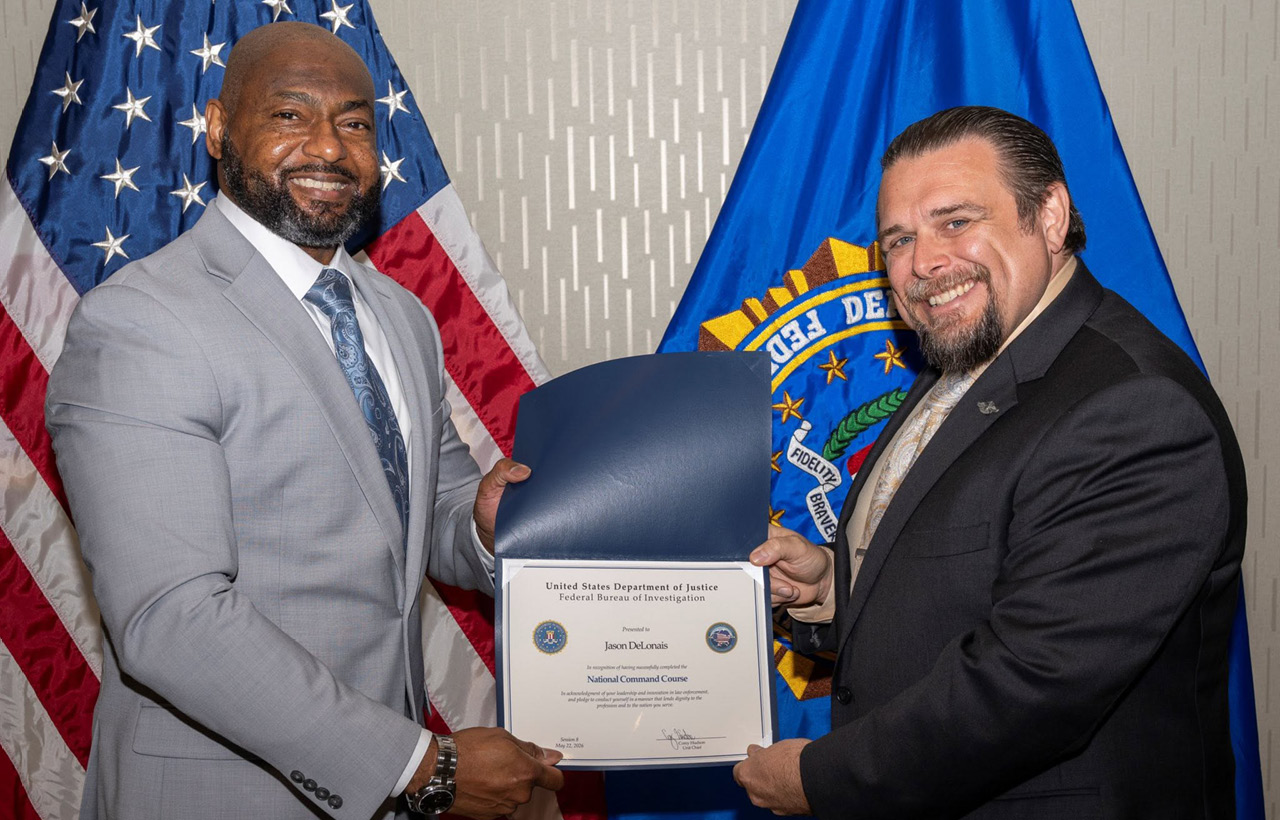 Chief Jason DeLonais graduates from the FBI’s National Command Course
(Courtesy Fletcher PD).
These programs placed me alongside experienced law enforcement leaders and exposed me to different approaches to command, organizational leadership, investigations, and public safety. I brought those lessons back to Fletcher, judging them by what they could help us build back home. Fletcher has become a training hub for our region, working with the Department of Justice, the Oklahoma State Bureau of Investigation, and the Rural Disaster Preparedness Consortium to provide hundreds of hours of meaningful continuing education for officers across our region and state.
But as much as my new education and training has benefited my local community, its reach extends much farther. I have been published several times in national law enforcement magazines and publications, where I have shared my experiences and championed the professionalization of small agencies, which make up the bulk of departments throughout the United States.
Advice for Those Who Want to Shape the Future of Law Enforcement
Education and service have continually strengthened one another throughout my career. My bachelor’s degree supported my transition from military service into civilian public safety and my transformation of a detention center medical department. My master’s degree in criminal justice built on that experience and prepared me to lead a police department through significant organizational change.
That experience is why I encourage anyone considering a master’s degree to think carefully about what they want their education to help them accomplish. For me, education has never lived apart from the work—or from the people counting on us to get that work right. I learned something in class, carried it back to Fletcher, and put it to work for the officers beside me and the community who trusted us to serve.
My Master of Science in Criminal Justice from Excelsior University did more than change the course of my criminal justice career. It helped save a small-town police department from closing its doors and helped us rebuild something our community could trust, depend on, and once again call its own.