With a liberal arts education, students are ready to seize their futures
Barbara M. White, former Foreign Service officer and former president of Mills College in Oakland California, said, “The basic purpose of a liberal arts education is to liberate the human being to exercise his or her potential to the fullest.” White, who received her BA from Mount Holyoke College in 1941 and later her MA in American Studies from Harvard, became the first female ambassador in the U.S. delegation to the United Nations in 1973. She used her liberal arts education to achieve goals many may have thought unattainable. That is what a liberal arts education can do: it can provide one with the necessary knowledge and skills to pursue his or her goals with confidence and determination.
A liberal arts education can equip students with skills that can be versatile in a variety of job disciplines, says George Timmons, dean of the School of Liberal Arts. “The liberal arts foundation prepares you to communicate well, to identify and creatively solve problems, to think critically. These foundational skills will be applicable in any job …” he says. “Those are transferrable skills that any employer would be delighted to have in their staff of employees.”
In fact, it’s widely believed that key components of liberal arts education — teaching students how to think, question, and evaluate — are valuable across careers. Timmons believes it’s important for students to have a well-rounded education when going into the 21st-century workforce. He notes, “Studies in liberal arts disciplines aligned with the study of ethical philosophy allow students to engage with a variety of real-world issues and problems, studying the past and creating solutions to problems that affect everyone in our global society.”
According to a 2015 study conducted by the U.S. Bureau of Labor Statistics, Americans born in the latter years of the “Baby Boom” held an average of 11.7 jobs between the ages of 18 and 48. Consequently, the workforce is always changing and one must be versatile in a variety of disciplines. In this way, it’s important for students to be well-versed and adaptable. This is where it pays to have a liberal arts degree.
Students learn patience, attentiveness, clarity of thought, and a respect for varying points of view. The School of Liberal Arts’ program catalog points out some benefits of studying the liberal arts, stating it: “promotes your ability … to think critically and pose solutions to problems; to propose cohesive arguments with appropriate supporting evidence; to interpret events using more than one perspective; to explain the role of culture in shaping diverse societies; and to demonstrate an awareness of the ethical implications of actions.”
Terrence Campbell, a recent graduate with a bachelor’s in liberal arts, is an administrator with the Fort Worth (Texas) Independent School District’s JROTC Department. Excelsior’s liberal arts program attracted Campbell, who had previously been through a couple of major career changes. “I was filled with intrigue at the possibility of studying a major that would allow me the ability to really apply and enhance both my talents and skillsets,” he says. Campbell reports that with his chosen educational path, he has been able to carry out the following in his career: prepare manuscripts, articles, personal books, poems, and stories for newsletters; conduct research; hold interviews; report department facts; and develop concepts for the application of findings.
Students with a liberal arts degree can expect to find employment in a variety of disciplines, from law and government and business, to social services and media and arts. This is true of Excelsior graduates, as well. Graduates from the Master of Arts in Liberal Studies program go on to find employment in such fields as education, the military, management, information technology, counseling and social work, engineering, human resources, and journalism.
PayScale reports that the mid-career pay range of those with an undergraduate liberal arts degree is from $64,400 to $79,000. The 2013 study notes Excelsior College alumni earn 30 percent more than graduates at other schools, and Excelsior is among one of the top 10 schools producing liberal arts graduates with starting salaries of $50,000.
Timmons strongly believes that a liberal arts degree can open several different doors, career-wise, but it also encourages students to be open-minded and more worldly. “Having a liberal arts foundation is cross-cultural because it’s no longer just competing against your neighbor or cross town or cross states,” Timmons says. “This is truly a global economy so you really have to understand what that represents, and a liberal arts foundation helps you understand diversity of thought, global thought, ethical behavior.”
Graduate Carina Forsythe is an example of a liberal arts cross-cultural education put into practice. She received her master’s in liberal studies, and used her degree to explore Filipino-American identity [see page 7]. She has gone on to design museum exhibits and publish several books on the topic. Studying liberal arts at Excelsior, she says, “led me to many respected and informative writings that changed my life for the better by understanding people of different cultures, and enabling me to intelligently write about it.”
The Huffington Post reports that 9 in 10 employers want new hires to demonstrate ethical judgment and integrity, intercultural skills, and the capacity to continue learning. Employers went on to say that they would recommend education with this kind of foundation to any young person looking to step foot into today’s fast-paced workforce.
“Many liberal arts students initially struggle with finding their way and finding their first job, but research suggests that many of the leadership positions in various organizations are [held by] people who have a liberal arts background,” says Timmons. In fact, in a 2014 Forbes article, it was reported that a third of Fortune 500 company CEOs have a liberal arts degree.
In 2015, Boston-based technology company Burning Glass Technologies examined 25 million job postings and found that “soft skills” like interpersonal communication, problem-solving, and project-management skills were more desirable than “hard skills”— those found in more technical disciplines, like programming, mathematics, physics, etc. Studies concluded that writing, communication skills, and organizational skills were in high demand in nearly every occupation, including in the IT and engineering fields.
Studying the liberal arts can propel one’s career to great heights. When Excelsior surveyed alumni who earned a Master of Arts in Liberal Studies, 27 percent of respondents reported receiving a promotion in their job within one year of graduation. Still, other graduates went on to further study, worked toward other professional certifications, or worked on other personal projects that grew from their graduated research.
“My studies in liberal arts have changed my life tremendously,” says Campbell. “My education and experience as an Honorably Discharged Veteran with 20+ years have afforded me the opportunity to teach in a high school, work as an administrator, manage educational training/operation, and manage a learning center.”
“From a business program perspective, we want our students to be well-rounded, and the kind of skills they can get from a liberal arts program are important.” – Scott Dolan, Associate Dean of Business
Now he hopes to work at a local college, using skills and talents gained from his liberal arts education and his background as a soldier “to assist in the molding process of young citizens.” Ultimately, Campbell believes “that the keys (young people) to our success should always be motivated to learn and achieve with the hopes of contributing to a deeper love for others, self, and country.” Campbell wants to use his personal techniques and experiences to foster a love of learning in students. He’d like to bring something creative to his classes, too. “Specifically,” describes Campbell, “I would start every class with a brief exercise such as viewing news, weather, and sports to stimulate the very essence of education and its relation to our country, society, communities.”
Excelsior’s liberal arts program has allowed Forsythe to have a critical and open mind in her studies. She says, “It gave me insight into different cultures, people, religion, and the many more things that make us human.”
Gary Goldberg, a member of the military police and a recent Excelsior graduate, has also benefited from earning a liberal arts degree. He explains, “I feel that my studies have enhanced my ability to apply critical thinking and analysis to not only my company’s daily challenges but to a broad range of complex issues that may affect personnel management and/or company priorities.”
With so many supporters, why aren’t more students walking the liberal arts path? There are several possibilities. George Timmons comments, “Historically I think the liberal arts degree is seen as a degree for some elite populations in our society, and I think it’s hard for people to understand how it translates into launching or progressing a career.”
It’s important to emphasize how versatile a liberal arts degree can be, and how it can cross disciplines. Some critics of the liberal arts argue that the technological fields are more important areas on which institutions of higher education should place their focus. The emphasis in primary and secondary education has been placed on STEM (Science, Technology, Engineering, and Math) programs, and PayScale reports that STEM degrees are among the highest earning salary potential.
Proponents of a liberal arts education argue that it is important to understand our technological world, but claim it’s just as crucial to know history, writing, reading, and basic science. Goldberg emphasizes the broad approach of a liberal arts degree saying, “I feel that many students continue to dismiss a [liberal arts] degree program based on preconceived opinions of its utility in finding employment. However, students who pursue degrees in a technical field … will often find themselves seeking employment in a challenging job market while there are many opportunities in other types of jobs where there are significantly less candidates in which to compete.”
It doesn’t have to be “either or,” though. People with liberal arts skills can apply their skills in many ways, especially when it comes to technology. At Excelsior, for instance, administrators in the School of Liberal Arts are collaborating with their counterparts in the Schools of Business & Technology and Health Sciences to fuse liberal arts knowledge with industry-specific knowledge and show how the blended education translates into the workforce.
New concentrations within the liberal arts programs include the professional and technical writing concentration, population health concentration, logistics operations management concentration, and the industrial/organizational psychology concentration. In the School of Business & Technology, work has begun to develop a Master of Science in Data Analytics program, which will contain three courses from liberal arts, six courses from business, and concentrations in health sciences, business, and technology.
In the professional and technical writing concentration, students learn how to communicate the sensitive data from someone on the technical end and communicate it with the layman on the other end. Scott Dolan, associate dean of business, explains, “In the tech field, just like on the business side … they want someone who can take mathematical, natural science knowledge, or applied engineering knowledge and translate that to a lay audience.” It is the person with a liberal arts background who can make this exchange of ideas possible.
The new courses in the School of Business & Technology allow students to take the broad liberal arts base and add a specific career component to it. Both business students and liberal arts students can benefit from taking these courses because they can learn about different ideas as opposed to one set of framework, says Dolan. With these courses, his hope is to teach students about the business world and how to run a business, as well as to give them a foundational knowledge in liberal arts.
“From a business program perspective, we want our students to be well-rounded, and the kind of skills they can get from a liberal arts program are important,” says Dolan. “That’s what employers are telling us they want: they want critical thinking, they want the students who have a strong ethical framework, they want students to be able to write well, to communicate clearly, orally, and do it in way that’s accessible to a variety of audiences; they want people who have an understanding of the world, and respect for global diversity and how culture impacts peoples’ beliefs and attitudes.”
The skills students learn with a liberal arts degree remain relevant and applicable in many career settings. In a 2014 blog post on the school’s website, Assistant Professor of English at Dominion College Dr. James Reitter remarked that those who possess skills like critical thinking, interpersonal communication, and those in the liberal arts, are the ones who become hired and promoted.
“Judging the value of a liberal arts education with our current economic status shifts, I believe it to be more relevant than ever before,” says Campbell, who has relied on his liberal arts background when making career changes. “The career mix that is found within this study complements our society and the level of flexibility, creativity, critical thinking, and strong communication skills (particularly writing) that are still at the core of our nation’s existence.”
A liberal arts education encourages students to think critically, creatively, and ethically; to propose cohesive arguments; and to appreciate various perspectives and cultures. It supplies scholars with a broad repertoire of various tools that they will need throughout their careers and their lives. With such a comprehensive toolbox at their disposal, liberal arts students are prepared to go after their futures with arms — and minds — wide open.
Serving Others with a Liberal Education
Alumnus Tom Hoeg received his Master of Arts in Liberal Studies in 2013 and has since put it to good use. Hoeg is a policy analyst with the New York State Office of Children and Family Services, where he follows the legislature for changes to laws related to juvenile justice and child welfare, and decides how to best communicate those changes to the local districts of social services and voluntary agencies of New York State.
Originally from Crown Heights, Brooklyn, Hoeg has always had an interest in psychology. While working in inner-city schools in Queens, he realized he had a gift for working with kids. Working with children also gave him a connection to his father, a victim of child abuse.
The Master of Arts in Liberal Studies program allowed him to pursue a degree in which he could further benefit the children with whom he worked. Hoeg recalls, “What the MALS did for me was cement everything I ever believed in…and enabled me to discuss things on a very high level with the necessary people that could impact change.”
Hoeg remembers using the online Excelsior College library to conduct research for his class assignments. While doing research, he said, he began to see a pattern of many child abuse victims growing up to join the military. It also explained what happened to Hoeg’s father, too. He later dedicated his thesis, “PTSD in Victims of Child Abuse and Combat Veterans,” to him. “The MALS program pulled it all together for me,” he says.
“My degree has made me eligible for promotion, provided confidence in my area of expertise,” Hoeg says, crediting his degree with his recent work with children of incarcerated parents. He worked with then Chief Brendan Cox of the Albany Police Department to develop a way to take care of the kids of parents who were arrested, thus reducing any possible inflicted psychological and emotional trauma.
Hoeg’s ability to engage with children and adults has increased and has become somewhat of “his specialty.” Liberal arts courses focus on social competencies such as interpersonal communication, cultural communication, teamwork, and ethics. He encourages others to pursue the liberal arts, suggesting that the more background one has, the better off one will be. Hoeg personally attests: “Without my studies [while] pursuing my master’s, such as diaspora, gentrification, poverty, immigration, and trauma in a global sense, including work being done currently with PTSD, I could not be conversant as I am, would negotiate with less effectiveness for the underdog, and fail to execute plans considerate of all variables.”
Hoeg turned his appreciation for his Excelsior experience into action. He taught the student success seminar with Excelsior College in fall 2016. “The ability to engage, the ability to dialogue, the ability to help someone begin to understand and how to pursue their dreams and goals was really, really rewarding.” –J.K.



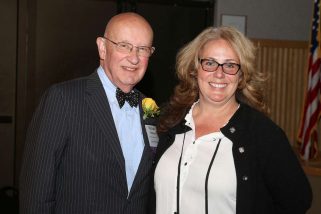 Michael and Margery Whiteman have been active members of the Capital Region community for 50 years. Margery Whiteman has served as a volunteer, director, and chair of many local organizations such as Albany Pro Musica, the Robert C. Parker School, Family Planning Associates of New York State, and Upper Hudson Planned Parenthood. Michael Whiteman has served as an officer or director of organizations such as the Albany Institute of History and Art, the Albany Symphony, the Government Law Center at the Albany Law School, the Historic Albany Foundation, Independent Defense Commission, and WMHT Educational Telecommunications.