
Harold Geller, of Burke, Va., was recently conferred the title of associate professor emeritus of the Department of Physics and Astronomy at George Mason University in Fairfax, Va. Since earning a Bachelor of Science in Liberal Arts from Excelsior (then Regents) College in 1983, Geller has earned a master’s degree and a doctorate from George Mason University. For the past 28 years, he has also taught at the university and currently serves on the board of directors of the GMU Alumni Association as a director-at-large. In his free time, he volunteers as a Solar System Ambassador for the NASA Jet Propulsion Laboratory.
Leading the Charge to Document Women Who Served
There’s a first time for everything, and Lachrisha Parker, a 2012 graduate of Excelsior College with a BS in Liberal Arts, can lay claim to several notable firsts in her life—the first twin to be born, the first in her family to graduate from college, and the first to hold the position of community engagement manager at the Military Women’s Memorial.
Retired from the Army in 2018 with 28 years of service, the former master sergeant and Fort Wayne, Indiana, native is now in charge of outreach for the Military Women’s Memorial. Located at Arlington National Cemetery, the Military Women’s Memorial not only honors the more than 3 million women who have served, but also provides educational resources with interactive exhibits, artifacts, and programs.
Gathering the names and details of so many servicewomen is no easy task. Only 300,000 women’s stories are recorded at the memorial, representing only 10 percent of those who served. Parker is rebuilding and enhancing the data from a variety of sources and reaching out to relevant organizations. The memorial’s website also offers the ability for servicewomen to submit their own information or for family and friends to enter relevant data about someone they may know.
While Parker admits that data mining can be tedious, the benefits far outweigh the drudgery. “Our mission is to tell the story of women veterans through the registry,” she explains. To illustrate her point, Parker recalls one example where a young man and his fiancée visited the memorial. Although the fiancée knew her grandmother had served, she doubted she was documented in the memorial. But when she found her listed, Parker says, “It brought tears to her eyes. She stood in front of our big screen and took a picture of her grandmother’s registry,” adding, “For people to come and find their loved ones is so rewarding.”
A memorial for women is important, according to Parker, because when the average person thinks of active-duty military or veterans, men are top of mind. “It (the Military Women’s Memorial) puts women at the forefront of telling our story. This is our home where you can relate to women in service as a spouse, a mother, a servicemember,” she explains.
Parker supports her fellow servicewomen in other ways, too. In 2019, she was a top-10 finalist in the Ms. Veteran America competition. Her former executive officer had urged her to participate for several years, but Parker deflected the encouragement, thinking the event was solely a beauty pageant. However, when she realized the proceeds of the competition helped homeless women veterans and their children, she agreed to take part. After all, Parker had experienced homelessness briefly, earlier in her military career when as a 24-year-old single mother she resorted to couch surfing with friends for a time. “Those humble beginnings broadened my horizons,” she reflects.
For the talent portion of the competition, Parker lip-synced to the song “This Is Me,” from the movie, “The Greatest Showman,” because she felt the lyrics reflected her experience. She explains, “It hit home in a lot of ways,” noting the words mirrored her struggles in and out of the military as well as those of being a minority woman. Named a Top-Talent Showstopper for her performance, she raised $7,000 that was used to provide housing for the group’s target population.
Another way she gives back is as a member of the Department of Veteran Affairs (Center for Women) Advisory Committee Member on Women Veterans. In this role, she advocates for women vets to ensure resources for specific needs such as mammograms are available at Department of Veterans Affairs (VA) facilities. Previously, she notes, most services provided at the VA were targeted toward men and the facilities did not necessarily have an atmosphere that women found welcoming. Fortunately, with guidance from Parker and others, more women veterans are seeking services at the VA.
Now living in Maryland, she also has volunteered as a dental assistant with the Mission of Mercy in Frederick and served at Walter Reed National Military Medical Center–Bethesda in its restorative dental clinic. Parker’s dream is to build on her experience and education to launch her own business—a mobile dental clinic to assist women veterans and their children.
Helping her to achieve that dream is Parker’s interest in pursuing a master’s degree at Excelsior, which she attributes to her positive undergraduate experience in the School of Liberal Arts. “Excelsior was heaven-sent for me,” she says. Like many Excelsior students, Parker had gone to a traditional college following high school but found the large university overwhelming. She withdrew, joined the Army Reserve, and eventually enlisted full-time. When she enrolled at Excelsior, she had more than 90 credits and military training that could be applied toward her degree. With children at home, a military spouse, and a full-time Army career, Parker had her hands full. “Excelsior was a good fit for me because I didn’t have to find a babysitter; I could be right here at home in the evening and not have to leave work,” she recalls. She tapped into her Post 9/11 GI benefits to help fund her education as well as her own financial resources. As a matter of fact, Excelsior is somewhat of a family affair for Parker. Her husband Reggie is a graduate as well, earning an associate degree in 2012.
Through her work at the Military Women’s Memorial, Parker hopes to bolster the contributions of women in the military. “We are very intelligent, we are very talented, we don’t want to be micromanaged,” she notes. “We are trailblazers, we are women of courage and strength, we are leaders. And we must continue to tell and share the stories for generations, one soldier at a time!”
Conversations on Higher Ed: Episode 9 with David Schejbal
Schejbal, D (Guest) with Lee Maxey (Host). (2021, April 26). Conversations on Higher Ed: Episode 9 with David Schejbal. Mindmaxing podcast.
For Excelsior College President David Schejbal, Ph.D., the COVID-19 pandemic reminded him just how important the academic experience is and helped him reflect on how it has changed over the years. “I think in many ways, higher education in this country has lost its way over the past couple of decades,” Schejbal said, “because we’ve gone from talking about the social value and the benefit of higher education and how we help improve people’s lives and how we help support the country broadly…And we’ve reduced a lot of higher education to just a conversation about job training. And in my view, that just isn’t what it’s about.” Listen to episode nine of MindMaxing to hear how David believes colleges and universities can truly focus on students’ needs as they look ahead to the future.
Harassment and Bullying: Two Wrongs that Do Not Make a Right: A Case Study with a Brief Analysis
Abstract
This is a two-part case study that describes a situation in a New York City public high school, where a devout Christian male physical education gymnastics teacher was quite outspoken and proselytizing about his faith to both his students and fellow instructors. After an incident occurred in the teacher’s lounge around continued use of religious expressions, the instructor was warned by his supervisor to tone down his Christian rhetoric. The following day this instructor found every item on his desk to be perfectly turned/shifted 180 degrees. -He was quite unnerved by this action and reported it to his supervisor who then issued a warning to the department. The incident was repeated the following day, which resulted in a written warning to each member of the department — all of whom strongly stated their innocence. No additional incidents occurred, and the Christian instructor reduced his use of Christian expressions. The case is then briefly analyzed by examining the human resources issues of religion in the workplace as well as harassment and bullying. Please note that this is a disguised case — the high school in question and the affiliated employees’ names have been changed to protect their anonymity.
Introduction
Religion in the workplace has become a contentious subject during the past few years, ever since employers have had the challenge of balancing the right to practice religion with the right to privacy — the bottom line being creating a productive workplace where everyone’s viewpoints are respected and appreciated. The U.S. Department of Labor has provided guidelines to help employers walk this contentious tightrope.
Employees are permitted to engage in private religious expression in personal work areas that are not regularly open to the public to the same extent that they may engage in non-religious private expression. Generally, such religious expression must be permitted so long as it does not interfere with the agency’s ability to carry out its official responsibilities. If such interference does occur, supervisors may limit such religious expression, so long as it is restricted without regard to its content or the viewpoints it may convey. … when such expression is directed towards other employees, such as views regarding religious practice expressed in a conversation, an employee must refrain from such expression when a fellow employee asks that it stop or otherwise demonstrates that it is unwelcome. Continuing that conduct in such circumstances could manifest into unlawful religious harassment. (https://www.dol.gov/agencies/oasam/centers-offices/civil-rights-center/internal/policies/religious-expression)
What happens, however, to employees who continue to express their religious views (or who display religious posters and use religious terminology) and are asked to cease and desist by their co-workers, yet they persist in expressing those views? One reaction may be religious discrimination.
There are typically three main forms of religious discrimination in the workplace: (1) employment decisions based on religious preference (2) harassment based on religious preferences and; (3) failing to reasonably accommodate religious practices. … Harassing individuals due to their religion can include making fun of employees or telling them they are violating the company’s dress code because they wear religious clothing such as yarmulkes, turbans, or hijabs (head scarves); repeatedly mocking a person because of his or her strong, Christian beliefs; ridiculing a Muslim employee for refusing pork at a company picnic; making efforts repeatedly to “save the soul” of a fellow employee who is an atheist.” (https://www.workplacefairness.org/religious-discrimination)
The following case describes a real situation that occurred within a New York City high school. Please note that this is a disguised case — the high school in question and the affiliated employees’ names have been changed to protect their anonymity.
Harassment and Bullying: Two Wrongs That Do Not Make a Right
Part A
“Have a blessed day” Washington said to his fellow gymnasium coach as he left the men’s physical education office to teach softball during physical education class on a beautiful spring day. His colleague was anything but amused. He had asked Washington to stop pushing his religion (or any religion for that matter) on him. He was an “ardent atheist” and felt that one’s religious beliefs should be kept to oneself. He certainly did not go around preaching atheism and jokingly “thanked G-d he was an atheist.” This was the final straw of Washington’s continual barrage of preaching and proselytization. “I will take matters into my own hands,” he thought to himself.
Schoolyard
City High School (CHS) was a public high school and part of the New York City Department of Education (NYCDOE) in one of the outer, more suburban boroughs. Grades 9–12 are taught at CHS with a student population of more than two thousand. The demographics of the students were a melting pot: 30% Hispanic, 20% Black, 20% South Asian, 10% East Asian, 10% Middle Eastern, and 10% white. At the time of this story, the NYCDOE teacher demographics were very different from the student population: approximately 60% white, 21% Black, 14% Hispanic, and 4% Asian (New York City Independent Budget Office). The principal of the CHS was a young, 40-year-old Jewish white male.
CHS had a strong physical education program for both male and female students and employed numerous well-trained faculty. The male physical education teachers shared an open office where they were each assigned their own personal desk. The teachers used the office to prep their classes and to eat lunch. The department had been very stable and had worked together for a long time. (See Exhibit A for the list of teachers and their demographic backgrounds.)
| Exhibit A: Physical Education Male Teachers at CHS | |||||
|---|---|---|---|---|---|
| Name | Race | Religion | Age | Tenure | Notes |
| David | White | Jewish | 55 years | 30 years | Union Chapter Leader (10 years) |
| Michael | White | Jewish | 50 years | 25 years | |
| Patrick | White | Christian | 42 years | 15 years | |
| Fred | White | Jewish | 35 years | 12 years | |
| Washington | Black | Christian | 30 years | 9 years | |
| Ben | White | Jewish | 29 years | 7 years | |
Although the newest member of the faculty, Ben had already been at CHS for seven years. The biggest change had been when George (32 years old, white, Christian, 7 years), who started at the same time as Ben, was promoted two years ago to athletic Director. George’s teacher position was not filled due to budget cuts so he assisted in class instruction. Each teacher was responsible for teaching five classes with 50 students in each class. David, another gymnasium teacher, was elected by the school’s faculty to be the union chapter leader. This was a very influential position, as the union chapter leader served as the link between the faculty, school administration, union officers, borough representative, and district representative.
Stable but Not Harmonious
Washington was very passionate and outspoken about his Christian faith. His desk was meticulously arranged and organized and contained a lot of Christian articles on it. He hung inspirational posters above it as well. (See Exhibit B.)

Washington felt he had a spiritual duty to teach others about his faith with the hope to convert them to his way of thinking. His relentlessness at times caused tempers to flare since several of his colleagues were of different faiths. It bothered Patrick a lot that his fellow Christians did not have the necessary zeal to also talk about the “good book” nor the need to challenge others’ morality because of their differing beliefs. The office atmosphere was less than collegial in the office when Washington was present. Washington had a habit of confronting both his Christian and Jewish colleagues as to their religious fervor. One confrontation was so bad that George heard the commotion in his office between Washington, Patrick, Ben, and Fred. George invited Washington to his office and explained that he needed to tone down his evangelism in the teacher’s office as it was not the proper place for it. The others in the department tried their best to distance themselves from Washington so as not to engage in his religious rhetoric. After the incident, Washington was trying to be more contained, but the awkwardness of the situation made him nervous. He wanted to be liked by his co-workers and feel accepted, but the silence was deafening. As Washington left the office to go to class, he uttered the most positive thing he could think of — “Have a blessed day” — to his colleague, not even realizing its religious content nor the possible associated unintended consequences of making such a statement.
The Next Day
When Washington arrived at the office the next morning, nobody else was in the office. He found every item on his desk to be perfectly turned 180 degrees. Washington found the action to be unnerving, humiliating, and a personal affront. He ran into George’s office, upset and confused — Why did this occur, and who could have done such an unchristian thing?
Questions to Think About for Part A
- What law or laws could be applied to the confrontation in the teacher’s lounge about Washington’s proselytizing?
- Do you agree with the actions that George took after the commotion in the teacher’s lounge? If not, what actions would you have taken, given your answer to question 1?
- How might David, the union leader, have handled Washington’s original proselytizing?
- If you were George, how would you now handle Washington’s complaint regarding his desk items being turned around? What laws could be applied in this situation?
Harassment and Bullying: Two Wrongs That Do Not Make a Right
Part B
George interviewed each of the male physical education teachers to find out what happened. Nobody admitted to doing it nor seemed to know what happened. George also had a private meeting with Washington to see if he had had any clashes with anyone in the department after the last blowout. Other than being awkward, he had not had any conflicts. George raised the issue to the rincipal, who guided him to pull the department together and issue a verbal warning that this sort of behavior would not be tolerated. George did as he was told and instructed the team about the importance of creating a respectful environment where everyone felt comfortable: This type of harassing behavior would not be tolerated.
The following Monday, when Washington arrived, he found his desk to be rearranged again in the exact same manner. Washington did not even sit down; instead, he went straight to George. George was flabbergasted. He could not believe someone would do it again. George spoke to everyone on the team again, and nobody knew what had happened or even acknowledged that the situation had become “awkward” in terms of Washington’s prior religious expressions. They all “seemed” shocked that it had happened again. George and the principal were convinced that at least one of the male physical education teachers had taken the action, and, worse, that the rest knew what happened and who did it. The principal advised that a written warning should be delivered to each of the male physical education teachers other than Washington.
George delivered the written warning to each teacher, which resulted in furious rebuttals. “I am innocent …, Why are you looking at me …, I did not do anything …, How dare you accuse me when you have no proof?” The other gym teachers were angered by George’s formal actions and near simultaneously yelled, “Why are you siding with Washington, He could have done this himself in retribution for being called into your office. Doesn’t the Bible say, ’Vengeance is Mine; I will repay says the Lord’? (Romans 12:19). The loudest complaint came from David who said, “How dare you accuse me of this wrongdoing. I am the union chapter leader!”
Postmortem
George never found out who the culprit was who rearranged his desk, but there were no future incidents. Washington also realized that he needed to tone down his religious passion in the workplace and removed some of the Christian elements on his desk and took down the poster. The office conditions became more tolerable for all, although never truly collegial.
Questions to Think About for Part B
- Do you agree with how George handled the first incident of desk rearrangement? If not, what would you have done differently and why?
- Do you agree with how George handled the second incident of desk rearrangement? If not, what would you have done differently and why?
- How should David have handled the desk rearrangement incidents and George’s accusations against the male physical education teachers?
- What would you have done if you were in George’s and David’s place? Why?
A Brief Case Analysis
The above story touches upon three human resources topics: religion, harassment, and bullying. Each will be discussed in short below.
Religion
Lussier & Hendon (2019) noted that religious discrimination is a violation of the Civil Rights Act of 1964 and identified religion as a protected class. Employers are required to provide a “reasonable accommodation” for requests that are based on religious beliefs (Lussier & Hendon, 2019). Washington’s religious articles, posters, and discussions with fellow adults were all protected by this right. However, the moment he was asked by his co-workers to desist from conversations about his religious beliefs, he was required to respect their request, which is their right under the same law.
Religion in public schools is a hot topic and creates a lot of debate. Did Washington’s rights change because his employer was a public high school? The answer is “no.” Freedom of religion is guaranteed under the First Amendment of the U.S. Constitution, which has two parts: 1) Government (state and local government, including public schools) may not either promote religion (the “establishment clause”) or 2) prevent people from practicing their religion (the “free-exercise clause”) (Gjelten, n.d.).
However, in 1971, the Supreme Court established the Lemon Test from the case of Lemon vs. Kurzman. Schools must not 1) prohibit or promote a particular religion, 2) be motivated by a secular purpose, and 3) avoid excessive entanglement between church and state (Heinrich, 2019). Washington was protected as long as he was not engaging students in prayer, preaching during class, or behaving in a way that was deemed unwarranted or harassing. However, the moment he was asked to tone down his religious rhetoric by his colleagues and his supervisor, he was required to (DOL, n.d.).
Harassment
Washington’s preaching could have been construed as harassment to his fellow teachers. The U.S. Equal Employment Opportunity Commission defines harassment as unwelcome conduct that is based on race, color, religion, and so on, which results in a work environment that is intimidating, hostile, or abusive (EEOC, n.d.). According to the Society for Human Resource Management (n.d.), proselytizing in the workplace could affect an employee’s right to work in an environment free from religious harassment. His behavior clearly bothered his co-workers and was unwelcome. Washington did not correct his behavior after George spoke to him following the confrontation.
Firms have tightened the ability of employees to proselytize with strict solicitation rules in their Codes of Conduct (HR, n.d.), and, therefore, the teachers should have raised their concerns to their supervisor George that Washington’s behavior had not changed. David, the union leader, also could have stepped in and tried to diffuse the situation and raise his concerns to the supervisor, George (United Federation of Teachers, n.d.). Regardless, rearranging Washington’s desk constituted harassment, implying that employees were unilaterally going to take matters into their own hands.
Bullying
“Bullying can best be understood as a pattern of aggressive, contemptuous and abusive behavior toward another party” (Petersen, 2018). The actions taken against Washington constituted bullying behavior, as it was meant to make him feel upset and uncomfortable. Worse than the bully, nobody stood up to defend Washington or to say what they saw. The behaviors of the bully and the bystanders cannot be condoned or allowed to occur (Emamzadeh, 2018). The swift action taken by the administration in both occurrences with varying degrees of punishment was also necessary. It is also recommended that the department to have had professional development on the importance of a respectful environment and the importance of bystander intervention.
Conclusion
In the United States, there are three taboo topics to bring up in a polite discussion: religion, politics, and money (May, 2017). An individual’s personal beliefs in religion and values are core to their essence, and for many it is very private. Although Washington’s intention to enlighten his fellow teachers might have been noble, the way he went about this illumination became controversial, harassing, and annoying. Washington did not respect his co-workers when he took the topic too far; nor did he listen to his supervisor. More should have been done to modify Washington’s behavior because the silence and the actions done to his desk were an “underground” reaction to Washington’s persistent behavior. That being said, the desk rearrangement (not once but twice) clearly was also a form of harassment. This case is a true example of “two wrongs do not make a right.”
Anonymous (n.d.). Religious Discrimination. Retrieved fromhttps://www.workplacefairness.org/religious-discrimination
Department of Labor (n.d.). Religious Expression in the DOL Workplace. Retrieved from https://www.dol.gov/agencies/oasam/centers-offices/civil-rights-center/internal/policies/religious-expression
EEOC (n.d.) Harassment. Retrieved from https://www.eeoc.gov/harassment
Emamzadeh, A. (2018). Workplace Bullying: Causes, Effects, and Prevention. Retrieved from https://www.psychologytoday.com/us/blog/finding-new-home/201809/workplace-bullying-causes-effects-and-prevention
Gjelten, E.A. Religion in Public Schools. Retrieved from https://www.lawyers.com/legal-info/research/education-law/religious-beliefs-and-public-schools.html
Heinrich, J. Ask the Expert: What does separation of church and state mean in America’s public schools? Retrieved from https://news.cornellcollege.edu/2019/11/ask-expert-separation-church-state-mean-americas-public-schools-report/
Human Resources (2004). Proselytizing at Work: Accommodate or Eliminate? Retrieved from https://www.hr.com/en/communities/legal/proselytizing-at-work-accommodate-or-eliminate_ead0ocyj.html
Lussier, R. & Hendon, J. (2019). Human Resource Management: Functions, Applications, and Skill Development. 3rd ed. Los Angeles: SAGE Publications, Inc.
May, Veronica (2017). Taboo Topics: 3 Things to Never Discuss in Polite Conversation. Retrieved from https://lessonsanddigressions.com/2017/05/19/tabooconversationtopics/
New York City Independent Budget Office (2014). Demographics and Work Experience: A Statistical Portrait of New York City’s Public School Teachers. Retrieved from https://ibo.nyc.ny.us/iboreports/2014teacherdemographics.pdf
Nolo Press (n.d.). Does my coworker have a right to proselytize at work? Retrieved from https://www.nolo.com/legal-encyclopedia/does-coworker-right-proselytize-work.html
Petersen, L. (2018). What Is Workplace Intimidation? Retrieved from https://smallbusiness.chron.com/workplace-intimidation-11868.html
Romans 12:19 (n.d.). Vengeance is mine. Retrieved from https://biblehub.com/romans/12-19.htm
Society for Human Resource Management (n.d.). Do we have to allow employees to proselytize or use religious expressions/greetings? Retrieved from https://www.shrm.org/resourcesandtools/tools-and-samples/hr-qa/pages/religious-accommodation–do-we-have-to-allow-employees-to-proselytize-or-use-religious-expressions-greetings.aspx
United Federation of Teachers (n.d.). Responsibilities of the chapter leader. Retrieved from https://www.uft.org/your-union/about-uft/chapter-elections/responsibilities-chapter-leader
Excelsior College Launches Innovative New Master’s Programs and Certificates
Albany, N.Y. — Excelsior College is responding to the future of work with two new master’s degrees and two certificate programs. The way companies work is changing. From remote or distributive workforces to changing technology to data-driven strategies, companies operate differently than they did even a year ago.
The Master of Science in Organizational Leadership with an Emphasis in Technology and Data analytics and the Master of Science in Human Resource Management with an Emphasis in Diversity and Technology received New York State Education Department (NYSED) approval this month, and courses are open for the term beginning in August 30, 2021. Both programs are offered fully online and led by industry experts to equip students with real-world strategies that can be put into practice for immediate impact.
“The pace of technological change is expected to continue to accelerate over the next five years, with cloud computing, big data, and e-commerce continuing to dramatically change the nature of work,” says Scott Dolan, dean of Excelsior’s School of Graduate Studies. “Skilled technologists have expertise in those areas may need to broaden leadership skills in problem solving, collaboration, and communication. In the reverse, business-focused leaders may need to strengthen foundational knowledge to understand how to reach people with technology and data backgrounds.”
The timing is right to prepare leaders for success in an ever-evolving work environment.
“There is a significant opportunity to train and educate leaders for the jobs of the new economy, an economy that operates at the intersection of technology, data, and human innovation,” says Dolan. “We are excited to be able to launch two new master’s degree programs aligned with these trends. And because the change is so rapid, we know that the window of opportunity for individuals to reskill and upskill is short. Leaders need to stay current, so in line with this approach, we have also developed two shorter duration certificates which are embedded in the two programs: a certificate in data analytics and a certificate in distributed workforce management.”
The certificate programs require three courses, and credit from the certificate programs can be applied to a degree program. The Graduate Certificate in Data Analytics integrates with the MS in Organizational Leadership with an Emphasis in Technology and Data Analytics, and the Graduate Certificate in Distributed Workforce Management integrates with the MS in Human Resource Management with an Emphasis in Diversity and Technology. Students can complete the 9-credit certificate programs in 6 months to have immediate impact and value in the field.
These programs add to the business suite of graduate programs offered by Excelsior College.
# # #
Media Contact Excelsior College:
Erin Coufal, ecoufal@excelsior.edu, 518-608-8498
ABOUT EXCELSIOR COLLEGE
Excelsior College (excelsior.edu) is an accredited, not-for-profit online college focused on helping adults complete their degrees and advance their careers. The college contributes to the development of a diverse, educated, and career-ready society by valuing lifelong learning with an emphasis on serving individuals historically underrepresented in higher education. Founded in 1971, Excelsior meets students where they are — academically and geographically — removing obstacles to the educational goals of adults pursuing continuing education and degree completion. Our pillars include innovation, flexibility, academic excellence, and integrity. Learn more at excelsior.edu.
The RARE Model for Collaborative Assessment
https://www.podbean.com/media/share/pb-pjcgn-102c423?utm_campaign=w_share_ep&utm_medium=dlink&utm_source=w_share
In this episode, Erin and André talk about the RARE model, a framework for collaborative assessment practices, with its creators Dr. Emilie Clucas Leaderman and Dr. Gina B. Polychronopoulos.
The Humanistic Leadership Model (HLM)
Abstract
There are many definitions for different types of leadership, such as transformational or transactional, autocratic or democratic, task-oriented or service-oriented. Others define leadership as situational or just plain management. I have found most of these terms to be too limited and too narrow to cover the complex act of leading others. Consequently, I have developed a humanistic leadership model or HLM. The aim of humanistic leadership is to place people over profit to make business more sustainable. To thrive and survive, every business needs profit, but, with a humanistic leadership approach, business and people thrive. With the constant threats of environmental change and geopolitical conflict, we need humanistic leadership more than ever to enable a sustainable and more peaceful world.
The HLM Model
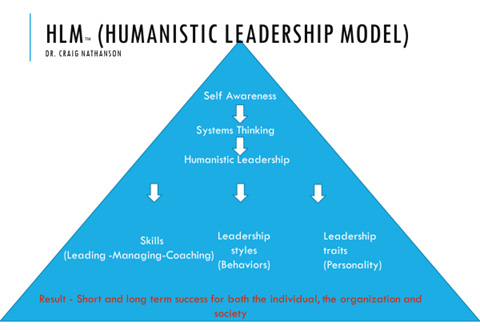
Humanistic Leadership Starts with Self-Awareness
To lead others well, one must be able to lead oneself first.
What does it mean to be self-aware? This is a lifelong process. To be self-aware means being able to answer the question: “Who am I?” This is a question that most people do not ask themselves. However, this is the most important question to answer. Self-aware leaders should also ask themselves: “What is most important and why?” In connection to this, understanding one’s values and which goals are aligned with these values are the key. Otherwise, people will spend most of their day on activities that have nothing to do with their most important values. A self-aware person should also reflect on one’s daily behavior to ensure that it always aligns with one’s most important values. Another attribute of self-awareness is to have a healthy perspective of oneself and others.
Become a System’s Thinker
I have observed that many self-aware leaders are also system’s thinkers. To be a system’s thinker means being able to think through one’s actions and potential outcomes. This includes understanding how your actions affect others. Being a system’s thinker means having the ability to understand that each action can result in unintended consequences that might affect many other people.
Humanistic system’s thinkers consider of the big picture.
- David Katz, founder of the Plastic Bank, has the mission for his company to reduce the amount of plastic in the ocean and poverty in the world through recycling projects.
- The Fourth King of Bhutan continues the pledge of national happiness for the people of Bhutan as the country’s gross national product. The country’s constitution shows that system’s thinking as environmental protection is a written law to ensure that 60% of the land is forested.
- The Chinese government has a national plan to move more than 250 million people from the farmlands to the big cities to enable economic growth.
- Norway has a national strategy to be carbon neutral by 2030.
Humanistic Leadership
Humanistic leadership is about trusting others, being ethical, having compassion, and participating as a collective whole. A humanistic leadership system has a clear and aligned vision, mission, values, and expected behaviors. There should be a transparent communication and collaboration versus internal competition among the system’s members. In a humanistic leadership system, the organizational culture is caring and supportive, and people feel appreciated and included. The humanistic leader understands at a deep level that the most important business indicator is the level of joy and meaning that people have in their work. When this is in place, all other indicators of business success will go up. The key tenants of humanistic leadership are placing the needs of people over profit and having empathy and respect for others.
- When the 2017 fires of Northern California hit, Airbnb offered free rooms to those without homes.
- Tony Hsieh, the visionary leader of the shoe company Zappos, stated that enabling people to find passionate work is the best route to delivering happiness to its customers.
- Squarespace, a web development company, lets its workers take as much vacation as needed, treating people as owners versus commodities. The company has an 18-week paid parental leave policy, believing that when a child is born, these are the most important times for family bonding.
- Patagonia, a clothing product company, closed the company for a day, encouraging customers not to buy their products to save global resources. The company views family, environment, and community first. One percent of all their revenues go to nonprofits.
- Quicken Loans is revitalizing Detroit by paying its workers subsidies to live there and has spent over 2 billion dollars to buy and renovate properties.
- The Container Store pays into a fund that is available for its staff when they have unexpected medical emergencies.
- The founder of TOMS shoes has restored eyesight in more than 400,000 people in 13 countries through eyewear donations and eye treatment in addition to donating 35 million shoes and safe drinking water to five countries.
- Love Your Melon, an apparel brand, supports children battling cancer by donating 50% of its profits to nonprofit partners.
All these companies have a compelling vision that focuses on positive influence on its people and society.
The Skills of Humanistic Leadership
The skills of humanistic leadership are leading, managing, and coaching. The humanistic leader should have all these skills.
Leading
Leading is about having a clear business vision and being able to explain this vision to people in a way that inspires them to come to work. Leading is selling tickets for the journey in a passionate and facilitative way.
Managing
Managing is the opposite of leading, requiring stability, structure, discipline, and consistency. However, it also takes into consideration the individual person. Managing requires consistent processes, good time management, and the transparent act of setting and measuring goals in a collaborative way.
Coaching
Coaching is about helping people on a daily basis to get them where they need to go. A strong leader is able to listen to and focus on people and their needs while enabling motivation. Coaching enables collaboration versus competition. The best coaches enable people to develop in their own ways, not rating and ranking them against others, but by treating them in unique ways and allowing for self-orientation and independence in their work.
The best way to see if there is humanistic leadership in place is to see if the followers can lead themselves.
The Behaviors of Humanistic Leaders
Humanistic leaders are aware of the behavioral style that fits them best and gets the best results from people.
Some people prefer a more autocratic style of leading; others prefer a more democratic and collaborative style. Some might utilize a more task-oriented and structured approach, while others are more comfortable leading in a service-oriented style. Some leaders just prefer to lead through their personal values and principles, while others lead in political ways, serving their interests first.
In my observations, leading others in a collaborative and democratic way tends to get the best results from people at work.
Personality Traits of Humanistic Leaders
Although personality is wired at birth and difficult to change, behavior can be changed. For example, an introverted leader can decide to be more outgoing and sociable even though it could be difficult for this person. However, the leader can modify the behavior to connect more directly with followers. In my observations, there are specific personality traits that humanistic leaders have. They have a high level of conscientiousness that enables deeper thinking, better organization, and discipline. A humanistic leader also should be open, have integrity, and make others feel appreciated and included. Finally, I have determined that having interpersonal sensitivity is important to understand others, and this becomes easier when a person is self-aware.
A Better Way
The humanistic leadership model is needed to better lead others at a personal, societal, and organizational level. Becoming a humanistic leader is not optional, but mandatory, if we aim for sustainability at all levels now and into the future.
Cardiometric Correlates of Using Coaching Associative Cards When Working with Human Ego States
Abstract
The article presents experimental evidence of the hypothesis that the theoretical construct ego state, widely used in coaching, in addition to its psychological content, reflects the physiological mobilization of a person to a certain reaction type. Such mobilization is manifested in how the human cardiovascular system works. Experimental evidence is given that the theoretical construct ego state really captures completely definite and meaningfully different psychophysiological states of a person. Also shown is that transitions from such an ego state to another one are indeed accompanied by significant changes in heart rate variability that was estimated with the help of the Baevsky Stress Index (SI). Also provided is experimental data confirming the validity of using the Baevsky (SI to evaluate the effectiveness of various options for working with coaching associative cards (CACs).
Introduction
For more than half a century, coaches, psychologists, and psychotherapists have been actively using a psychological concept of the ego state of a person, which means a combination of feelings, thoughts, and actions connected with each other as a way of manifesting our personality at a certain moment (Berne, 2010; Ognev, et al., 2019; Shmelev, 2015).
In transactional analysis, created by Berne (2006), such ego states as the Inner Child, the Inner Adult, and the Inner Parent (Berne, 2006) are distinguished as basic ego states. Each of these ego states has the quality that can be designated as subjectivity, which means “the cause of oneself” (Petrovskiy, 2010), which has its own phenomenological content and integrity of experience in a specific period of time. The Inner Child, according to transactional analysis, is a combination of thoughts, feelings, and behaviors characteristic of any experience at an earlier age. The Inner Adult is a set of thoughts, feelings, and behaviors related to the current situation with the reality of “here and now.” This stage focuses on a pragmatic assessment of what is happening as well as a rational assessment of the causes and possible consequences of certain events. The Inner Parent is a combination of thoughts, feelings, and behaviors inherent in one of the parents. Parental figure means any person who played a significant role in shaping the personality of that person. Parent formation occurs throughout life. In everyday life, the Inner Parent manifests itself in moral and ethical attitudes to your and others’ behavior. Both the Inner Child and the Inner Parent regress under stress. The higher the level of stress, the higher the level of manifestation of the Inner Child and the Inner Parent. The level of regression under stress shows the stability and strength of the self. This raises the question as to whether this is really the case: Are there physiological correlates of ego states?
Despite the years-long practice of using these theoretical concepts, there is practically no experimental confirmation that these ego states really differ from each other in the physiological reactions associated with them. The existence of such reactions follows from the proposition that its creators included the mobilization readiness of a person for a certain type of reaction in the theoretical concept of ego state. Initially, such a mobilization should be manifested in how the human cardiovascular system works. If the theoretical concept of ego state is not just a popular metaphor, and if it is used to register quite meaningfully different psychophysiological states of a person, then transitions from one ego state to another should be accompanied by significant changes in the work of the human body, and above all — of the heart. On the basis of the results described in our earlier studies (Ognev et al., 2019), the assumption is that such changes can be recorded by assessing heart rate variability using the Baevsky SI.
Study Methods
To test the hypothesis presented, the authors carried out a series of experiments in which the key transactional ego states were modeled with the help of metaphorical associative cards. At the same time, the psychophysiological reactions corresponding to these states were recorded with the help of the computer hemodynamic recorders Cardiocode. Meanwhile, the authors took into account the results of previous experimental studies, which showed that an increased Baevsky SI, when compared to average values, can be considered as a sign of an asthenic reaction to a stimulus, and the lower Baevsky SI value can be considered a sign of an asthenic reaction to a stimulus. We also believe that Baevsky SI indicators are a more effective indicator of the nature of participants’ emotional reactions than changes in their heart rates (Ognev et al., 2019).
Taking into account the pictorial turn, which became a clearly identified trend at the end of the 20th century and is constantly accelerating (Alexander, 2008; Dors & Vogel, 2014; Mitchell, 1994), metaphorical associative cards were chosen as a stimulus material to actualize the ego states described above. As shown in numerous scientific publications, the images used in metaphorical cards help the therapist to actualize certain psychophysiological conditions of the patient, which can be used as “targets” for psycho-corrective intervention (Buravtsova, 2018).
For stimulus material in the experiments, the authors used the standard set of coaching associative cards (CACs) created by Shmelev (2015). This choice was made because of productive use of CACs by consultants and coaches in different areas.
The study involved 126 respondents (average age of 20.5 years, the standard deviation from which amounted to a total of 5.4 years in the sample). The consistent algorithm for the work of all respondents included the following tasks. Initially, respondents were asked to select metaphorical associative cards that they associated with the negative Inner Adult, Inner Parent, and Inner Child, as well as with the positive Inner Adult, Inner Parent, and Inner Child.
Then all respondents spent 15 seconds alternately fixing their attention on the cards that they associated with each of the ego states listed above. The final task for the respondents was to select all the metaphorical associative cards that they associated with positive ego states and then focus their attention on all such cards for 15 seconds at a time.
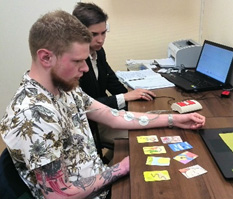
When the participants were performing these tasks, their cardiograms were recorded using computer hemodynamic recorders Cardiocode. This stage is shown in the photographs of participants performing tasks while their cardiograms are recorded.

Further, using the algorithms embedded in the software of these recorders, the authors calculated the Baevsky SI for each participant. Processing of all received data was carried out using the statistical package Stadia 8.0.
Discussion of Results
The obtained statistical patterns in determining the Baevsky SI for various ego states of the respondents are presented in Table 1.
Table 1. The Main Statistical Parameters of SI for Various Ego States of Respondents
| Ego States | Arithmetic Mean Value | Standard Deviation | Median value | Skewness | Excess Kurtosis |
|---|---|---|---|---|---|
| 1 | 341.4 | 196 | 288 | 0.99 | 3.317 |
| 2 | 257.5 | 214.3 | 206 | 3.195 | 16.04 |
| 3 | 335.3 | 247.8 | 279.5 | 2.462 | 12.26 |
| 4 | 254.8 | 216.3 | 200.5 | 2.681 | 11.46 |
| 5 | 334.1 | 340.4 | 251 | 0.169 | 0.56 |
| 6 | 258.1 | 185.2 | 168.9 | 0.173 | 6.8 |
| 7 | 210.5 | 208.4 | 185.2 | 2.984 | 15.35 |
The first column of this and all the following tables shows the numbers that indicate the following ego states: 1, 3, 5 — the negative Inner Adult, Inner Parent, and Inner Child that were successively triggered; 2, 4, 6 — the positive Inner Adult, Inner Parent, and Inner Child that were successively triggered; 7 — the integrative ego state, caused by the respondents’ simultaneous concentration on the stimuli with which they designated as the positive conditions of the Inner Adult, Inner Parent, and Inner Child.
The static significance of differences in average values was confirmed by the χ (chi-square) criterion, which was evaluated with the help of the statistical package Stadia 8.0.
The resulting distributions differed from the Gauss-Laplace distribution. Therefore, to identify correlation relationships, the authors used Spearman’s rho and Kendall’s tau coefficients. Since the nature of the identified relationships for each of these coefficients and the factor structure revealed for each of them are similar, in the following tables only data for Spearman’s rho coefficient are given, in view of its greater universality.
The tables below show the results of various options for optimizing the factor structure of the data using Spearman’s rho coefficient. Table 2 shows the parameters of the factor structure after using the Varimax Rotation, with which we sought to minimize the number of variables with high loads on each factor. Table 3 presents the data obtained after applying the Quartimax Rotation, with which we tried to minimize the number of factors that are required for a meaningful interpretation of each variable used. Table 4 shows the results of the Equimax Rotation, which was used to simultaneously minimize the number of variables with large factor loads and the number of factors explaining them. The authors also performed the Оblique Rotation, with which we sought to minimize the number of factors without ensuring their complete orthogonality. The result was that the factor structure of correlations after the Оblique Rotation exactly corresponded to the structure obtained after the Varimax Rotation. While optimizing the factor structure of the revealed correlation relationships, we analyzed the options, which included from three factors (covered up to 50% of the variance and was associated with large losses of information) to seven factors (covered more than 90% of the variance and was characterized by the presence of a significant number of uninformative relationships). Optimal was the optimization of the factor structure of the revealed correlation relationships, which included four factors and covered more than 80% of the variance. The data for this optimization option are presented in Tables 2–4.
Table 2. Factor Structure of Correlations After the Varimax Rotation
| Ego States | Factor Numbers | |||
|---|---|---|---|---|
| 1 | 2 | 3 | 4 | |
| 1 | 0.8852 | |||
| 2 | 0.5996 | 0.59 | ||
| 3 | 0.9457 | |||
| 4 | 0.4961 | 0.3833 | 0.5888 | |
| 5 | 0.9013 | |||
| 6 | 0.6684 | 0.3228 | ||
| 7 | 0.8814 | |||
Table 3. Factor Structure of Correlations After the Quartimax Rotation
| Ego States | Factor Numbers | |||
|---|---|---|---|---|
| 1 | 2 | 3 | 4 | |
| 1 | 0.853 | |||
| 2 | 0.6916 | 0.4843 | ||
| 3 | 0.9276 | |||
| 4 | 0.6208 | 0.3407 | 0.481 | |
| 5 | 0.8514 | |||
| 6 | 0.763 | |||
| 7 | 0.8797 | |||
Table 4. Factor Structure of Correlations After the Equimax Rotation
| Ego States | Factor Numbers | |||
|---|---|---|---|---|
| 1 | 2 | 3 | 4 | |
| 1 | 0.8775 | |||
| 2 | 0.6383 | 0.5528 | ||
| 3 | 0.9387 | |||
| 4 | 0.543 | 0.3646 | 0.5581 | |
| 5 | 0.8897 | |||
| 6 | 0.7072 | 0.2811 | ||
| 7 | 0.877 | |||
As seen from the data presented, SI indicators for the positive ego states are part of some factors, and SI indicators for the negative ego states are part of other factors. Moreover, these regularity and factor structures are retained for all the rotation options used. The structures, as well as the statistically significant differences in average SI indicators, also demonstrates a substantial generality of the positive ego states, which differs significantly from a substantial generality of SI indicators for the negative ego states.
The most powerful factors in all variants of rotation included SI indicators for all positive ego states, when they were successively triggered, and the SI indicator, which was obtained when respondents worked with all three positive ego states. In this regard, we should recall that in transactional analysis, the therapy completion is considered successful when the patients achieve such a level of organization of their lives when their Inner Child is able to freely realize their authentic intentions with the help of the effectively functioning Inner Adult under the protection of the Inner Parent (Stewart & Joines, 2012). Thus, the factor structure confirms the presence of a positive integrative effect from the joint actualization of the positive varieties of imaginary Internal Adult, Internal Parent, and Internal Child by the respondents at the psychophysiological level, since joint actualization corresponds to the optimal Baevsky SI.
In terms of testing the hypothesis about the difference in psychophysiological indicators associated with certain ego states of a person, attention is also drawn to the generality and specificity of the data obtained in all the described types of transformations of the revealed correlation relationships (Table 5).
Table 5. The Generality and Specificity of Baevsky SI for Various Ego States
| Ego States | Generality | Specificity |
|---|---|---|
| 1 | 0.8683 | 0.1294 |
| 2 | 0.7165 | 0.288 |
| 3 | 0.9655 | 0.0342 |
| 4 | 0.7398 | 0.2599 |
| 5 | 0.9178 | 0.0872 |
| 6 | 0.6536 | 0.3452 |
| 7 | 0.7848 | 0.2094 |
As can be seen in Table 5, indicators of generality and specificity of SI values for the positive and negative ego states have noticeable differences. The SI indicators for the negative ego states have the greatest generality (i.e., they account for the largest share of variance with respect to the identified factors that are most universal). At the same time, the SI indicators for the positive ego states have the greatest specificity (i.e., they account for the largest share of variance with respect to specific factors).
Conclusion
During the research, experimental evidence of the validity of the hypothesis that the concept of ego state in addition to its psychological content really reflects the physiological mobilization of a person to a certain type of response. In particular, such mobilization is manifested in a certain nature of the work of the cardiovascular system.
The obtained experimental data indicate that the concept of ego state is not just a successful metaphor; rather, substantively distinct psychophysiological states of a person can be observed. Transitions from one ego state to another one are accompanied by significant changes in the work of the human body — especially the heart. A reliable reflection of such changes is the assessment of heart rate variability using the Baevsky SI.
In addition, as in previous research (Ognev et al., 2019), we obtained experimental confirmation of the validity of using such a complex cardiometric indicator as the Baevsky SI to assess the effectiveness of various psycho-correctional methods. But if earlier this concerned the methods of psychosomatic self-regulation, now the productive use of the Baevsky SI is also shown through transactional analysis.
Alexander J.(2008). Iconic experience in art and life. Theory, Culture and Society, 25.
Berne, E. (2006). Transactional analysis in psychotherapy. Grove Press, Inc.
Berne, E. (2010). Games people play: The psychology of human relationships. Penguin.
Buravtsova N.V. (2018). Associative cards in psychotherapy of destructive Manifestations. Novosibirsk.
Dors, B. ,& Vogel, R. (2014). Active imagination. Stuttgart.
Mitchell, W. J. T. (1994) The pictorial turn.
Mitchell, W. J. T. (1994). Picture theory. Essays on verbal and visual representation. The University of Chicago Press.
Ognev, A.S., Zernov V.А., Likhacheva E.V., Nikolaeva L.P., Rudenko M.Y.
Dymarchuk, D.D., Yesenin, D.S., Maslennikova, P.А., Mizin, N.V. (2019). Cardio-metric detection of effects and patterns of emotional responses by a human individual to verbal, audial and visual stimuli. Cardiometry,14, 79–86.
Petrovskiy, V. A. (2019). Personality of difficult life situations: At the intersection of three cultures. Psychology Journal of the school of higher economics, 16(3) 408–433.
Shmelev, I. (2015). Beyond the dramatic triangle: The mastering self. Journal of the Higher School of Economics, 12, 133–149.
Stewart I., & Joines, V. (2012). A new introduction to transactional analysis. Nottingham, Lifespace Pub.
Technology as a Catalyst to Facilitate Connections in the Online Classroom
Abstract
People are social creatures who often seek out connections with their family members, friends, co-workers, and peers. Dr. Joel Salinas’ (2018) research found that the number and quality of social connections can even have health benefits. People with high social connections have a lower risk for strokes, cognitive dysfunction, and even pathology (Salinas, 2018). This desire for social connections transcends the college classroom — where students look to connect with their peers, the course content, their faculty, and the campus. Various technologies are available in many learning management systems (LMSs) and as open-source resources, which can be used to enhance faculty, student, and curriculum connections. The authors examine and address how technology can be used to establish and nurture social connections within the online college classroom and what role technology can play in improving student satisfaction and success outcomes.
Connections
Connections are an important part of education and student success. This is true of both online (Weller, 2007) and traditional classrooms (Kop, 2011). Past research (Baumeister & Leary, 1995; Bergin & Bergin, 2009; Teven & McCroskey, 1997) indicates that student connections influence student perceptions and are key factors in student success. This is especially true when examining perceptions of the students toward the faculty member teaching their course. In a brick-and-mortar institution, these perceptions often stem from the various interactions between the student and professor across the college (both in and out of class). The challenge is how to build and sustain rapport online, which is important for two reasons. First, students want a close, harmonious relationship with a group that shares similar feelings and ideas (Frisby & Martin, 2010). Second, positive perceptions of the students’ rapport with their faculty member are associated with emotional, cognitive, and pro-academic behaviors such as motivation, class attendance, and participation (Frisby, Slone, & Bengu, 2017; Solis & Turner, 2017).
Additionally, positive perceptions can predict student and course outcomes. Considerable research indicates that students’ interactions with the course, the content, the faculty, and other students influence their perceptions of not only the class but also their opinion of the faculty, the course learning outcomes, and their overall experience with the university. This finding is important since other research suggests that many students want a lifelong relationship with their college or university (Clinefelter, Aslanian, & Magda 2019; Frisby & Gaffney, 2015, Hagenauer & Volet, 2014; Halx, 2010; Sibii, 2010). The terms connection and rapport can be used to describe a wide range of concepts. Sibii (2010) defines student connections to include closeness, care, safety, trust, honesty, fairness, respect, openness, support, encouragement, availability, and approachability (p. 535). All of these factors can contribute to building rapport, which is defined as students’ general perception of the relationship with their instructor (Frisby & Gaffney, 2015). Students who hold positive perceptions of connection and rapport and believe their instructor cares about their success also conclude that they learn more (Boynton & Boynton, 2005). The challenge is determining if this outcome can be effectively implemented in the online or virtual environment. How can the trends in the higher education industry, coupled with technology, be used in the online classroom to help facilitate student and faculty connection and rapport? These issues and others will be addressed, and a list of free or open-source technology tools for consideration when facilitating and engaging students in an online classroom is provided.
Trends
Online education continues to grow in popularity. A 2018 report by Best colleges.com found that 80% of students felt the online learning method was at least as good as or better than traditional on-campus learning. According to Clinefelter, Aslanian, & Magda (2019), 85% of participants in their study reported that their online school experience helped them improve critical-thinking and problem-solving skills. Google data analytics indicate that the fastest growing internet search query for education in 2018 included a specific education program and the term online (Mangles, 2018).
Enrollment in online education has more than quadrupled since the early 2000s. Even at a time when tuition at universities is rising faster than inflation, and wages are stagnant, enrollment in online programs is holding steady (Dusst & Winthrop, 2018). There is a national interest in student success in higher education institutions, especially in the online market. Poor student outcomes have led to negative publicity and skepticism from potential students to enroll in some online institutions. Colleges and universities are using data analytics to manage return on both student and university investments (Mangeles, 2018), which has led to colleges and universities looking for ways to integrate technology to increase the return on investment in online education and to better support student success.
New technology is entering the online education space, including virtual and augmented reality. These new immersion technologies have the potential to provide students with real-world experiences and can provide a collaborative environment connecting students in the same virtual space, regardless of their physical location (Lopez, 2016). Although this technology might be cost prohibitive in its current state, the potential is pervasive. Some universities have created virtual campus tours via mobile applications. Other virtual technology offerings include instructors holding virtual office hours, live tutoring, and student–advisor video meetings. For example, students can set up a meeting with their instructor via a mobile calendar app. During the agreed-upon time, the student would knock on the instructor’s virtual office door, sit down in the virtual chair on the opposite side of the instructor’s desk, and have a real-time conversation via video about the course content or assignment instructions in a virtual reality setting. In instances where a faculty member or student might not want to use video, they can opt for an avatar or still picture to display on the screen and still benefit from the real-time interaction. Such a strategy also creates an opportunity for a student–instructor exchange that contributes to connection and rapport building, which can better support student success as noted previously.
Student Engagement
The proverb “No man is an island” (Donne, 1624) is as relative to life today as it was in the 17th century and can be applied to the area of higher education. Connections continue to be an important part of education and student success. When students begin their online college journey, they are excited, motivated, and ready to start a new adventure. Students see this opportunity as a way for them to improve their personal and professional lives. However, this excitement can temper quickly if students feel they have entered a desolate wasteland, left to navigate the unknown online environment all by themselves.
By focusing on finding ways to present an enriching online experience for students through encouraging relationship building with their peers and faculty, and engagement with their program and school as a whole, we might be able to improve student connection, rapport, and engagement. These critical success factors influence the overall student experience, success, and satisfaction (Bergin & Bergin, 2009). Leveraging technology to foster these connections and relationships is key.
Observations
The student–instructor connection and rapport are important aspects of improving student success. Technology will play a key role in fostering both components in the online modality. Although an exhaustive review of all current educational technology is beyond the scope of this paper, our intent is to highlight the importance of these factors and provide tangible examples of using technology to enhance student–instructor connection and rapport. We also introduce some resources that have potential to augment the student’s experience in the online environment. Examining social media and its impact on connection and rapport within the online classroom is beyond the scope of this paper; however, we do note the important role social media can play and the benefits of examining social media in future research. See Appendix A for a sample of technology tools that can assist the online instructor. See Appendix B for a sample of technology tools that might benefit the online student.
An online university instituted a communication system within the Canvas Learning Management System (LMS) called CVITAS. CVITAS displays a visual graphic, called a heat map, which shows students’ engagement in the course. All students are awarded a score based on their level of engagement in the course. The score shows how often and how much time the students spend reviewing the syllabus, the assignment instructions, discussion board activity, and on the course material activity page. Students are assigned an engagement score between 1 and 10, based on the LMS data point, which is refreshed every 24 to 48 hours. Over time, the expectation would be that the distribution of the engagement scores would hover at the midpoint or around 5 out of 10. Instructors are encouraged to send out communication weekly to low-performing students (those scoring below 5), which not only fosters rapport but also supports the likely increase in students’ participation. Instructors are also able to include the students’ advisors on the outreach should they feel extra student support is needed. The goal is to increase both peer-to-peer and student-to-faculty communication in an effort to increase students’ overall experience and, ultimately, their success in the class.
In addition, instructors are encouraged to send messages to midlevel students (those scoring between 5 and 8) to encourage them to continue engaging in the course work and contact high-performing students (those scoring above 8), acknowledging a job well done. Students across the board, including high-performing students, frequently responded, thanking their faculty member for reaching out and recognizing their hard work and commitment to the classroom. The reviews from students since the CVITAS initiative began, approximately 12 months ago, have been mostly positive. Instructors have observed a notable difference in student responses. Students answer favorably to the positive engagement emails acknowledging their participation and accomplishments. Many students receiving the low-engagement scores are inquiring as to what they can do to get out of the red zone or low-engagement category. The table illustrates a few paraphrased examples of the types of student responses received when given their CVITAS engagement scores via email. Even though not everyone might have access to this tool, the principle (regardless of the tool utilized) of taking the opportunity to connect with students at key touch points across the course is both needed and effective. Using something as basic as the gradebook and roster can prove effective if given attention.
Student Responses to Engagement Emails
| Engagement Score | Positive | Average | Low |
|---|---|---|---|
| Comment |
|
|
|
Common Technology
Many of the current technology tools used in the online classroom are mostly static. Examples include course announcements, discussion assignments, written guidance, recorded lectures, and integrated rubrics, which are valuable methods of communicating information to students even though they might see these as more of an information dump or reiteration of what has already been posted in the syllabus or in the assignment instructions. Repetition in education has some value. Aristotle (Ross & Phil, 1906) recognized this in 350 BCE with his laws of association and frequency stating that learning “is frequent repetition that produces a natural tendency” (p. 113), and “the more frequently two things are experienced together, the more likely it will be that the experience or recall of one will stimulate the recall of the second” (p. 11). However, instructors should be mindful of how much information is presented in the course and avoid students experiencing cognitive overload.
Administrators might also keep this in mind when considering faculty expectations, i.e., more is not always better. If the announcements, discussions, and other static tools are used to enhance or augment the material already presented in another form, they can provide value for the students. Oftentimes these tend to be more repetitive in nature and offer very little in the way of encouraging engagement, reflection, and creative thinking. Simple adjustments to these static methods, such as focusing on the visual appeal of the delivery method, can encourage students to read and engage in the material. For example, instructors can use a free service such as Canva (see Appendix A) to create interesting infographics when posting an announcement or a discussion response. Something as simple as creating a visually appealing PowerPoint slide, saving it as a .jpg, and uploading it to the class as an announcement or discussion post can catch the students’ attention and encourage them to respond.
Less Common Technology Tools
Digital technology allows instructors to provide audiovisual feedback to students. Screen-casting technologies offer a different approach to providing students with feedback on their assignments or discussion posts. Early research supported the idea that audiovisual feedback can enhance the student learning experience and create rapport and support between faculty members and their students (Liou & Peng, 2009). This type of feedback allows instructors to engage students with multiple learning styles. Whether this type of feedback is more effective in improving student performance or engagement than written feedback is debatable, but it is an option for instructors who are looking for different ways to reach their students. Providing audiovisual feedback is now simple and easy to incorporate with built-in features in some LMSs.
Most LMSs have alert systems that can filter and target students who have missed a deadline or performed poorly on an assignment. Instructors can quickly home in on students who might be struggling and use the alert system to contact students and encourage them to participate in the class or submit a missing assignment. Even if an LMS does not have this feature, a quick glance at the grade book could allow instructors to perform targeted outreach via email or telephone. Email is likely the most common tool used to communicate with students in the online classroom, but text messaging, social learning communities, and even social media could be used to reach students as well. Digital badging can be incorporated to show students when they have met or exceeded a goal within the classroom. For example, if a student is the first to respond in a discussion forum, they might earn a digital conversation starter badge. The full potential of digital badging has not been recognized yet, but some early research suggests that badging can be used to motivate students by recognizing their accomplishments. Seixas, Gomes, & Filho (2016) found that students with low engagement in the online classroom were often motivated to increase their participation when gamification techniques were applied.
Considerations and Recommendations
Quality Versus Quantity
Technology can be implemented to present content that is interesting and relevant to students. This can draw students deeper into a topic, direct their own learning, and help them attain technological literacy skills that can translate to the workforce. We have to be cognizant of providing quality resources versus bombarding students with too much information. Examples of quality might include taking time to develop highly visual and appealing announcements and discussion posts that are accurate and error free; following best practices for creating videos, being mindful of background, presentation, length, and content; and embedding video instead of just posting a link.
Balance / Americans with Disabilities Act — Especially with Video
Alternative methods are needed for presenting information feedback in conjunction with video, such as written transcripts or closed captioning. Many software programs are available that will transcribe the videos. Google Docs and Temi both have built-in voice-typing tools. Amara is one of many collaborative captioning and translation tools. Not all students are going to prefer video feedback and lectures over written ones. Video lectures and feedback should be as short as possible when conveying the information. Instructors might find that they need to communicate in multiple formats to appeal to multiple student-learning styles, keeping the course content relevant, timely, and up-to-date to hold student interest and attention. Engaging students can be challenging, as they face constant distractions; in addition, their attention spans are getting shorter. Research indicates that three to four minutes is the average time students will spend reviewing video lectures or feedback (Briggs, 2014; Bradbury, 2016; Armes, 2018).
Helping Students Make Connections
The online classroom is diverse, and students come from different backgrounds, cultures, and experiences. The instructor can give students a survey at the beginning of the course to capture data about their interests and abilities and then share the aggregate results in the introduction discussion forum to build a sense of community. For example, if the informal survey indicated that 45% of students were interested in learning more about the stock exchange, the instructor could look for ways to incorporate that information into a lesson. Stanford University developed a program called Talk About, which enables peer discussion in a global classroom via Google Hangouts (Hertz, 2013). Students and instructors are able to post their video responses in real time. If instructors are able to find commonalities across the discussion thread, they can use these commonalities to connect the students to each other and the instructor.
Mindful of Communication Style in Public and Private Settings
One may not readily distinguish between public and private conversation in the online environment, but students will certainly note the tone of the communication. Using one approach in the discussion forum or in a live seminar/session and another in the gradebook can actually hinder instructor–student rapport and ultimately learning. A simple, mindful practice that goes a long way to ensuring consistency across communication includes always using a greeting (Hi, John) and providing a complimentary close (Thanks, Dr. J.). Effective communication needs participation from all parties. Emotional awareness, or the ability to recognize feelings, plays a role in the effectiveness of communication (Pogosyan, 2018). Being mindful of how our communication styles affect others can assist us in becoming better communicators.
Careful Not to Overwhelm with Mass Communications
Students receive a lot of information from various stakeholders across the university. They receive university-wide emails, alerts, and notifications, which do not even include the communications they receive from outside the university to that same email address for nonschoolrelated activities. Being cognizant when posting announcements, sending emails or texts, and responding in the discussion forums that our communication has a purpose is important. If students receive too many messages that they see as irrelevant or not pertinent to them, they could begin to ignore our attempts or else see them as disingenuous.
Limitations and Future Research
This work is based on the two authors’ experiences. In addition, we recognize there are other limitations, including our own bias toward appreciation of online learning. In future studies, we will consider specific practices connected to building rapport and success outcomes. Apps and social media platforms, such as Twitter badges, where students push their discussion posts using a hashtag to be a storyteller or other badges that recognize student achievements could be explored to see if they encourage student engagement, rapport, and satisfaction. Future research could examine ways to encourage students to tap into emotions, and add personal stories in an effort to build rapport. Additional consideration might be given to negative influences outside school that could be impacting key metrics, including rapport building with peers and instructors. Being mindful of the ethical issues around personal disclosures will be important.
Adding self-assessments and peer-review opportunities where students grade each other’s discussion posts or rough drafts could be explored as an effort to give students a sense of ownership, accountability and control over their learning. Students could be given the opportunity to choose between several options for assignments versus forced choice. For example, they could be given the option of creating a voice-over PowerPoint presentation, creating a personal video, or creating an animated video as options for a presentation assignment.
Future research about the benefits of training online instructors on the implementation of engagement strategies, not just on theories and pedagogies, should be addressed. Instructors should be given access to specific engagement tools to leverage technology and build rapport in the classroom. Additional research on engaging learners by using a mix of content delivery methods (video, text, audio, etc.) should be explored. Various methods for keeping the course content relevant and updated by bringing in new research, news, articles, policies, and emerging trends should be examined.
Another opportunity for future researchers is the use of how specific technology tools might affect course retention or success rates. Methods of leveraging email notifications from the LMS, scheduling and sending automated encouraging and motivating messages to high-performing students (and not just focusing on those who are falling behind) should be explored in more detail.
Conclusion
Many college students today grew up in the digital age and are comfortable with various social media and technology tools. Regardless of the level of comfort with these tools, technology is part of all online college students’ lives. These students will need to use some sort of technology, such as a computer or mobile device, to manage their day-to-day online learning tasks. Additionally, research (Bergin & Bergin, 2009; Hagenauer, & Volet, 2014; Frisby, Slone, & Bengu, 2017) has shown that students need to build a connection and establish rapport with their peers, faculty, and the university. Knowing this, faculty members and university systems need to find effective ways to use technology in the classroom, which gives students the opportunity to interact with their classmates and instructor in various ways. Providing a variety of options to find what options work best for the individual needs of the students is important. Integrating technology in the college classroom encourages students to stay engaged and develop their digital citizenship skills (Mareco, 2017). As educators, we can help students improve outcomes, including their grades, course completion rates, technology skills, and critical-thinking skills. At the same time, instructors must support efforts to foster student–faculty rapport. Technology is an integral part of life in the 21st century and can be used to make positive changes in the online college classroom and, ultimately, in the lives of students.
Armes, C. (2018). Pay attention! 5 ways to improve your students’ attention spans. eSchool News. April 12, 2018.
Baumeister, R. F., & Leary, M. R. (1995). The need to belong: Desire for interpersonal attachments as a fundamental human motivation. Psychological Bulletin, 117, 497–529.
Bergin, C., & Bergin, D. (2009). Attachment in the classroom. Educational Psychology Review, 21, 141–170.
BestColleges.com: 2018 online education report. (2018). Best Colleges. Retrieved from bestcolleges.com/press-release/bestcolleges-com-publishes-2018-online-education-trends-report/
Boynton, M. & Boyton, C. (2005). Preventing and solving discipline problems. ASCD Publishing.
Bradbury, N.A. (2016). Attention span during lectures: 8 seconds, 10 minutes, or more? Psychology.org.
Briggs, S. (2014) The science of attention: How to capture and hold the attention of easily distracted students. InformEd. Retrieved from opencolleges.edu.au/informed/features/30-tricks-for-capturing-students-attention/
Clinefelter, D.L., Aslanian, C.B., & Magda, A. J. (2019). Online college students 2019: Comprehensive data on demands and preferences. Louisville, KY. Wiley edu, LLC.
Donne, J. No man is an island. (1624). No man is an island. Retrieved from poemhunter.com/poem/no-man-is-an-island/
Dusst, E. & Winthrop, R. (2018). Top 6 trends in higher education. Retrieved from brookings.edu/blog/education-plus-development/2019/01/10/top-6-trends-in-higher-education/
Frisby, B., & Martin, M. (2010). Instructor–Student and Student–Student Rapport in the Classroom. Communication Education. 59(2), 146. DOI: 10.1080/03634520903564362
Frisby, B. N., & Housley Gaffney, A. L. (2015). Understanding the role of instructor rapport in the college classroom. Communication Education, 32(4), 340–346.
Frisby, B. N., Slone, A. R., & Bengu. E. (2017). Rapport, motivation, participation, and perceptions of learning in U.S. and Turkish student classrooms: A replication and cultural comparison. Communication Education, 66(2), 183–195.
Hagenauer, G., & Volet, S. E. (2014). Teacher-student relationship at university: an important yet under-researched field. Oxford review of education, 40(3), 370–388. DOI:10.1080/03054985.2014.921613
Halx M. D. (2010) Re-conceptualizing college and university teaching through the lens of adult education: Regarding undergraduates as adults, Teaching in Higher Education, 519–530.
Hertz, M.B. (2013). How educators and schools can make the most of Google Hangouts. Edutopia. Retrieved from https://www.edutopia.org/
Kelly, R. (2017). Survey: Most students say technology boosts academic success. Retrieved from campustechnology.com/articles/2017/09/28/survey-most-students-say-technology-boosts-academic-success.aspx
Kop, R. (2011). The challenges to connectivist learning on open online networks: Learning experiences during a massive open online course. Retrieved from http://www.irrodl.org/index.php/%20irrodl/article/view/882/1689
Liou, H.-C., and Z. -Y. Peng. 2009. “Training Effects on Computer-Mediated Peer Review.” System 37, (3): 514–525. DOI: 10.1016/j.system.2009.01.005
Lopez, L. (2016). Virtual reality and augmented reality in education. eLearning Industry. Retrieved from elearningindustry.com/virtual-reality-augmented-reality-education
Mangles, C. (2018). Search engine statistics 2018. Smart Insights. Retrieved from smartinsights.com/search-engine-marketing/search-engine-statistics/
Mareco, D. (2017). 10 reasons today’s students need technology in the classroom. SecureEdge. Retrieved from securedgenetworks.com/blog/10-reasons-today-s-students-need-technology-in-the-classroom
Pogosyan, M. (2018). The benefits of emotional awareness. Psychology Today, Online Education Trends Report (2018). bestcolleges.com/research/annual-trends-in-online-education/
Ross, G.R.T., & Phil, D. (Eds.) (1906). Aristotle De Sensu and De Moria. Cambridge at the University Press.
Salinas, Joel (2018). How the quality and quantity of your social connections can impact your brain health as you age. Massachusetts General Hospital News Article. Retrieved from massgeneral.org/brain-health/news/newsarticle.aspx?id=6623
Seixas, L.R., Gomes, A.S., Filho, I.J.M. (2016). Effectiveness of gamification in the engagement of students. Computers in Human Behavior. Vol. 59, pp. 48–63.
Sibii, R. (2010). Conceptualizing teacher immediacy through the ‘companion’ metaphor. Teaching in Higher Education,15(5), 531–542.
Solis, O.J. & Turner, W.D. (2017 March). Building positive student-instructor interactions: Engaging students through caring leadership in the classroom. Journal of Empowering Teaching Excellence, 1(1), DOI: 10.15142/T37P72.
Teven, J. J., & McCroskey, J. C. (1997). The relationship of perceived teacher caring with student learning and teacher evaluation. Communication Education, 46(1), 1–9.
Weller, M. (2007). Virtual learning environments: Using, choosing, and developing your VLE. Abingdon: Routledge.
60 Cities: https://www.360cities.net/ You can show almost instantaneously the places that you will be studying. There is a VR setting that you can click so students can view through their VR devices. Same concept: Google Earth: https://www.google.com/earth/
Canva: https://www.canva.com/ Create infographics to use in announcements or discussion assignments.
Edpuzzle: https://www.google.com/earth/ This website allows you to make videos interactive. You can turn them into formative assessments. Upload a video you want to use or search their gallery, and then you can clip the video to include only portions of the video. You can also add audio narration or comments to the video. You can embed both multiple-choice and open-ended questions as well.
Flipgrid: https://flipgrid.com/ Facilitate video discussions. You can record short videos to post in the discussion or reply to others. Similar to snapchat (filters, stickers, etc.)
Listenwise: https://listenwise.com/ Allows you to add audio components. You can browse their collections to find relevant stories for your topic. Then just click the share button to get a link to take the students to this audio recording. Listenwise also provides discussion questions for each story as well as premade Socrative quizzes.
SMMRY: https://smmry.com/ Summarizes any text or webpage. (Use to summarize journal articles or difficult concepts.)
Smore: https://www.smore.com/ Easy to create newsletters and flyers. Templates are customizable and mobile enabled.
Temi: https://www.temi.com/ Speech to text transcription.
Two free phone apps: Typorama / Font Candy. Allows you to create graphics on your iPhone or iPad. Add quotes, artwork, filters, colors, etc.
ViewPure: http://viewpure.com/ Allows you to copy a video URL, paste it into the box at the top, and then click the purify button. The site then generates a new URL with all the clutter removed. Great for YouTube videos.
Yellowdig: https://yellowdig.com/ Engagement platform with social media features, nudges, and multimedia posting capabilities. Organizes content via topics and incorporate gamification (point system). Educational version of Facebook.
Excelsior College Named a Winner of the Times Union 2021 Top Workplaces Award
Albany, N.Y.—Excelsior College has been awarded a 2021 Top Workplaces honor by the Times Union. The winners list is based solely on employee feedback gathered through a third-party survey.
“Excelsior College is honored to be one of only 62 organizations in the Capital Region to make the Top Workplaces list,” said Mark Howe, vice president of human resources. “The award is especially meaningful because it comes from employee feedback. Thank you to our Excelsior staff for making us a Times Union Top Workplace in 2021.”
The anonymous survey conducted by Energage measures 15 culture drivers, including alignment and connection. The research-based employee engagement survey results included rankings and comments.
“When you give your employees a voice, you come together to navigate challenges and shape your path forward,” said Eric Rubino, Energage CEO. “Top Workplaces draws on real-time insights into what works best for their organization, so they can make informed decisions that have a positive impact on their people and their business.”
# # #
Media Contact Excelsior College:
Erin Coufal, ecoufal@excelsior.edu, 518-608-8498
ABOUT EXCELSIOR COLLEGE
Excelsior College (excelsior.edu) is an accredited, not-for-profit online college focused on helping adults complete their degrees and advance their careers. The college contributes to the development of a diverse, educated, and career-ready society by valuing lifelong learning with an emphasis on serving individuals historically underrepresented in higher education. Founded in 1971, Excelsior meets students where they are — academically and geographically — removing obstacles to the educational goals of adults pursuing continuing education and degree completion. Our pillars include innovation, flexibility, academic excellence, and integrity. Learn more at excelsior.edu.
Excelsior College Ranked #1 and #3 by Online U as Best College Return on Investment
Albany, N.Y. — Excelsior College was recently recognized by OnlineU in its 2021 Best Online Colleges for Return on Investment rankings, featured as No. 1 for best online associate degrees and No. 3 for best online bachelor’s degrees. Since 2004, OnlineU has been helping students accomplish their educational goals by identifying the online degree program with the best value.
OnlineU’s new 2021 Best Colleges for Return on Investment rankings are the first to be based on the median salary and mean debt numbers found in the U.S. Department of Education’s College Scorecard. To determine mid-career ROI, schools were ranked by graduates’ salaries and debt payments for 10 years after graduation, accounting for standard salary growth and interest on debt payments. This formula gives each school a percentile “ROI score” that reflects how the salary and debt of each school’s programs compare to similar ones. The ranking lists also include manually researched tuition rates for each school.
David Schejbal, president of Excelsior College, stated, “We are honored to be recognized by OnlineU for best college return on investment. This ranking is significant for Excelsior College, our students, and our graduates as we strive for a strong return on investment and low student debt. Many of our students balance full-time work and personal responsibilities while pursuing a degree, and we recognize the sacrifices and investments they make.”
Excelsior helps students save money and time on their education by accepting previously earned college credit and awarding credit for military training, workplace training, and certain professional certifications. Of the students enrolling in the 2019–2020 academic year, 93.5 percent transferred in college credits prior to enrollment or within three weeks after enrolling. Those pursuing a bachelor’s degree transferred in an average of 69.37 credits, which amounts to more than half the number of degree credits required for a bachelor’s degree.
 Optimal, the producer of the rankings, helps prospective students make informed, data-driven decisions to improve their collegiate experience and their post-college careers. OnlineU is one of its major products to navigate through the remote education landscape. “The pandemic has significantly accelerated the growth of online learning and delivered us into a territory where there is not a lot of qualitative or quantitative information yet,” said Optimal founder and CEO Sung Rhee. “As student debt continues to rise exponentially and finances are strained as a result of COVID-19, many people are asking themselves, ‘Is an education worth it right now?’”
To better address student needs, Optimal’s rankings for best online colleges for ROI and thought-leadership articles provide students with the data, information, and insights needed to make the best possible decisions for their circumstances. By showing the salary and debt that can be expected 10 years after graduation, the rankings can help prospective students make their college selection.
# # #
Media Contact:
Erin Coufal, ecoufal@excelsior.edu, 518-366-9992
ABOUT EXCELSIOR COLLEGE
Excelsior College (excelsior.edu) is an accredited, not-for-profit online college focused on helping adults complete their degrees and advance their careers. The college contributes to the development of a diverse, educated, and career-ready society by valuing lifelong learning with an emphasis on serving individuals historically underrepresented in higher education. Founded in 1971, Excelsior meets students where they are — academically and geographically — removing obstacles to the educational goals of adults pursuing continuing education and degree completion. Our pillars include innovation, flexibility, academic excellence, and integrity. Learn more at excelsior.edu.
Excelsior College Places First in National Cyber League Competition
Albany, N.Y. — Team Excelsior earned first place in the competitive Cyber Power Rankings of the National Cyber League (NCL) spring competition.
Held biannually, the NCL is an inclusive, performance-based, learning-centered collegiate cybersecurity competition. Students who participate in the NCL gain advantages such as cybersecurity experience, preparation for the workplace, and increasing their competition skill level.
Under the guidance of Team Captain, Trainer, and National Cybersecurity Institute Fellow Weylin Leavitt, Excelsior College had 28 students and alumni who participated in the individual, preseason, and the team games. For the team games, Excelsior created four teams led by Team Captains: Weylin Leavitt (a master’s in cybersecurity graduate), Todd Kresbach (a master’s in cybersecurity graduate), Stephanie Barnes (a master’s in cybersecurity student), and Steven Meredith (a Bachelor of Professional Studies in Technology Management student). Each team collaborated, trained, and spent countless hours competing on the challenges, which resulted in Excelsior College placing No. 1 in the Top 100 schools in the NCL and Excelsior placing No. 2 in the NCL Team games.
Amelia Estwick, director of the National Cybersecurity Institute at Excelsior College and faculty advisor for the NCL, stated, “I’ve been advising Excelsior’s NCL teams for over 4 years and this is our top placement! I’m so proud of our students for accomplishing this goal. The students demonstrated strong determination and incredible skill throughout the competition. Thank you to our team captains who stepped up to lead and share their expertise with their teammates. Congratulations, Team Excelsior!”
Excelsior’s bachelor’s and master’s programs in cybersecurity prepare students to prevent, detect, counter, and recover from cyber incidents. The National Security Agency (NSA) and Department of Homeland Security have designated Excelsior College as a National Center of Academic Excellence in Cyber Defense Education.
# # #
Media Contact Excelsior College:
Erin Coufal, ecoufal@excelsior.edu, 518-608-8498
ABOUT EXCELSIOR COLLEGE
Excelsior College (excelsior.edu) is an accredited, not-for-profit online college focused on helping adults complete their degrees and advance their careers. The college contributes to the development of a diverse, educated, and career-ready society by valuing lifelong learning with an emphasis on serving individuals historically underrepresented in higher education. Founded in 1971, Excelsior meets students where they are — academically and geographically — removing obstacles to the educational goals of adults pursuing continuing education and degree completion. Our pillars include innovation, flexibility, academic excellence, and integrity. Learn more at excelsior.edu.
