
Joe Levy, Excelsior University associate vice provost for accreditation and quality improvement, co-wrote the book “Foundations of Assessment: From Theory to Practice.” In the work, assessment experts Levy and Natasha Jankowski thoughtfully explore assessment across both academic and student affairs, highlighting equitable strategies to demonstrate the transformative potential of assessment to enhance student learning outcomes, support institutional decision-making, and ensure continuous quality improvement in higher education. With insights drawn from extensive research and work with more than 300 institutions, this text prepares graduate students and practitioners to make informed choices around assessment.
How to Maintain a Healthy Work-Life Balance While Earning Your Degree
Earning a degree can be a great step in improving your personal and professional lives. But it can also feel like you’re walking on a tightrope! It can be hard to balance classes, exams, and assignments with work, family responsibilities, and self-care.
Going to school isn’t just about getting a degree; it’s about staying healthy and avoiding major burnout along the way. It might seem impossible to maintain a healthy work-life balance while pursuing your education, but with the right mindset and strategies, you can thrive in your academic and personal lives.
7 Tips for Cultivating a Healthy Work-Life Balance
If you’re not sure how to survive the world of academia combined with work and home life, don’t worry. We’ve got plenty of tips to help you maintain your sanity and your relationships, all while succeeding at school.
Set Boundaries
Right off the bat, you should lay down some boundaries for yourself. Learn to say no to outrageous requests of your time, especially to ones that will overwhelm you. For example, don’t plan to study 10 hours straight with only a half-hour break. Likewise, practice saying no to those friends who want you to skip doing your homework so you can go with them to that new pub instead.
Compartmentalize Your Tasks
Learning to compartmentalize your tasks is also a good way to avoid burnout as a student. Try creating mental and physical spaces for different activities. For instance, have a set space and time for studying, for your decompression time, and for hanging out with family and friends. When you separate these areas, you can prevent them from negatively impacting one another.

Manage Your Time
Many of the study tips you’ll find involve time management. Learning how to set reasonable study hours, when to set time aside for homework, and how to submit your assignments on time are all important to your success. That being said, learn to make the most of your time. Try the Pomodoro technique or ask family members for help.
Collaborate
Building supportive networks is a good way to ease your stress and avoid burnout, too. Forming study groups so you can review homework and study for exams together, asking fellow classmates or professors for help when you need it, and remembering to participate in social activities with clubs or your friends are excellent ways to stay connected to others and grounded in your academic career.
Make Your Health a Priority
Making sure your mental, emotional, and physical health is in top form is key to work-life balance. When exercising, eating right, and maintaining a healthy mind get pushed aside in preference for all-night studying sessions, it can be detrimental to your health. Maintaining a nutritious diet, physical activity, staying hydrated, getting enough sleep, spending time outside, and practicing mindfulness can boost overall well-being and reduce stress.
Find Help If You Need It
Don’t be afraid to ask for help. If you get stuck on a tricky assignment or need a study buddy to prepare for an upcoming exam, ask a friend or family member to help. If you don’t understand some material in your courses, ask your professor or an academic advisor for some one-on-one time.
Make Time to Relax
A major aspect of prioritizing your health is making time to relax. All that stress you’re feeling builds up in your shoulders. Treat yourself to a massage and relax! Or draw yourself a bubble bath. Not into that? How about just vegging out in front of your favorite movie? The point is to release the tension and stress that’s built up from studying so much. You’ve done a lot; it’s time for a break.
Find Your Balance with Excelsior
Finding the right institution of higher education to match your academic goals is important, but so is choosing one that helps you maintain your work-life balance. Excelsior University meets students where they are, academically and geographically, offering 100% online courses students can take on their time so they can fit their studies into their already busy lives. We offer more than 45 degree and certificate programs across six areas of study, so students can choose the path that’s right for them. And with dedicated student advisors, help is only a phone call or email away.
If you’re looking for the right university for you, contact Admissions and learn how Excelsior can help you achieve your goals in the way that works best for you.
Career Spotlight: ICU Nurse
What Is an ICU Nurse?
ICU nurses work in the fast-paced environment of a hospital’s intensive care unit, where the stakes are high. You’ll need specialized training, as well as registered nursing certification, to handle the unique challenges of the ICU environment. This specialized role involves complex, high-tech equipment; complicated medication protocols; and the need to respond quickly to changes in your patients.
You may hear the term “critical care nurse” and wonder how that differs from an ICU nurse. Although both types treat patients with serious illnesses or significant injuries, critical care nursing is a more general role for a nurse that works in an array of settings, like emergency departments, cardiac care units, or trauma centers. An ICU nurse specializes in intensive care environments.
The work is challenging, but your contribution greatly matters. You’re a guardian of people in their most vulnerable and fragile moments. Your care means the difference between life and death.
What Do ICU Nurses Do?
As a nurse working in intensive care, you will do much more than simply watch over patients and administer medication. You are a highly skilled clinician managing complex medical needs where the smallest shift in a patient’s condition can signal a major turning point. You need technical expertise to manage advanced equipment, medical expertise to monitor and respond to a patient’s physical needs, and emotional resilience to support others and manage your own emotions in a high-stakes environment.
ICU Nurse Responsibilities:
- Monitor and assess vital signs
- Review lab results
- Operate advanced life support equipment
- Administer complex care protocols and medications
- Perform specialized procedures
- Coordinate care across multiple disciplines
- Maintain records and write reports
- Serve as the central link between patients, families, and the care team

ICU Nursing Salary and Career Outlook
The U.S. Bureau of Labor Statistics reports a salary range for registered nurses, not necessarily those working in intensive care, of between $66,030 and $135,320, with a median salary of $93,600. According to Lightcast, the median advertised salary for ICU nurse roles requiring a bachelor’s degree is $106,800, 14% more than the median for RNs as a whole, with some annual salaries advertised as high as $160,000. Lightcast projects job growth through 2035 of bachelor’s-prepared registered nurses at more than 9%, with 138,500 annual job openings.
What you can earn partly depends on location and scheduling. For example, if you work at night, you can earn a shift differential, essentially a bonus that can be up to 8% more per hour.
What Are the Types of ICU Nurses?
Within the ICU nurse specialization, you can focus on specific patient populations and conditions. Any such role requires critical care skills around making rapid assessments and solving complex problems. Here are some of the nursing specialty areas to consider:
Coronary
Working in a coronary ICU, you’ll focus on patients dealing with severe heart conditions like heart attacks, heart failure, and recovering from cardiac surgery. You’ll monitor heart function and manage life-support technologies, collaborating closely with cardiologists to strengthen cardiac function.
Trauma
Dealing with severe injuries from accidents, falls, or violence requires quick thinking. Patients often arrive in unstable condition and need rapid interventions to survive. You’ll treat complex wounds and will likely coordinate among multiple medical and surgical teams.
Neonatal
The youngest and most fragile patients come to the neonatal ICU. You’ll manage incubators and ventilators, provide specialized feeding, and support development.
Pediatric
This specialization focuses on children through adolescence, helping them cope with serious illnesses or injuries. As a pediatric nurse working in intensive care, you’ll adapt care and treatments to be age appropriate. You may need to provide emotional support and communicate with family members.
Surgery
As a surgical ICU nurse, you’ll support patients experiencing surgical complications or recovering from major operations. Everyday duties include watching for infections and organ failure, as well as managing pain.
Start Your Nursing Career with Excelsior
Earning your Bachelor of Science in Nursing at Excelsior University, as well as attaining your registered nursing certification by passing the NCLEX-RN, prepares you to become an ICU nurse. Excelsior’s program builds the skills and knowledge you’ll need to perform with confidence in this fast-paced, high-stakes environment. Many hospitals now require you to hold a bachelor’s degree to demonstrate and document your clinical expertise and readiness to handle the responsibilities of critical care.
If you’re already a registered nurse, Excelsior’s RN to BS in Nursing program gives you a flexible schedule to balance working with advancing your education. Earning this degree makes you an attractive job candidate and can pave the way to increased responsibilities, promotions, and salary raises.
Working in the intensive care unit takes a special kind of nurse. If that’s you, Excelsior can provide you with the skills and confidence to take your calling to care further.
Is an Information Technology Degree Worth It?
If you’re considering a career in information technology, you may be asking yourself whether an IT degree is truly necessary. In an era where coding boot camps and certification programs offer quick and specialized training, it’s understandable to wonder whether formal education is still the best route. Although short-term programs may provide a fast path into the workforce, they often focus on narrow skill sets. A degree in information technology, on the other hand, offers a more comprehensive and enduring foundation for success in a dynamic and rapidly changing field.
A bachelor’s degree in IT prepares students for a wide range of technical roles across industries. From cybersecurity and cloud computing to database management and systems administration, graduates gain the knowledge and versatility to pursue meaningful, future-ready careers. Equally important, an IT degree fosters critical thinking, problem-solving, and communication skills that are essential for collaboration, leadership, and long-term professional growth. Whether you’re new to the field or looking to advance, this is a valuable investment in your future.
What Are the Benefits of an IT Degree?
An IT degree benefits a wide range of learners, from recent high school graduates to working professionals looking to grow or pivot their careers. A few of the key advantages include:
- Broader career options across high-demand industries such as health care, finance, education, and government
- Stronger earning potential, with the median salary in IT exceeding $100,000 according to the U.S. Bureau of Labor Statistics
- Greater job security in a field projected to grow much faster than average over the next decade
- Transferable skills that apply across technical, analytical, and managerial roles
- Ongoing adaptability, as a degree equips students to keep pace with emerging technologies and shifting market needs
Whether you’re interested in managing networks, building digital platforms, analyzing systems, or protecting data, there’s no shortage of possibilities for what you can do with an IT degree.

What Skills Will You Pick Up in an IT Degree Program?
A well-rounded IT degree program blends technical training with professional development. It prepares students to solve real-world problems, communicate effectively with diverse teams, and make informed, ethical decisions in complex environments.
Students typically gain skills in:
- Programming languages such as Python, Java, and JavaScript
- Cybersecurity fundamentals and risk mitigation strategies
- Cloud computing, networking, and systems administration
- Database design, querying, and data governance
- Web design and user experience (UX) development
- Project management methodologies and collaboration tools
- Diagnostic thinking, systems analysis, and troubleshooting
- Ethical practices related to privacy, accessibility, and technology’s social impact
Together, these competencies create a strong base for future learning, industry certifications, and career advancement.
Why Earn an IT Degree at Excelsior?
Excelsior University’s Bachelor of Science in Information Technology program is specifically designed for learners at every stage. It serves working adults seeking a career change as well as students entering higher education for the first time. The fully online format offers flexibility without sacrificing quality and helps students balance academic progress with personal and professional responsibilities.
The program provides more than just technical training. It encourages strategic thinking, ethical awareness, and practical application. Graduates are prepared to lead and adapt in a digital world.
Future-Friendly
The IT curriculum at Excelsior is continuously updated to reflect current industry needs. Students take courses in cloud infrastructure, systems administration, data communications, and cybersecurity, all while building a strong foundation in programming, design, and integration. The focus is on not only learning new tools but also understanding how to apply them to solve business and societal challenges.
Workforce-Aligned
Through hands-on projects, case studies, and real-world scenarios, students learn to approach problems with both technical precision and human perspective. Ethical decision-making and inclusive design are woven throughout the curriculum and ensure that graduates understand the broader implications of the technologies they develop and manage.
Transfer-Friendly and Designed for Adult Learners
Excelsior accepts up to 113 transfer credits, enabling students to apply prior college coursework, military training, or professional certifications toward their degree. Courses are offered in eight-week sessions, with multiple start dates throughout the year. The program meets students where they are and helps them progress efficiently toward their goals, whether they’re looking to start a career in information technology or building on years of experience.
Study Abroad with Excelsior
Excelsior students may also participate in virtual or in-person study abroad programs. These experiences provide insight into global technology trends, foster collaboration across cultures, and help students build valuable international perspectives that can enhance their future roles in a global workforce.
Ready to Get Started?
A degree in Information Technology can unlock meaningful opportunities, increase your earning potential, and position you for long-term success in one of the world’s most resilient and fast-growing industries. Whether you’re starting fresh or expanding your skill set, a formal degree will give you the structure, credibility, and confidence to take the next step.
To explore how your experience and interests align with Excelsior University’s Bachelor of Science in Information Technology program, visit the program page or connect with our Admissions team.
Excelsior University and MedCerts Partner to Expand Access to Career Training Programs
ALBANY, N.Y. – Excelsior University has partnered with MedCerts, a Stride, Inc. company and a leading provider in health care and IT training, to expand student access to more than 50 workforce-ready certification training programs. The unique collaboration opens pathways for students to gain in-demand career skills, hands-on training, and flexible online learning, helping learners start with a certificate and advance their careers with a degree while building toward long-term goals.
Excelsior now offers students an array of MedCerts programs in health care and IT training, providing onramps to Excelsior’s comprehensive portfolio of associate, bachelor’s, and master’s degrees. The partnership represents Excelsior’s first steps into allied health education, equipping students with knowledge and practical skills for a broad range of health care careers that provide essential services to patients. These professions include occupational and physical therapy, social work, diagnostics, and medical technology. The University plans significant future growth in these vital fields.
MedCerts programs prepare students for certifications in allied health fields, including phlebotomy technician, medical assistant, and surgical technologist; and IT certifications such as IT support professional, PC technician, and cloud technology professional. These self-paced, high-quality online certification training programs prepare students for exams in their chosen field and include vouchers for exam fees. Students earning certifications can take advantage of opportunities in high-demand professions, while building pathways to long-term career success through further study with Excelsior.
“Excelsior’s partnership with MedCerts creates exciting new opportunities for lifelong learning,” said Excelsior University President David Schejbal. “These certificate programs provide an entry point to higher education while helping students learn the job skills they need to begin or advance careers. As learners continue their professional development, Excelsior’s flexible, online degree programs can support their growth.”
“This partnership is about meeting learners where they are, whether they’re entering the workforce for the first time or looking to advance their careers,” said Todd Goldthwaite, Stride, Inc.’s managing director of portfolio companies, which includes MedCerts. “We are proud that MedCerts is creating a more connected educational journey that allows students to gain real-world skills, pursue in-demand employment opportunities, and take the next steps toward earning a degree.”
For more information on the partnership and available programs, visit https://excelsior.medcerts.com.
# # #
Media Contact Excelsior University:
Jason Bonafide
jbonafide@excelsior.edu
518-608-8446
Media Contact MedCerts:
Edward M. Yang
Firecracker PR
1-888-317-4687 ext. 702
edward@firecrackerpr.com
About Excelsior University
Excelsior University is an accredited, not-for-profit online institution focused on helping adults complete their degrees and advance their careers. Excelsior contributes to the development of a diverse, educated, and career-ready society by valuing lifelong learning with an emphasis on serving individuals historically underrepresented in higher education. Founded in 1971, Excelsior meets students where they are — academically and geographically — removing obstacles to the educational goals of adults pursuing continuing education and degree completion. Our pillars include innovation, flexibility, academic excellence, and integrity.
About MedCerts
MedCerts provides innovative, online career training programs that prepare adult learners for in-demand roles in healthcare and IT. With interactive eLearning, expert instruction, and strong industry partnerships, MedCerts has helped over 100,000 students gain the skills and certifications needed for career success. Through MedCerts Partner Solutions, the company collaborates with employers, higher education institutions, and workforce agencies to bridge the gap between training and career opportunities. MedCerts is a portfolio brand of Stride, Inc., a leader in online education. Learn more about MedCerts at medcerts.com. For more information on MedCerts Partner Solutions, visit partners.medcerts.com.
What Is a CRM System?
A customer relationship management (CRM) system is a set of tools that helps you manage interactions with potential, current, and past customers. You can build durable relationships and fill the sales funnel, leading to profit. A CRM creates a central hub for data about contacts and companies, tracking interactions with them, automating communication, and managing your sales pipeline.
Let’s dive in a little deeper.
What Does a CRM Do?
A CRM system organizes information, automates interactions, and synchronizes engagement with contacts. The system gives various parts of your organization visibility into what is happening—and what has happened—with prospects, current customers, and former customers. Typical users are sales and marketing, customer service, product development, strategy leaders, and upper management. The idea is that no opportunity falls through the cracks, and no problem gets overlooked.
CRM Features
Some key features of a CRM system include the following:
- Content management. Capture and store contact information that powers the other functions. Names, titles, contact information, preferences, communication history, and more are typical data points collected.
- Sales pipeline management. Map out the steps decision-makers take in the purchase process. Assign prospects by step, as well as a likelihood they will move through to a transaction. Predict performance and analyze ways to improve conversions.
- Activity and task tracking. Make sure your people are making connections, answering questions, dealing with issues, following up, and pushing relationships through the purchase process.
- Marketing automation. Many of the tasks of keeping in touch can be automated and scheduled. Segmenting customers, targeting by stage in the purchase process, and running campaigns, including email sequences, are typical functions.
- Customer support tools. The system can log service requests and manage tickets, track customer issues, and report on resolutions.
- Reporting and analytics. Provide reports on campaigns, customer behavior, and sales performance for insights that can guide decision-making.
- Integration capabilities. A key function is linking your CRM system to other systems and tools, including calendars, ERP systems, and communications tools such as email, social media, and ad campaign platforms.
- Mobile access. The system is most useful in the real world when users can access and use information on the spot and in context. Mobile access provides on-the-go utility.
CRM Benefits
When you optimize your CRM, you can bring a wide array of benefits to individuals on your team and to your organization at large.
- Stronger relationships. Centralizing data and connecting it to functions, you can engage with contacts in a personalized and consistent way to build loyalty and trust.
- Improved customer retention. When you make sure to resolve issues and drive satisfaction, you increase loyalty, reduce churn, and increase referrals and recommendations.
- Increased sales efficiency. Automating repetitive tasks like calendaring, lead tracking, and strategic opportunity prioritization can focus resources on closing the most lucrative deals faster.
- Better organization and accessibility. No more digging through spreadsheets or emails. CRM systems store all customer info in one searchable, shareable place.
- Smarter decisions. Gather insights into sales trends, customer behavior, and campaign performance to guide your strategies.
- Enhanced team collaboration. Give teams across functions access to a “single version of the truth” on customers, communication, and coordinated activities.
- Automation and personalization. Target the right people at the right time with messages and activities that are customized to get results.
- Scalability. As your business grows, the CRM system supports expansion in adding users, integrating with new tools, and tracking more and more customer interactions.
- Time savings. By automating tasks and calendars, you eliminate time-consuming manual work—along with the errors and omissions that come with it.
- Better customer support. Tracking support requests, complaints, and improvement suggestions leads to loyal, satisfied customers who come back for more and recommend you to others.

What Are the Types of CRM Systems?
There are several different types of customer relationship management systems. The right CRM for your business depends on your goals and use cases.
Operational
Streamline processes, automate repetitive tasks, and drive follow-up with a calendar and processes to drive efficiency and satisfaction.
Analytical
When you collect and organize data, you can analyze it for behaviors, trends, and opportunities.
Collaborative
Encourage different functions and departments to share and use information for a consistent and unified customer experience.
Strategic
This approach considers CRM as a philosophy, not just a functional tool. The CRM system becomes a way to align everything in a company around the customer.
Industry-Specific
Your implementation is faster and more effective using a tool that is prebuilt for an industry, such as real estate, health care, financial services, e-commerce, and more.
How to Gain the Foundational Knowledge You Need to Operate a CRM
The idea of a CRM is powerful, but implementing it isn’t easy. It takes a comprehensive skill set to create and effectively operate a CRM system.
You can develop those skills in Excelsior University’s Bachelor of Science in Business program. Accredited by the International Accreditation Council for Business Education (IACBE), the program features a hands-on, career-focused curriculum that covers key business skills, from finance to data analysis to marketing to leadership, with six concentrations to choose from: Management of Human Resources, Marketing, Logistics Management, Finance, General Accounting, and General Business. And Excelsior’s flexible online courses and personalized support from start to finish make the BS in Business program ideal for working adults.
For all their myriad benefits, CRM systems are ubiquitous throughout the business world. And with the skills you’ll gain in Excelsior’s BS in Business program, you’ll be able to successfully wield this powerful set of tools to further your business and your career.
Azure Data Science Certification
What Is the Azure Data Scientist Associate Certification?
The Azure Data Scientist Associate certification, offered by Microsoft, documents your expertise in using data science and machine learning on the Microsoft Azure cloud computing platform.
Earn the credential by passing the DP-100, demonstrating your ability to run experiments, train artificial intelligence models, and put solutions to work as real-world applications. The Azure data science certification exam evaluates your mastery of theoretical knowledge and your skills in building actual machine learning applications in the Azure cloud environment.
As you explore what you can do with your computer science degree, you’ll find that passing the DP-100 opens doors to roles like Azure-focused data scientist, machine learning engineer, or AI specialist, to name a few career paths.
Prerequisites for Certification
The Azure Data Scientist Associate certification is not for beginners. You’ll have to gain knowledge and experience in several domains before you’re ready to take the exam, covering fundamental concepts from Azure and data science basics to knowing how to code and use data science libraries for machine learning.
Azure Basics
You’ll need to know what Azure’s core services are, as well as the fundamentals of cloud computing concepts. Beyond these basics, you’ll need to know how to navigate and work with components in the Azure Machine Learning workspace.
Coding Proficiencies
You must be able to code in Python or R and use prebuilt libraries for cleansing, manipulating, and visualizing that are used to build and evaluate machine learning models. Commonly used machine learning–relevant libraries include NumPy, Pandas, Matplotlib, scikit-learn (sklearn), PyTorch, and TensorFlow.
Data Science Knowledge
You require a solid background collecting, organizing, interpreting, and performing various types of statistical analysis on data. You also need to invest in developing know-how in the area of machine learning, including data presentation, evaluating and scoring your learning model, and optimizing how a given model functions.

What Is Covered on the DP-100?
To help you know what to expect on the DP-100 exam, here are key Azure, data science, and machine learning concepts that the test will cover.
Azure Machine Learning Workspace
You will be asked questions about creating on Azure Machine Learning workspaces, managing projects on the platform, creating databases, data warehouses, and data lakes. You will select hardware resources and configure these compute targets to handle training the workloads of machine learning.
Training Models and Experimenting
You’ll need to create and train machine learning models using the ML Designer visual interface and then run and manage the models using the tools and libraries in Azure SDK. The test will measure your expertise in producing metrics, using data from training runs to evaluate models, and troubleshooting any glitches.
Optimizing and Managing ML Models
You will need to show you can use Azure Data Studio or Azure SKD to create models with the automated machine learning (AutoML) tool and then fine-tune its hyperparameters if you detect data drift and resulting performance declines.
Deploying and Consuming ML Models
This last test area is concerned with how your models perform in the real world. You’ll select compute targets upon which to deploy your model, set up the model as a service on the Azure platform, and then create and run batch inference models to make predictions based on your dataset.
Prep for the DP-100 with Excelsior
Earning your Bachelor of Science in Computer Science from Excelsior University not only gives you a broad foundation for a career in tech also imparts the knowledge and skill set you’ll need for the DP-100. The Data Science concentration, in particular, gives you the edge you need to perform at a high level when earning your Azure data science certification.
Becoming a Microsoft Certified Azure Data Scientist Associate positions you for roles in one of the fastest growing disciplines in tech. And a computer science degree from Excelsior is your first step on that path.
Career Spotlight: Hospital Administrator
What Is a Hospital Administrator?
When you think of a hospital, you might think of white coats, beeping monitors, and nurses rushing to care for patients. But beyond exam and operating rooms, there are professionals who make sure the complex health care facility keeps running smoothly. These specialists are hospital administrators.
Hospital administrators facilitate the smooth operation of each part of the hospital. They balance budgets, coordinate departments, support staff, and ensure that patients receive the highest quality care possible.
If you have an interest in health care but aren’t interested in direct patient interaction, consider exploring a career as a hospital administrator helping shape the patient experience.
What Does a Hospital Administrator Do?
Professionals in hospital management need to have knowledge and skills in both business and health care. They assume broad roles overseeing the functions of a hospital, but sometimes hospital administrators also specialize in specific areas like patient advocacy, health informatics, or human resources. Generally, these administrators carry out the following tasks and duties:
- Planning and managing hospital resources and finances
- Overseeing hiring and firing
- Managing staff needs, including work schedules
- Collecting and analyzing patient data to improve and enhance patient care
- Creating goals for hospital development and improvement
- Communicating goals and needs to managers, investors, and boards of directors
- Staying up to date on medical advances and health and safety regulations
- Planning new projects and leading initiatives for better hospital performance

How Much Can You Make as a Hospital Administrator?
Health care administration salaries are competitive. According to the Bureau of Labor Statistics, the median annual wage for medical and health services managers, a designation that includes hospital administrators, was $117,960 as of May 2024. Professionals who work in state, local, and private hospitals can see those wages increase to $130,690.
Employment of medical and health services managers is projected to grow 29% from 2023 to 2033, which is 625% faster than the 4% average growth rate of all occupations combined. This could be due, in part, to the need for workers to care for the aging population or to replacing workers leaving or changing positions.
Start Your Career in Health Care Administration with Excelsior
The first and biggest step in pursuing a career in health care administration is to obtain a bachelor’s degree. Excelsior University’s Bachelor of Science in Health Care Management program provides students with a solid understanding of the clinical environment. Students gain expertise in business areas such as budgeting, human resources, and project management; they also learn to use electronic health records and performance metrics to improve patient care and operational efficiency. In addition, the degree emphasizes leadership, strategic planning, and professional communication, which are key skills in managing staff and collaborating with stakeholders.
To further your educational development and improve your career prospects, you may also consider pursuing a master’s in health care administration. In a master’s program, students can focus and expand on leadership and talent management.
Hospital administrators help create an environment where medical professionals can provide the highest quality of care and where patients can feel safe and supported. If you’re passionate about health care but prefer a focus on management, organization, and strategic planning, a career in hospital administration offers a meaningful path with real impact. With a Bachelor of Science in Health Care Administration from Excelsior University, you can step into this dynamic field and help shape the future of health care.
What Is the Certified Information Systems Security Professional Certification?
Becoming a Certified Information Systems Security Professional (CISSP) gives you a globally recognized qualification in the information security field. You can earn the certification, offered by ISC2, by demonstrating your expertise across eight domains.
The benefits of earning the CISSP certification include better job opportunities, higher salaries, and credibility. You will also have access to a network of leaders in the field. Furthermore, organizations benefit when they can hire people with proven knowledge and skills as well as a shared approach and commitment to cybersecurity best practices.
What Are the Prerequisites for CISSP Certification?
You cannot earn this certification simply by studying and taking a test. The credential has experience requirements and stipulates other essentials. You will need at least five cumulative years of industry experience, including full-time work in two or more of the eight exam domains, though internships and part-time work may also be applied. You may be able to count other achievements toward that requirement, as well, such as:
- A bachelor’s or master’s in computer science, information technology, or cybersecurity, which may count toward up to a year of the experience requirement
- A credential on the list approved by ISC2, which may also count toward up to a year

What Are the 8 Domains on the CISSP Exam?
Earning your CISSP requires that you have expertise across eight areas to design, implement, and then manage a comprehensive cybersecurity program.
Cybersecurity is multidisciplinary, having technical and managerial aspects that fit together to protect systems and data. That’s why the exam requires well-rounded expertise across the eight domains. Being a specialist in one area is not effective against the broad and sophisticated threat actors of today.
The following overview of CISSP domains gives you an idea of the breadth and depth of knowledge required.
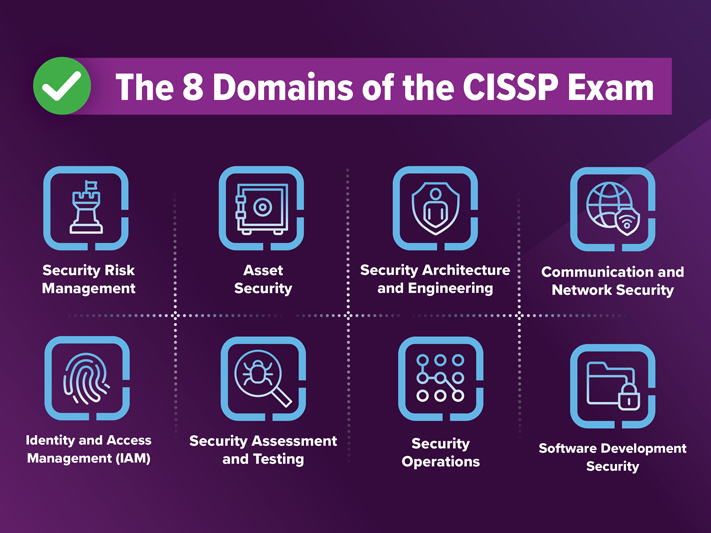
Security Risk Management
This domain encompasses the foundational principles, policies, approaches to risk assessment, and cybersecurity frameworks for governance, compliance, and ethical practices that underpin effective cybersecurity. They are based on the initialism “CIA” for confidentiality, integrity, and availability of your IT systems and data.
Asset Security
Your data, applications, and infrastructure are key digital operational assets that need protection. This domain is about classifying the assets, determining ownership, and ensuring the proper handling of data from its creation to eventual archiving or destruction. In short, it’s about defining who can access what and under what conditions.
Security Architecture and Engineering
Security needs to be designed into systems and technologies from the beginning. Cybersecurity techniques around cryptography, as well as both hardware and software architecture, must be considered at every step.
Communication and Network Security
In our connected world and with so much computing done in the cloud, the secure design and protection of networks is paramount. Defending data in motion requires firewalls, VPNs, network protocols, and communication channels that are kept secure.
Identity and Access Management (IAM)
Controlling access and managing the identity of systems and data users keeps threat actors out. This CISSP domain covers authentication, authorization, conditions of access, and levels of access. Recordkeeping and compliance are also vital in this area.
Security Assessment and Testing
Cybersecurity is a dynamic concept that constantly changes based on threats, techniques, and trends. This domain is about constantly checking and testing the effectiveness of your cybersecurity programs. It covers tools and techniques, how to conduct audits and penetration tests, and how to assess and respond to vulnerabilities.
Security Operations
This domain is composed of the everyday operations and tasks of running a cybersecurity program, including responding to incidents. Logging, monitoring, recordkeeping, and reporting play a part, as does responding to attacks, mitigating damage, and recovering to keep systems operating.
Software Development Security
Security that’s designed into all phases of software development is a must. Secure development practices, including secure coding, testing, and documentation, are part of software life cycle management.
Prepare for the CISSP Exam with Excelsior
Excelsior University’s Bachelor of Science in Cybersecurity program not only is academically rigorous, including hands-on experience, but also prepares you for the CISSP exam. What’s more, a bachelor’s degree in a relevant field could lower your experience requirement by up to a year. But earning your Excelsior degree prepares you for so much more than just a certification; you’ll be picking up the hard and soft skills necessary to build a successful career. And if you seek leadership positions within the field, you can transition seamlessly into Excelsior’s MS in Cybersecurity program.
Earning a degree from Excelsior opens the door to a wide array of job opportunities in the field of cybersecurity. And adding the CISSP credential takes you to another level. Contact Admissions when you’re ready to take the first step toward your dream career.
Excelsior University Celebrates 54th Commencement Ceremony
View photos from the ceremony here.
View b-roll video footage here.
ALBANY, N.Y. — Excelsior University celebrated its 54th Commencement and its 200,000th graduate on Friday, July 11 at 11 a.m. at the MVP Arena in Albany, New York. The Commencement ceremony brought together graduates of Excelsior’s online programs to commemorate their achievements in-person with University faculty and staff, family, friends, and supporters.
This year’s Commencement ceremony featured remarks from graduate speaker Natasha Arnold, a married mother of four and 20-year U.S. Army veteran who shared the story of her journey to earn her Bachelor of Psychology degree with the Class of 2025.
The event closed with the ceremonial passing of the Excelsior Alumni Torch from Excelsior Alumni Leadership Council members John Baldino and Sena Amegbletor to Class of 2025 graduate Jatik Gibbs-Judd. A poet, U.S. Navy veteran, and radiological control technician at Los Alamos National Laboratory in New Mexico, Gibbs-Judd rose from a childhood marked by homelessness and foster care to graduate magna cum laude with a Bachelor of Science in Nuclear Engineering Technology. He shared a short original poem to conclude Commencement.
The Excelsior Alumni Service Award was presented to Emmy-nominated broadcaster, writer, and public servant Benjamin Bryant. A 2006 Excelsior graduate, Bryant’s distinguished career in media, communications, and government service includes senior roles on high-profile task forces and commissions for the Department of Defense and the President of the United States. Bryant is a 2024 recipient of the Office of the Secretary of Defense Medal for Exceptional Public Service, the Department’s third highest non-career civilian award. He delivered the Commencement address to the Class of 2025.
Excelsior celebrates its diversity and global representation. The Class of 2025 includes 3,783 graduates from across the world. The graduates represent 49 U.S. states, the District of Columbia, Guam, and Puerto Rico, as well as 17 other nations spanning six continents. A total of 1,058 graduates are from New York state, including 94 from the Capital Region. The graduates range in age from 16 to 84, and the average age of the Class of 2025 is 35 years old. 35% of graduates are active-duty service members or veterans of the U.S. military, and 22 students earned more than one degree during the academic year. For more facts about Excelsior’s Class of 2025, view the Graduates at a Glance document.
“As our alumni community welcomes its milestone 200,000th graduate with the Class of 2025, we reflect on the determination, resilience, and passion for lifelong learning that these extraordinary individuals share,” said David Schejbal, president of Excelsior University. “Most Excelsior graduates are working adults balancing careers, families, and service with their education. They are putting their Excelsior degrees into practice immediately, making a positive impact on communities and workplaces around the world. We are proud to join their families and friends in celebrating the accomplishments of Excelsior University’s Class of 2025 today.”
The event was livestreamed for those unable to attend. The video and all Commencement information is available at excelsior.edu/commencement.
# # #
Media Contact Excelsior University:
Jason Bonafide, jbonafide@excelsior.edu
ABOUT EXCELSIOR UNIVERSITY
Excelsior University is an accredited, not-for-profit online institution focused on helping adults complete their degrees and advance their careers. Excelsior contributes to the development of a diverse, educated, and career-ready society by valuing lifelong learning with an emphasis on serving individuals historically underrepresented in higher education. Founded in 1971, Excelsior meets students where they are — academically and geographically — removing obstacles to the educational goals of adults pursuing continuing education and degree completion. Our pillars include innovation, flexibility, academic excellence, and integrity.
Excelsior University Honors the Legacy of Lt. Gen. Arthur J. Gregg with Building Naming and President’s Medal Ceremony
ALBANY, N.Y. – Excelsior University commemorated the life and service of the late Lt. Gen. Arthur J. Gregg, the U.S. Army’s first Black three-star general and a founding trustee of the University, with a ceremony today to officially dedicate Excelsior’s Albany headquarters as the Lt. Gen. Arthur J. Gregg University Center. Gregg was also posthumously awarded the Excelsior University President’s Medal at the event. The medal was accepted on his behalf by his daughter, Alicia Collier.
Gregg’s accomplished military career was recognized in 2023, when Fort Lee in Virginia was renamed Fort Gregg-Adams in honor of Gregg and Lt. Col. Charity Adams Earley. At the time, Gregg was the only living service member with a United States military installation named in his honor. With the recent news of the fort reverting to its original name, Excelsior University is proud to continue sharing Gregg’s story and celebrating his trailblazing accomplishments.
“In a life filled with achievements and accolades, Lt. Gen. Arthur Gregg’s most important legacy may be the example he set for those who did not see themselves represented in education, military leadership, or the boardroom,” said Excelsior University President David Schejbal. “His impact on Excelsior University, the armed forces, and the nation is immeasurable. We continue to honor his commitment to the power of service every day at the Lt. Gen. Arthur J. Gregg University Center as we fulfill Excelsior’s mission.”
Growing up in the segregated South, Gregg overcame discrimination to reach the upper echelons of the military. During his remarkable 35-year career with the U.S. Army, Gregg served as quartermaster general for Europe and deputy chief of staff for logistics for the Army. In 1966, he commanded one of the largest battalions in Vietnam, earning a Meritorious Unit Citation. His success in Vietnam pushed him to further advance his career by attending the U.S. Army War College. In 1977, Gregg became the first Black service member to achieve the rank of lieutenant general. The Army created the Lt. Gen. Arthur J. Gregg Sustainment Leadership Award in 2016 and honored its namesake as the first award recipient.
Gregg continued serving his country and community long after he retired from the Army. A lifelong proponent of higher education, Gregg was a strong supporter of Excelsior University for more than three decades, beginning under the institution’s early identity as a program of the New York State Board of Regents. Gregg began serving on the Regents College Board of Overseers in 1993, and was one of the five founding trustees of Regents College when it first received its charter to operate as the independent institution now known as Excelsior University. Gregg served as chair of the board of trustees from 1998 to 2004, was awarded chair emeritus in 2007, received an honorary degree in 2012, and continued to actively support the institution for many years.
Gregg died at the age of 96 in August 2024. Excelsior University established a scholarship fund in his memory, which supports military students with scholarships granted through the Lt. Gen. Arthur J. Gregg Fund for the Advancement of Military and Veteran Education. Learn more about the scholarship fund at https://www.excelsior.edu/giving/in-memory-of-arthur-gregg.
# # #
Media Contact Excelsior University:
Jason Bonafide, jbonafide@excelsior.edu
ABOUT EXCELSIOR UNIVERSITY
Excelsior University is an accredited, not-for-profit online institution focused on helping adults complete their degrees and advance their careers. Excelsior contributes to the development of a diverse, educated, and career-ready society by valuing lifelong learning with an emphasis on serving individuals historically underrepresented in higher education. Founded in 1971, Excelsior meets students where they are — academically and geographically — removing obstacles to the educational goals of adults pursuing continuing education and degree completion. Our pillars include innovation, flexibility, academic excellence, and integrity.
Why Your Career in Computer Technology Starts with an Associate Degree
Employment in computer technology careers is expected to grow faster than the average over the next decade, offering not just jobs, but resilient and purpose-driven vocations. If you’re considering a new career path, whether you’re just starting out or looking to shift to something more future-focused, computer technology is worth a serious look. From solving everyday tech problems to helping secure vital systems, this field touches nearly every industry, offering opportunities to grow, specialize, and make a meaningful difference.
Whether you’re brand new to IT or transitioning from another field, an associate degree in computer technology gives you a solid foundation. It helps you acquire the skills employers need today while preparing you for future learning and advancement in the fields of information technology and computer science.
Why Start with an Associate Degree in Computer Technologies?
An associate degree in computer technologies is more than just training in tech; it’s a practical starting point for a wide range of careers, from cybersecurity and health care IT to data analytics. Today’s programs are built with input from industry leaders and aligned with in-demand skills, so you’re not just learning what’s current—you’re learning what’s relevant.
But technical skills aren’t the whole picture. Today’s tech professionals are also expected to think critically about the ethical and social impacts of their work. Understanding topics like AI bias, data privacy, and responsible system design is becoming just as important as knowing how to write code or configure a network.
Associate Degree in Computer Technology vs. Boot Camp
Coding boot camps can be fast and focused, but they often leave out the broader understanding that helps professionals adapt and grow over time. An associate degree provides a deeper, more balanced approach. You’ll build technical knowledge and critical thinking skills. Plus, a degree often carries more weight with employers and can open doors to promotions or certifications down the line.
Associate vs. Bachelor’s
A bachelor’s degree offers a wider range of opportunities, especially at the midcareer level, but starting with an associate degree helps you get working faster. In many cases, you can finish in under two years, start earning income, and then continue your education with a clear path forward. Many associate programs are designed with transfer in mind, so your credits can count toward a bachelor’s degree later on.
Computer Technology Jobs You Can Get with an Associate Degree
There’s no one-size-fits-all path in tech, and that’s a good thing. With an associate degree, you can pursue entry-level roles that let you build experience, explore specialties in information technology or computer science, and grow into more advanced positions.
Some common roles include:
Computer service technician. In this role, you would help diagnose and repair hardware and software issues in desktops, laptops, and mobile devices. These professionals often work directly with users to troubleshoot problems, replace components, and keep systems running smoothly.
Software technician. The primary duties of software technicians include assisting with installing, configuring, and maintaining software across devices or departments. In this role, you would support software updates, manage compatibility issues, and help ensure systems stay up to date and secure.
Computer specialist. In this role, you would provide general IT support across systems, software, and devices. In addition, you may manage user accounts, support equipment setup, or help troubleshoot a wide range of tech issues for individuals or teams.
Technical support analyst. These tech professionals troubleshoot more complex issues involving software, hardware, and networks. This role often involves remote support, ticketing systems, and diagnostic tools to resolve problems efficiently and keep systems online.
Network support technician. In this role, you would maintain secure and reliable networks for businesses, schools, or nonprofit organizations. Your responsibilities might include setting up routers, monitoring network performance, or assisting with cybersecurity basics like firewalls and access controls.
6 Key Skills You’ll Need for a Career in Computer Technology
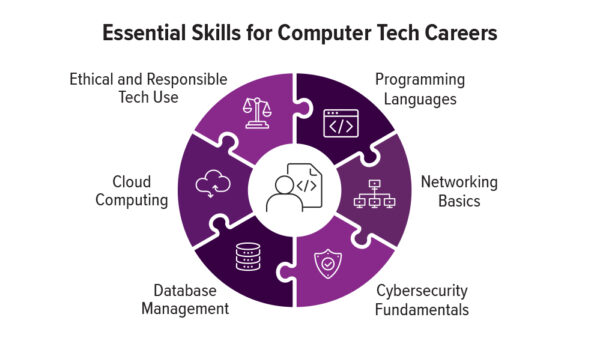
The field of computer technology calls for more than just knowing how to code. The following six skills are essential to getting started and growing in a tech career:
Programming languages. Learning languages like Python or Java helps you understand how software works and how to make computers do what you want them to do.
Networking basics. Knowing how data moves and how systems connect is core to most IT roles.
Cybersecurity fundamentals. With so much at stake, being able to identify and fix security risks is a critical part of almost any tech job.
Database management. From customer information to internal records, nearly every business runs on data. Understanding how it’s stored and accessed is a valuable skill.
Cloud computing. Today’s systems increasingly run in the cloud. Knowing how to work with platforms like AWS or Azure helps you stay current.
Ethical and responsible tech use. Good tech work means thinking beyond the screen. Can users trust the system you built? Is it fair? Is it secure? These questions matter, and students who can engage with them thoughtfully stand out. Whether you’re building a network for a school district or configuring cloud services for a hospital, understanding the broader impact of privacy, accessibility, and fairness, as well as your technical choices, makes you a more thoughtful and trusted professional.
Why Start Your Career in Computer Technology with Excelsior University?
Excelsior University’s AAS in Computer Technologies program is designed for working adults and career changers who require flexibility without compromising on quality. You’ll get real-world scenarios, hands-on practice, and a program built around the skills employers care about.
Even better—this associate degree isn’t a dead end. It’s a direct pathway into Excelsior’s bachelor’s program in information technology, cybersecurity, or computer science. Your credits transfer seamlessly, so when you’re ready to take the next step, you won’t have to start over. You can keep building on what you’ve already accomplished.
Additionally, new tuition scholarships can reduce the program’s cost to as little as $350 per credit, making it one of the more affordable, high-quality options available. And you may be eligible to receive credit for specific industry certifications, like some offered through our partner MedCerts, which can help you gain workforce skills and earn your degree sooner.
Ready to Take the First Step?
Whether you’re returning to school, switching to a career in computer technology, or just starting out, Excelsior’s associate degree in computer tech gives you the tools and the support to take your next step with confidence. Explore the AAS in Computer Technologies program or reach out to one of our friendly admissions counselors with your questions.
