Keywords are often treated as a technical requirement, but they serve a practical purpose. They are the terms employers use to define roles and evaluate candidates across job descriptions and hiring systems. If your resume and cover letter do not reflect that language clearly, your experience can be overlooked. Using resume keywords effectively is not about adding more words. It’s about choosing the right words to describe your experience so employers can quickly understand your fit during a job search.
Cover Letter and Resume Keywords
Your resume and cover letter serve different purposes, but both rely on the same underlying language. Resume keywords are specific words or phrases that describe the skills, tools, and responsibilities required for a role. Employers use these terms to define expectations, and applicant tracking systems use them to sort and rank applications before a recruiter reviews them.
For example, a business role may include “data analysis,” “reporting,” and “process improvement,” whereas a health care role may include “patient care,” “clinical documentation,” and “care coordination.” These keywords reflect how work is performed in that field and signal what employers expect from candidates.
Resume keywords matter because they help applicant tracking systems identify relevant candidates and allow hiring managers to quickly assess alignment. Your cover letter should reinforce those keywords by showing how you have applied them in a specific situation. If a keyword is not supported with clear evidence from your experience, it creates a gap between what you claim and what you can demonstrate.
Choose from more than 40 flexible, career-focused degree programs at Excelsior University.
Learn More
Get Started at Excelsior University
Optimizing with the Best Keywords
Optimizing your resume and cover letter starts with identifying keywords that reflect your target role and then confirming they match your experience.
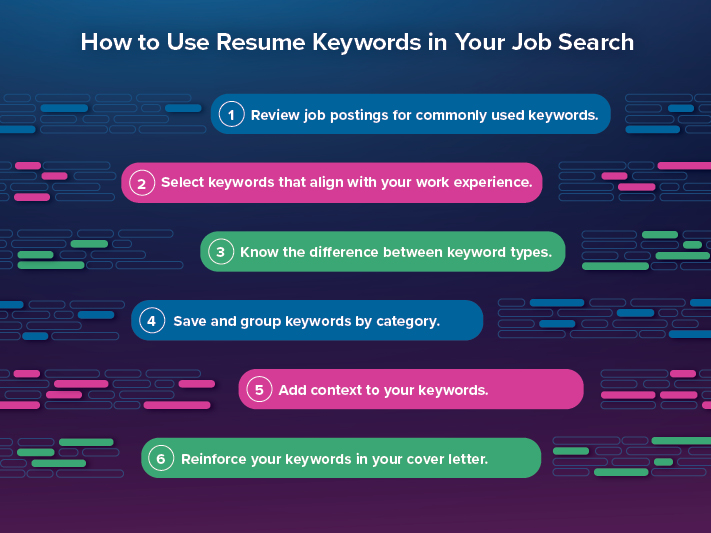
Review multiple job postings within the same occupation:
Similar roles use similar resume keywords.
For example, project coordinator roles often include “scheduling,” “budget tracking,” and “stakeholder communication.”
These patterns show how employers define the role.
Keep a running list of keywords:
Save commonly used terms across roles in your field.
Group them into categories such as technical skills and interpersonal skills.
This saves time and creates consistency across your job search.
Understand the difference between keyword types:
Hard skills are technical and measurable, such as “data analysis,” “Excel,” or “patient documentation.”
Soft skills describe how you work, such as “communication,” “team collaboration,” or “problem solving.”
Validate keywords before using them:
Only include resume keywords that accurately reflect your experience.
Use the same language as the job description when it accurately reflects your experience.
Avoid substituting similar terms, as different wording may not be interpreted the same way.
Be prepared to explain each keyword with a specific example.
Use resume keywords with context:
Do not list keywords without showing how they were applied.
Pair each keyword with a specific action or outcome.
Example: “Analyzed monthly sales data to identify trends and improve forecasting accuracy.”
This demonstrates the keyword “data analysis” by showing how it was applied rather than simply stating it.
Use your cover letter to reinforce keywords:
Select one or two key terms and explain how you applied them in a specific situation.
Focus on why the experience matters and how it connects to the role.
Use the same language as your resume but provide additional detail rather than repeat it.
Strong resume keywords improve visibility, but accuracy and clarity are what make them effective. When your resume demonstrates the skill and your cover letter explains how it applies to the role, your application becomes clearer and more credible during a job search.
Level Up the Education Section of Your Resume with Excelsior
Your education section can do more than list a degree. It can reinforce your experience by highlighting relevant coursework, certifications, and applied learning that connect to your target role.
When structured intentionally, this section reinforces the skills and knowledge already presented throughout your resume. For example, coursework in data analytics, project management, or health care systems can strengthen how you present your experience when it is clearly tied to what you have done or are prepared to do.
Excelsior University’s career-focused programs are designed with workforce relevance in mind. That makes it easier to translate what you have learned into language that aligns with employer expectations.
Excelsior also offers Career Readiness resources to help you refine your resume, strengthen your cover letter, and approach your job search with a clear and focused strategy.
ALBANY, N.Y. – As National Nurses Week begins, Excelsior University is proud to announce a major gift from the Massry family to support Capital Region nursing students serving the community. Massry’s $25,000 donation will fund scholarships for Excelsior nursing students completing their in-person clinical training at Albany Med Health System. The scholarships are available for immediate use for Excelsior students residing in the Capital Region.
“We are thrilled to support the nursing program at Excelsior University, and the relationship with Albany Medical Center deepened our interest in supporting this particular venture,” said Julie Massry Knox. “This partnership reflects our commitment to expanding access to education and ensuring that talented nurses are prepared—and inspired—to build their careers here in Albany.”
“Excelsior University has been a valued partner in developing the next generation of nurses, and we are proud to work alongside them to strengthen the nursing workforce. The support from the Massry family is a meaningful investment in our nursing students and helps remove barriers as they complete their clinical training within the Albany Med Health System,” said Megan Keenan, DNP, MSN, RN, CPHQ, vice president and chief nursing officer for Albany Medical Center. “We have consistently been impressed by the dedication, professionalism, and readiness of Excelsior nursing graduates, and many have gone on to make important contributions across our organization. Together, partnerships like this help support our vision to be the first choice for patient experience, quality, and clinical excellence.”
“The Massry family’s generous contribution eliminates barriers for local students ready to serve our community in rewarding nursing careers,” said Robin Goodrich, EdD, RN, Purnell executive dean of Excelsior’s College of Nursing and Health Sciences. “Excelsior University is grateful for the partnership of the Massry family and the Albany Med Health System as we work together to educate the Capital Region healthcare leaders of tomorrow.”
With more than 500 Associate Degree in Nursing students passing the National Council Licensure Examination (NCLEX) to become registered nurses in 2025, Excelsior University is bringing more nurses into the New York state workforce annually than any other institution.
For more information on Excelsior University, visit www.excelsior.edu.
ABOUT EXCELSIOR UNIVERSITY Excelsior University is an accredited, not-for-profit online institution focused on helping adults complete their degrees and advance their careers. Excelsior contributes to the development of a diverse, educated, and career-ready society by valuing lifelong learning with an emphasis on serving individuals historically underrepresented in higher education. Founded in 1971, Excelsior meets students where they are — academically and geographically — removing obstacles to the educational goals of adults pursuing continuing education and degree completion. Our pillars include innovation, flexibility, academic excellence, and integrity.
Excelsior is a not-for-profit university with a main campus in Albany, New York, and an educational site in St. Petersburg, Florida. Excelsior University’s academic programs are registered by the New York State Education Department, with additional licensing for Florida-based programs.
Licensed by the Commission for Independent Education, Florida Department of Education (License No. 12928). Additional information regarding this institution may be obtained by contacting the Commission at 325 West Gaines Street, Suite 1414, Tallahassee, FL 323099-0400, toll-free number: (888)-224-6684.
Being a business professional means dealing with a new challenge every day, having the confidence to make quick decisions, and taking bold action that gets results, all while managing a team and keeping your eye on the bottom line. But where do you go when you’ve already mastered the daily grind but find yourself craving something deeper? What do you do when you aren’t just looking to manage a business, but to redefine how it operates?
You earn your DBA.
A Doctor of Business Administration (DBA) degree program is designed for the professional practitioner and gives executives the skills to connect theory, research, and strategy to real solutions. For the right person, it’s the added alchemy that elevates your mindset, leadership, and career.
What Do You Need to Enroll in a DBA Program?
In addition to tenacity, curiosity, and a willingness to be challenged, DBA programs typically require candidates to have a few standard qualifications to enroll. First, you’ll need to submit transcripts verifying that you’ve earned a master’s degree. Because DBA programs are geared toward seasoned business leaders, you’ll likely need to submit a resume demonstrating your management experience and professional background. Selective programs may also require letters of recommendation, a personal statement, and a portfolio of professional written materials with your application.
Make your next big move. Earn your Doctor of Business Administration at Excelsior.
Learn More
Get Started at Excelsior University
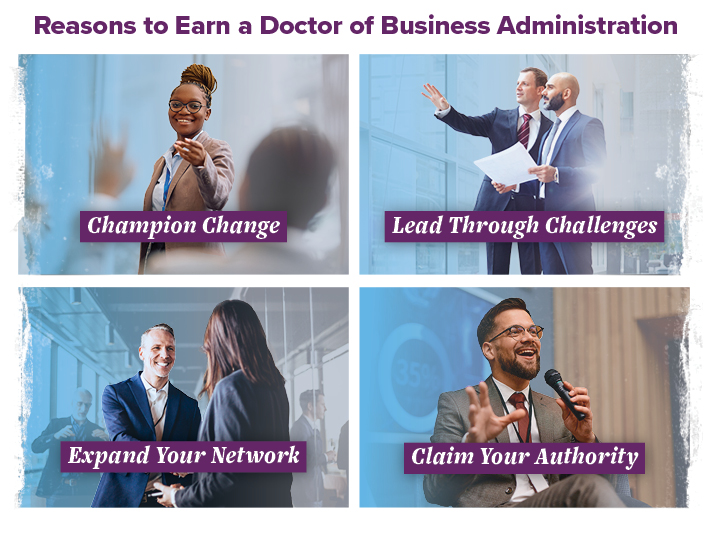
4 Reasons to Earn a DBA Degree
Whatever motivates you, you’ll find that stronger leadership skills, a larger network, and higher-level strategic ability aren’t just reasons to earn your doctorate—they’re at the core of the DBA experience.
Champion Change
A DBA degree program is rigorous, but the research you do is never a purely academic exercise. Throughout your program, you’ll develop workable methodologies in real time that shift you from a consumer of business trends to a creator of sustainable change that succeeds from all angles.
Lead Through Challenges
The challenges a modern leader faces are ambiguous, interconnected, and ever evolving. When there is no established playbook, a DBA equips you with strategies you can tailor to your leadership style that help you guide your business through challenges with nuance, ethics, and confidence.
Expand Your Network
Whom you earn your DBA with can be just as impactful as the degree itself. DBAs attract a diverse group of students, and the collaborative nature of the program means that diversity of knowledge and experience becomes your own. You’ll graduate with not only your doctorate but also potential mentors, business partners, and lifelong professional contacts.
Claim Your Authority
Whether you’re a consultant, an entrepreneur, or a part of a large organization, earning your DBA shows the world that you have the credentials and the credibility to back up your recommendations and decisions. It’s an achievement that earns you a seat at any table.
What Can You Expect in a DBA Degree Program?
A DBA is an experiential degree, which means that part of your work will be applying what you’re learning to the professional world. Most DBA programs include short, in-person residences where you can collaborate with your program peers, present and receive feedback on your research, and meet one-on-one with faculty. In addition to your dissertation, which you’ll work on from the start of the program, DBA courses are focused on a few core study areas, with opportunities for you to concentrate on specific areas that support your goals.
Core Study Areas
You can expect the core of DBA study to expand on the skills learned in your master’s program and help you build a holistic view of organizational strategy and leadership with courses that can examine:
Business theory
Consulting
Strategic development
Financial management
Marketing
Concentrations or Areas of Focus
Choosing one or multiple concentrations can help develop your areas of professional interest and enhance your doctoral research. Concentrations in a DBA degree program often focus on a specific industry like cybersecurity, health care, or finance, or a facet of business management like data analytics, sustainability, or leadership strategy.
Excelsior’s Doctor of Business Administration Program
Excelsior University’s DBA program empowers you to create the change you want under the expert mentorship of our faculty, who are experienced scholar-practitioners themselves.
Designed for maximum flexibility for working professionals, you’ll collaborate with a diverse residency group of your fellow students both online and during two weeklong in-person residencies that focus on refining your dissertation. You may choose between two formats for your dissertation: designing a considered solution for an organization or writing three interconnected papers addressing an aspect of your research focus.
Although the prestige of adding “Dr.” to your email signature is a definite perk, the lasting value of earning this doctorate is the confidence with change, challenge, and critical thinking that only a DBA can impart. It’s about leaving a legacy that others notice immediately and that you feel forever.
Are you ready to take the next step in the evolution of your leadership? Start exploring Excelsior’s DBA program.
ALBANY, N.Y. – Excelsior University is partnering with CDPHP® for the third year in a row to celebrate National Nurses Week. New this year, CDPHP will be joined by co-sponsor Community Care Physicians (CCP). Held annually from May 6–12, National Nurses Week is an opportunity to highlight the stories of America’s nurses and thank them for their service and dedication.
Support from CDPHP and CCP will help underwrite scholarships for students in Excelsior nursing programs. In addition, CDPHP and CCP will partner with the University to host a panel discussion titled “Empowerment in Action: The Power of Nursing.” Presented by Excelsior University’s Advancement team in collaboration with CDPHP and CCP, the free online panel discussion will explore the role of nurses in shaping the future of healthcare.
“Empowerment in Action: The Power of Nursing” will be moderated by Excelsior University School of Nursing Dean Diane Pytlik-Flammia, DHA, MSN, RN, and feature the following healthcare leaders as panelists:
Megan Keenan, DNP, MSN, RN, CPHQ, vice president and chief nursing officer for Albany Medical Center, part-time Excelsior faculty member and Excelsior alumna
Rachel Garrett, RN, CLNC, CCH, clinical practice manager at Burnt Hills Pediatrics and Internal Medicine for CCP
Nancy Phelan, RN, CCM, care management supervisor of the Hospital to Home program for CDPHP
Excelsior will share the panel discussion recording on May 8 on its YouTube channel and via email with alumni and students from Excelsior’s nursing and allied health programs.
“CDPHP is proud to once again support Excelsior University’s Nurses Week,” said Jennifer Cassidy, director of corporate giving at CDPHP. “As a health plan committed to improving health outcomes, we recognize nurses as essential to high-quality, coordinated care. Supporting the nursing workforce reflects the ongoing CDPHP commitment to building a healthier, more connected community.”
“Nurses are essential at every point in care—from our practices to our central programs, education, and leadership—and their impact extends far beyond the exam room. At Community Care Physicians, we see firsthand how critical it is to support and grow this workforce,” said Kathleen Mattice, BSN, RN, senior vice president of clinical operations at CCP. “This partnership with Excelsior University and CDPHP, which expands access to nursing education, helps strengthen the future of care in our communities.”
“Excelsior University is grateful for the generous support of our community partners at CDPHP and CCP,” said Diane Pytlik-Flammia, dean of Excelsior University’s School of Nursing. “This collaboration reinforces our shared commitment to nursing education and to preparing the next generation of highly skilled nurses. Together, we are expanding access to educational resources that support student success and strengthen the nursing workforce in the Capital Region and throughout the country.”
For more information on Excelsior University, visit www.excelsior.edu.
ABOUT EXCELSIOR UNIVERSITY Excelsior University is an accredited, not-for-profit online institution focused on helping adults complete their degrees and advance their careers. Excelsior contributes to the development of a diverse, educated, and career-ready society by valuing lifelong learning with an emphasis on serving individuals historically underrepresented in higher education. Founded in 1971, Excelsior meets students where they are — academically and geographically — removing obstacles to the educational goals of adults pursuing continuing education and degree completion. Our pillars include innovation, flexibility, academic excellence, and integrity.
Excelsior is a not-for-profit university with a main campus in Albany, New York, and an educational site in St. Petersburg, Florida. Excelsior University’s academic programs are registered by the New York State Education Department, with additional licensing for Florida-based programs.
Licensed by the Commission for Independent Education, Florida Department of Education (License No. 12928). Additional information regarding this institution may be obtained by contacting the Commission at 325 West Gaines Street, Suite 1414, Tallahassee, FL 323099-0400, toll-free number: (888)-224-6684.
Scott Dolan, executive dean of Excelsior University’s College of Liberal Arts and Sciences, contributed to a Forbes Nonprofit Council article titled “Balancing Firm Values And Strong Results: Tips For Nonprofit Leaders.” Dolan discusses the importance of keeping an organization’s values in mind and encouraging open discussion while making difficult decisions.
Successful mechanical engineering technology careers require that you have a foundation in technical, practical, and general knowledge disciplines. Mechanical engineering technology, or MET for short, requires that you have theoretical knowledge as well as hands-on skills when it comes to designing, analyzing, and effectively maintaining mechanical systems. Mastery of mechanics, thermodynamics, materials science, computer-aided design, and manufacturing processes will support you as you graduate to work in real-world engineering environments. A career in MET is one that is challenging and one that will keep you engaged as it rapidly evolves globally.
What Is Computer-Aided Design?
Being able to effectively use computer-aided design, or CAD, is intrinsic to the field of mechanical engineering technology. When you master it, you’ll be able to render two-dimensional and three-dimensional models of mechanical systems and their components. CAD software powers visualization, simulation, testing, and modifications of parts and processes before you invest time, money, and materials into physically producing them.
CAD encompasses a variety of applications, including:
SolidWorks for 3D modeling and assembly simulation, as well as for testing functions, tolerances, manufacturability, and more
AutoCAD for drafting, making schematics, and creating detailed engineering drawings
PTC Creo for parametric and direct modeling of complex part assemblies and for simulation preproduction
Siemens NX for designing products, simulations testing, and manufacturing integration
CATIA for mechanical engineering in the aerospace and automotive industries
Autodesk Fusion, a cloud-based solution, for facilitating collaboration and fast prototyping
Build a better career with a BS in Mechanical Engineering Technology from Excelsior University.
Learn More
Get Started at Excelsior University
What Else Do You Need to Learn?
To grow and thrive in an MET career you need more than just CAD skills. You must learn the fundamental principles across a variety of areas of applied science, and you’ll need to master their practical application in real-world solutions. As you study how to become a mechanical engineering technologist, you will cover various fields such as:
Thermodynamics
This branch of physics studies how energy is transferred in mechanical systems to perform work. You’ll need to know the ins and outs of heat engines, refrigeration cycles, and the safe and efficient use of energy. Real-world applications include HVAC systems, power generation, and various types of engines. You must be equipped to design around functionality, reliability, efficiency, and sustainability.
Material Science
This area covers the study of the characteristics, behaviors, and uses of metals, polymers, ceramics, and composites. You’ll learn how stress, temperature, and fatigue affect materials in engineering applications. In the real world, this knowledge affects choice of materials, failure mode predictions, and durability in use. Materials are the cornerstone of manufacturability, product performance, and safety.
Fluid Mechanics
Liquids and gases perform differently in motion and at rest. This area of study encompasses concepts like flow, pressure, viscosity, turbulence, cavitation, and how fluids interact with structures in pumps, pipelines, HVAC systems, and hydraulics. You’ll learn how the science of fluid mechanics affects performance or leads to system failures. Designing and manufacturing products that are durable and energy-efficient is the goal.
Electrical Theory
You need to master the theories behind electrical circuits, the distribution of power, and control systems in mechanical applications that use electricity. You’ll learn to apply voltage, current, resistance, and the principles of electromagnetics to designing, testing, and perfecting motors and automation systems, to name a few. Electrical theory is essential in creating modern machinery and smart, connected technologies.
Manufacturing Processes
Transforming raw materials into efficient and functional products is the very definition of manufacturing. In industrial applications, machining, casting, 3D printing, welding, and quality control techniques are all part of the process. You’ll learn how to optimize product and process design for manufacturability in ways that are resource-efficient and cost-effective, aiming for zero defects or rework. You’ll apply technical and practical knowledge in creating processes for products that consistently meet specifications economically.
Start Your Career in Mechanical Engineering Technology with Excelsior
Mechanical engineering technology is a wide field with innumerable and exciting career paths. Excelsior University’s BS in Mechanical Engineering Technology program provides you with both essential and practical knowledge of mechanics, CAD, thermodynamics, fluid and materials sciences, and manufacturing processes. From a foundation in basic principles, the program prepares you for real-world roles in aerospace, energy, robotics, biomechanics, manufacturing, and more. Plus, you can tailor your education with one of three in-demand concentrations: Nuclear Engineering, Renewable Energy, or Robotics.
The program is 100% online with courses starting every eight weeks, making it ideal if you’re a working professional or if you need to balance your studies with other obligations. Excelsior supports you with programs that keep you on track to successful program completion, and our Career Readiness resources can help you explore MET career paths, build professional skills, and connect with employers through resources, events, and practical guidance.
Excelsior University is here to help you gain the knowledge and skills to launch or advance your career in mechanical engineering technology. Reach out to our Admissions team today to take the first step toward the future you want.
Scott Dolan, executive dean of Excelsior University’s College of Liberal Arts and Sciences, contributed to a Forbes Nonprofit Council article titled “Nonprofit Leaders On Innovative Revenue Models For Uncertain Times.” Dolan discusses nonprofit organizations collaborating to form strategic partnerships that can promote growth while sharing infrastructure and risk.
Python is the go-to programming language of developers worldwide. It’s easy for humans to read and understand, and it can be used across a wide range of applications, like web development, automation, data analysis, and even artificial intelligence. The popularity of Python coding has fostered an active support community and has driven the creation of rich libraries of prewritten code modules that speed development. If you’re considering a career in software development, learning Python is an essential first step.
Why Is Python Important?
The fast growth and widespread use of the Python programming language is no accident. These characteristics have propelled its adoption across industries and applications:
Readability: Python’s syntax is almost as easy to read as plain English, which makes coding easier, reduces the number of errors, and facilitates debugging.
Flexibility: It is one of the most versatile programming languages in the world. Developers in AI and machine learning, web and mobile apps, data analytics, and automation use it.
Easy integration: You can use Python with a variety of other common programming languages, like C, Java, and JavaScript, making it practical when you need interoperability.
Extended ecosystem: An active and supportive developer community helps you learn and use this programming language. A vast library of prewritten code modules makes adding common functions fast and easy without having to write code from scratch.
Explore a career in programming with a degree in computer science from Excelsior University.
Learn More
Get Started at Excelsior University
What Can You Use Python For?
Python’s capabilities as a programming language offer tools for developers, along with libraries and community support. You can use it to create a wide variety of projects and domains. It started out as a hobby project and got its name from the British comedy Monty Python’s Flying Circus. Dutch developer Guido van Rossum, who created Python, wanted a name that was short, playful, and memorable. From its roots in simple automation, scripting, and text processing, it has grown to dominate the following fields:
Web Development
Python is ideal for quickly creating scalable, secure, feature-rich, and well-structured websites. Frameworks like Django and Flask help developers organize its code and access libraries of Python-built tools and conventions.
Machine Learning
Python dominates machine learning, artificial intelligence, and large language models. It’s the language of libraries like PyTorch, scikit-learn, and TensorFlow that developers use to build predictive models, implement complex algorithms, and train AIs.
Data Science
Tools for manipulating data, cleaning data sets, and performing advanced analytics are typically created with Python. Pandas, NumPy, and Matplotlib are some of the more well-known examples.
Application Development
Python speeds the efficient development of desktop and mobile apps. Simple and extensive libraries make it easy for developers to create user-friendly and bug-free software. From simple utilities to full-featured programs, it’s the practical choice.
Scripting and Utility Software
This is where Python got its start. Developers found it to be easy to use to quickly and simply automate repetitive tasks and basic utilities. Python handles file management, system administration and monitoring, batch processing, and more.
Learn Python and Start Your Career with Excelsior
Python is an essential modern programming language. Mastering its capabilities opens the door to exciting technology careers in fast-growing fields.
Developing your Python skills is part of earning a BS in Computer Science at Excelsior University. The comprehensive program balances the technical elements of programming, algorithms, data structures, and software development with liberal arts courses in areas like English composition, humanities, and social and natural sciences that help you with critical thinking, communication, and analytical skills necessary for a well-rounded education and a successful career.
Beyond the classroom, Excelsior is known for supporting adult learners and working professionals with 100% online courses. Extensive student support and career readiness resources help you balance your responsibilities with your studies and then apply your education toward your professional goals. Excelsior University can help you launch or advance a rewarding and growth-oriented career. Start your journey today and learn why you belong at Excelsior.
A question I hear quite often from prospective students, alumni, and industry partners today is both timely and understandable: Is getting an MBA still worth it in the age of artificial intelligence (AI)? My answer is an unequivocal yes! A Master of Business Administration is not only worth it; it is more valuable now than ever. However, the reasons why an MBA is worth it are evolving.
The AI era is not diminishing the MBA—it is clarifying its purpose. Many universities that had seen a decline in MBA enrollments since 2024 are seeing a resurgence. At first, this may seem counterintuitive, but that does not reflect market realities.
The market reality hitting nearly every industry is that AI is transforming how work gets done. Routine analysis, data processing, and even elements of decision support are increasingly automated. This means that entry-level tasks that have been the very foundation of many traditional career ladders are being reshaped or eliminated altogether. Yet this shift reveals something critical: As AI expands, the value of human judgment increases. Some examples of this include:
AI can generate insights, but it cannot define purpose.
AI can optimize decisions, but it cannot own consequences.
AI can process data, but it cannot lead people to respond to the information derived from processed data.
Emerging evidence suggests that AI will disproportionately impact early-career roles, while managerial and leadership roles will remain more resilient and increasingly important. MBA programs prepare students for these critical leadership roles of the future. The central paradox of the AI era is that the more powerful AI technology becomes, the more essential human leadership becomes.
The Value of an MBA
There is a misconception that the Master of Business Administration is primarily about acquiring business knowledge in a respective business domain (leadership, human resources management, finance and accounting, marketing, etc.). However, that was never its true value. The real value of an MBA lies in three enduring capabilities:
Strategic thinking under uncertainty. AI thrives on patterns from the past. Leaders must make decisions about the future. MBA programs develop frameworks that allow individuals to navigate ambiguity, assess risk, and make high-stakes decisions.
Integration across disciplines. Organizations are not spreadsheets; they are complex systems of people, incentives, markets, and constraints. MBA graduates learn to integrate across functions, where they connect finance to strategy, operations to customer experience, and technology to value creation.
Leadership and accountability. Perhaps most importantly, MBA graduates are trained to lead. Not to manage tasks, but to guide people, shape culture, and assume responsibility for outcomes.
As one 2020 analysis noted, the enduring value of the MBA lies in developing leaders who can integrate technology, people, and strategy while making decisions under uncertainty. These are not skills that AI replaces. They are skills that AI amplifies.
Claim your spot in leadership with an MBA from Excelsior University.
Learn More
Get Started at Excelsior University
Is an MBA Worth the Cost?
Let us address the most practical question: Is the MBA financially worth it? The data remains compelling. According to the Graduate Management Admission Council, the median salary for MBA graduates in the U.S. is approximately $125,000, compared to about $75,000 for bachelor’s degree holders. Many programs report opportunities for salary increases within a few years of graduation.
Even more telling, employers continue to value the degree. Surveys indicate that a majority of corporate recruiters still view full graduate business degrees as more effective than short-form credentials for long-term success. Yes, costs matter. Yes, return on investment varies by program and career path. But the fundamental economic signal has not changed: An MBA remains one of the most reliable pathways to upward mobility and leadership-level compensation.
How AI Is Changing the Business World
The more important question is not whether the MBA is worth it, but whether the right kind of MBA is worth it. Modern MBA programs are evolving rapidly in response to AI. At Excelsior University, and across forward-thinking institutions, we are seeing three major shifts.
1. AI Literacy as a Core Competency
Students are no longer expected to become data scientists. However, they need to understand how AI works, where it creates value, and where it introduces risk. AI is becoming a decision support tool, and leaders must know how to interpret its outputs, question its assumptions, and apply its insights responsibly. They must do so while remembering they are ultimately responsible for presenting their own conclusions, authority, and authorship of decisions made. AI does not create a loophole for avoiding being a subject matter expert.
2. Emphasis on Human Skills
As technical tasks become automated, human capabilities become differentiators. These capabilities include communication, ethical reasoning, change leadership, cross-functional collaboration, and being a champion for the inclusion of diverse ideas and voices. These are not “soft skills.” They are strategic capabilities in an AI-enabled economy.
3. Applied, Experiential Learning
The best MBA programs are moving beyond theory. They are immersing students in real-world problems, which often involve AI integration, digital transformation, and organizational change. This is critical because in the AI era, knowing is not enough. Leaders must apply, adapt, and execute.
The Future of Business Belongs to AI-Augmented Leaders
The future does not belong to those who compete with AI. It belongs to those who lead with AI. Think of them as AI-augmented leaders. This is where the Master of Business Administration becomes uniquely powerful. An MBA graduate in today’s environment is not simply a business generalist. They are:
A translator between technical teams and executive leadership
A strategist who understands both data and context
A decision-maker who balances analytics with judgment
A leader who can align people around change
In other words, the MBA prepares individuals to become AI-augmented leaders. These are the professionals that organizations are actively seeking. They are the individuals who can harness AI not only to improve efficiency but also drive innovation and growth.
The Underappreciated Benefits of an MBA
One of the most overlooked benefits of an MBA is not immediate salary—it is career optionality. In a rapidly changing economy, the ability to pivot matters. An MBA provides access to multiple industries (consulting, health care, tech, finance), flexibility to move into leadership roles, and a credential recognized across sectors and geographies. Even in a shifting job market, MBA employment outcomes remain relatively strong, with employment rates around 85% within three months of graduation. More importantly, MBA graduates are increasingly being hired into emerging fields, even AI-driven industries themselves.
There is one aspect of the MBA that AI cannot replicate: human networks. Business is fundamentally relational. Opportunities often emerge not from applications but from connections. An MBA provides access to peer networks of high-performing professionals, faculty mentorship, alumni communities, and industry connections. These networks compound over time. They open doors, create partnerships, and accelerate careers in ways that no algorithm can replicate. In an increasingly digital world, trusted human relationships become more, not less, valuable.
A follow-up to the main question is, In what situations is an MBA not the right choice? An honest answer requires some nuance. An MBA is not universally the right path for everyone. If your goal is deep technical specialization in AI or machine learning, immediate entry into highly technical roles, or low-cost or short-term skill acquisition, then alternative pathways, such as a specialized master’s degree or certification, may be more appropriate. (Excelsior University can help with some of those paths, as well.) However, if your goal is to lead teams and organizations, transition into management, influence strategy and decision-making, and build long-term career mobility, then the MBA remains one of the most effective investments you can make.
MBA: A Degree in Leadership
A final perspective worth noting is that the MBA is really a leadership degree. This shift in thinking took time to set and, in part, contributed to periods of weakened MBA enrollments as prospective students questioned the return on investment and relevance of traditional business education. However, recent trends indicate a renewed recognition of the MBA’s core value, not as a purely technical or functional credential, but as a developmental pathway for leadership in increasingly complex and dynamic environments.
Now that this shift is more fully realized, the MBA is no longer just a business degree; it is a leadership degree for a complex, technology-driven world. Organizations today operate in conditions characterized by volatility, uncertainty, complexity, and ambiguity (VUCA), requiring leaders who can synthesize information, make decisions under uncertainty, and guide organizations through continuous transformation. MBA programs are uniquely positioned to develop these capabilities by integrating strategic thinking, cross-functional decision-making, and leadership development into a cohesive learning experience.
AI will continue to evolve. Industries will continue to change. Roles will continue to be redefined. But organizations will always need individuals who can make sense of complexity, align people around a vision, make decisions when outcomes are uncertain, and very importantly, take responsibility for results. That is what MBA programs are designed to develop.
Returning to the primary question, Is getting an MBA worth it in the AI era? Yes! But not because it teaches you what AI already knows. Rather, it develops what AI cannot become: a leader. The Master of Business Administration prepares you to lead. And in a world increasingly shaped by intelligent machines, the need for thoughtful, capable, and ethical human leadership has never been greater.
If you are considering an MBA, the question is not whether AI will replace the degree. The question is whether you are prepared to lead in a world where AI is part of every decision. At Excelsior University, we believe the answer should be yes.
A travel nurse is a registered nurse (RN) who is typically employed through a staffing agency and placed on short-term jobs in hospitals, clinics, or other care settings experiencing staffing shortages. This flexible career path allows nurses to explore new places, gain experience, and often earn higher-than-average pay. Travel nurses play an increasingly important role in offering quality patient care across a variety of environments.
What Does a Travel Nurse Do?
A travel nurse’s daily responsibilities vary depending on the assignment, specialty, and health care facility. However, most carry out basic nursing duties like assessing patients, administering medications, and assisting with treatment plans. They work with other health care professionals to ensure the best care and adapt to new teams and environments. Because they frequently change assignments, travel nurses must also be comfortable learning new electronic health record systems and adjusting to different workplace expectations.
What Are the Requirements to Be a Travel Nurse?
To become a travel nurse, you must earn an associate degree in nursing (ADN) or a Bachelor of Science in Nursing (BSN). Although you don’t need a bachelor’s degree necessarily to become a registered nurse, many employers prefer candidates with their baccalaureate. After completing your degree, you must pass the NCLEX-RN to obtain your license. Most travel nursing agencies also require hospital clinical experience (a year or more, typically) before accepting candidates. Additional certifications may be required depending on your nursing specialty, like Basic Life Support (BLS) or Advanced Cardiovascular Life Support (ACLS).
What Is the Nurse Licensure Compact?
The Nurse Licensure Compact (NLC) is an agreement that allows registered nurses to hold one license that allows them to practice in several states without needing to obtain separate licenses. This is beneficial for travel nurses because it streamlines the process of working across state lines. It should be noted, however, that nurses must still follow the regulations of the state where they are practicing. Also, not all states participate in the NLC, so you may have to pursue additional licensure.
Explore what you can do with a nursing degree from Excelsior.
Learn More
Get Started at Excelsior University
What Are the Benefits of Travel Nursing?
One of the biggest benefits of travel nursing is the opportunity for professional growth. By working in a variety of health care settings, nurses gain hands-on experience in new technologies, care techniques, and working with different patients. Nurses can strengthen their clinical skills and build their confidence and adaptability, making them more competitive in the job market and opening doors to advancement.
Another major advantage of travel nursing is the ability to explore new places. You can take on assignments in different cities across the country or even around the world. You can experience new cultures, meet people, and visit exciting places. Combined with flexible scheduling, this lifestyle gives nurses more control over their time.
Finally, nursing offers strong financial and job security benefits. Travel nurses often earn higher pay than staff nurses, along with perks like housing stipends, travel reimbursements, and comprehensive health, dental, and life insurance options. Also, there is a constant demand for nurses, so there are always opportunities available.
What Is a Travel Nurse Salary?
Travel nurse salaries can vary widely depending on location, specialty, experience, and demand. On average, travel nurses tend to earn an annual average of $101,132, according to ZipRecruiter. Compare that to $93,600, which is the latest median annual wage for registered nurses, reported by the U.S. Bureau of Labor Statistics. Assignments in high-need areas or during health care crises may offer even higher pay. Compensation packages may include additional benefits like housing stipends, travel reimbursement, and bonuses.
Advance Your Nursing Career with Excelsior
Starting your journey as a travel nurse begins with the right education. Excelsior offers flexible nursing programs designed to help students build the knowledge and skills needed for a successful nursing career. Whether you’re just beginning or looking to expand your opportunities, one of our programs—Associate in Applied Science in Nursing, RN to Bachelor of Science in Nursing, or Bachelor of Science in Nursing—can help you build the skills employers value. Many travel nursing roles increasingly prefer or require a bachelor’s degree, making continued education a smart investment in your future.
Travel nursing offers an exciting blend of professional advancement and personal exploration. As demand for skilled nurses continues to grow, travel nurses remain essential in filling critical gaps in health care systems nationwide. Explore Excelsior’s nursing programs and resources to start down the path toward your dream career.
Melissa Chim, scholarly communications librarian at Excelsior University, published the article “AI and Library Publishing: A Reflection” for Society & AI. The article discusses the impact AI has on open access publishing and authors’ rights.
Excelsior University President David Schejbal spoke with Presidents Forum about Excelsior’s commitment to designing programs for working adults balancing multiple responsibilities. President Schejbal details how Excelsior’s learner-first workforce model supports long-term career advancement for students by reducing barriers to education and aligning programs with workforce demands.