
Sarah Egerton, director of risk management and internal audit at Excelsior University, published an article in the journal HigherEdRisk titled “When Federal Uncertainty Becomes a Barrier to Student Success.” In the article, Egerton discusses the challenges that colleges and universities serving military students face, particularly during federal government shutdowns and times of policy uncertainty. She makes recommendations for institutions to proactively plan for governmental volatility to protect these students’ educational pathways and mitigate institutional risks.
Clinical vs. Nonclinical Careers with a Bachelor’s Degree in Health Science
The American health care system continues to evolve rapidly because of technological advancements, new health care policies, and the changing needs of the population. Health care organizations increasingly seek skilled professionals who can analyze complex challenges, make strategic decisions, and contribute to improving the quality of health care services.
A Bachelor of Science in Health Sciences offers students a strong foundation in health care systems, public health, and interdisciplinary collaboration. This degree opens the door to a wide range of career opportunities, including both clinical and nonclinical roles. Clinical roles involve direct patient care, whereas nonclinical roles focus on administrative, leadership, research, and education positions. Understanding the differences between these pathways can help students choose the career direction that best aligns with their professional goals.
Many graduates with a bachelor’s degree in health sciences enter the workforce after graduation, while others choose to pursue advanced degrees to expand their career opportunities.
Differences Between Clinical and Nonclinical Roles
Clinical roles involve direct interaction with patients and focus on patient care, treatments, and support for medical teams. These professionals work in environments such as clinics, hospitals, rehabilitation centers, nursing homes, and other medical facilities where patient care is the primary focus.
Nonclinical roles, on the other hand, support the health care system without providing direct patient care. Professionals in these positions often focus on improving health care delivery, managing health care organizations, conducting research, or developing health programs. Nonclinical professionals frequently work in areas such as health care leadership, administration, policy development, education, and research. Although they may not interact with patients daily, their work plays a crucial role in improving the efficiency and effectiveness of the American health care system.
Clinical Careers with a Bachelors’ Degree in Health Science
Many students use a health sciences degree as a stepping stone toward advanced clinical careers as physical therapists, physician assistants, and other roles requiring advanced degrees. In some cases, additional education, training, or certification may be required. However, several clinical or patient-focused positions are available to graduates with a bachelor’s degree in health science.
Some common clinical career paths include:
Health educator: These professionals develop and implement programs that promote healthy behaviors and the well-being of communities. Health educators may also participate in research projects aimed at improving public health outcomes.
Medical assistant: In this role, you’ll support physicians and other medical providers with patient care and help during medical procedures.
Medical technologist: At the intersection of health care and tech, medical technologists analyze bodily fluids, including blood and tissues, to help health care providers diagnose and monitor diseases.
Physical therapist aide: This clinical job involves assisting physical therapists in rehabilitation settings by helping patients perform exercises to recover from injuries and increase their mobility.

Nonclinical Careers with a Bachelors’ Degree in Health Science
Many professionals contribute to improving the health care system through leadership, research, and management. Some of the most common nonclinical roles you can land with a bachelor’s degree in health sciences include:
Medical office manager: In this important role, you’ll manage the daily operations of health care departments or organizations.
Health care consultant: This nonclinical role involves advising health care organizations on strategies to improve efficiency and overall performance.
Patient care coordinator: Although technically not clinical in nature, patient care coordinators nevertheless interface with the public, working with medical and administrative teams to ensure that patients receive coordinated and efficient services.
Clinical research coordinator: These nonclinical workers assist with clinical trials and research studies by recruiting participants and collecting and managing data.
Community health worker: In this role, you’ll support individuals and communities by providing education and guidance on accessing health care resources and improving health outcomes.
Choosing the Right Career Path
A bachelor’s degree in health science offers graduates significant flexibility when entering the health care workforce. Students don’t necessarily need to decide immediately whether they want to pursue a clinical or nonclinical career path, and many professionals transition between roles as their interests and experience evolve. Excelsior’s Bachelor of Science in Health Sciences program offers a diverse, career-focused curriculum that prepares students for the full spectrum of jobs available in health care, with a choice of four concentrations to help students shape their degree paths to fit their interests and goals. What’s more, Excelsior’s flexible online courses and support from start to finish are designed to accommodate busy schedules, even if students already have work and family commitments. And it’s also worth noting that earning Excelsior’s BS in Health Sciences positions graduates to pursue an advanced degree, which can provide greater job security and financial stability.
When exploring career options, it’s important to consider personal interests, professional goals, and the type of impact one hopes to make in the health care system. Some individuals find fulfillment in working directly with patients, while others prefer roles in research, leadership, or management. Both clinical and nonclinical pathways play essential roles in supporting health care systems and improving patient outcomes. Regardless of the path chosen, graduates with a degree in health science are well positioned to make meaningful contributions to the health and well-being of individuals and communities, and Excelsior is here to help mold those graduates into capable, versatile professionals and start them on their way.
What’s the Difference Between Criminology, Criminal Justice, and Forensics?
Criminology. Criminal Justice. Forensics. They all mean the same thing when it comes to fighting crime, right?
Not exactly.
The reality is more nuanced. Although they all share a common focus, criminology, criminal justice, and forensics are three distinct methods that help shape how our society thinks about, investigates, and addresses crime. Learning the differences between them can help us better understand the entire life span of a crime, from the individual responsible to the systems that help keep us safe.
What Is Criminology?
Criminology is an interdisciplinary field working to develop theories to explain the social, economic, and psychological reasons why people commit crimes. Spanning sociology, psychology, statistics, and public policy, criminology is predictive and preventative. Criminological research informs changes to social policy and law and then monitors how individuals interact with the changes over time.
The history of criminology has its roots in the Enlightenment in Europe, a period during the 18th century when humanistic ideals emphasizing tolerance, reason, and personal liberty were gaining strength over the authority of religion and royalty. Classical criminology of this time centered on examining the motivations of the individual as opposed to the details of the crime. Thinkers like Jeremy Bentham and Cesare Beccaria rejected corporal punishment in favor of social reforms and focused on the choices each individual has in opposition to the internal and external factors influencing them.
Modern criminologists are still studying the criminal implications of societal forces like poverty, childhood trauma, or addiction. Researchers look at longitudinal data on demographics and economics to identify trends in criminal activity and its impact over time, with an eye toward decreasing crime rates.
Criminologists do important work that helps us understand the interconnected reasons why crime happens, but they don’t arrest suspects, solve crimes, or gather crime scene evidence. Criminal justice professionals and forensics experts take over from there.
What Is Criminal Justice?
Criminal justice is a system of institutions and services that function as society’s day-to-day response to crime, as compared to criminology, which is a research-based field that explores the causes of crime in the long term.
The U.S. system is divided into the three pillars of law enforcement, courts, and corrections that manage the criminal process from investigation to rehabilitation. Police enforce laws, investigate crimes, and make arrests. Prosecutors, defense attorneys, and judges ensure that legal due process is followed, determine culpability, and deliver sentences. Corrections, probation, and parole officers focus on punishment and behavioral change.
Criminologists may not necessarily work within the criminal justice system, but there is a symbiotic relationship between the work that they do. A criminologist might discover that a neighborhood has a high rate of juvenile delinquency because of a lack of after-school programs. Based on that research, local law enforcement might shift their policing toward diversionary programs for crime prevention and away from increasing arrest volume. In turn, the criminal justice system provides ongoing crime statistics such as arrest records, recidivism rates, and trial outcomes, which criminologists then analyze to refine their theories.
What Is Forensics?
At its essence, forensics is concerned with proving or disproving the involvement of a person, place, or thing in a crime by using chemistry, physics, and technology to analyze physical and digital artifacts. While criminology works on the theoretical why of crime, and criminal justice deals in the how of enforcing the law, forensic science is focused on the physical what. The role of forensics is to act as the bridge between the lab and the legal system, providing objective scientific evidence that can be used in court.
Evolving from the early days of fingerprinting and crime scene photography, modern forensics encompasses several fields, including DNA analysis, toxicology, forensic pathology, ballistics, and the newest forensic innovation of digital forensics, which recovers and analyzes data from encrypted phones, hard drives, or deleted emails.
Criminology vs. Criminal Justice vs. Forensics
Criminal behavior is complicated, and it doesn’t happen in a vacuum. The challenge of preventing and addressing crime is a collaboration among professionals in criminology, forensics, and criminal justice, all working in parallel on different elements of the process.
Here’s a breakdown of the goals of each discipline, the tools they use, and where they work.
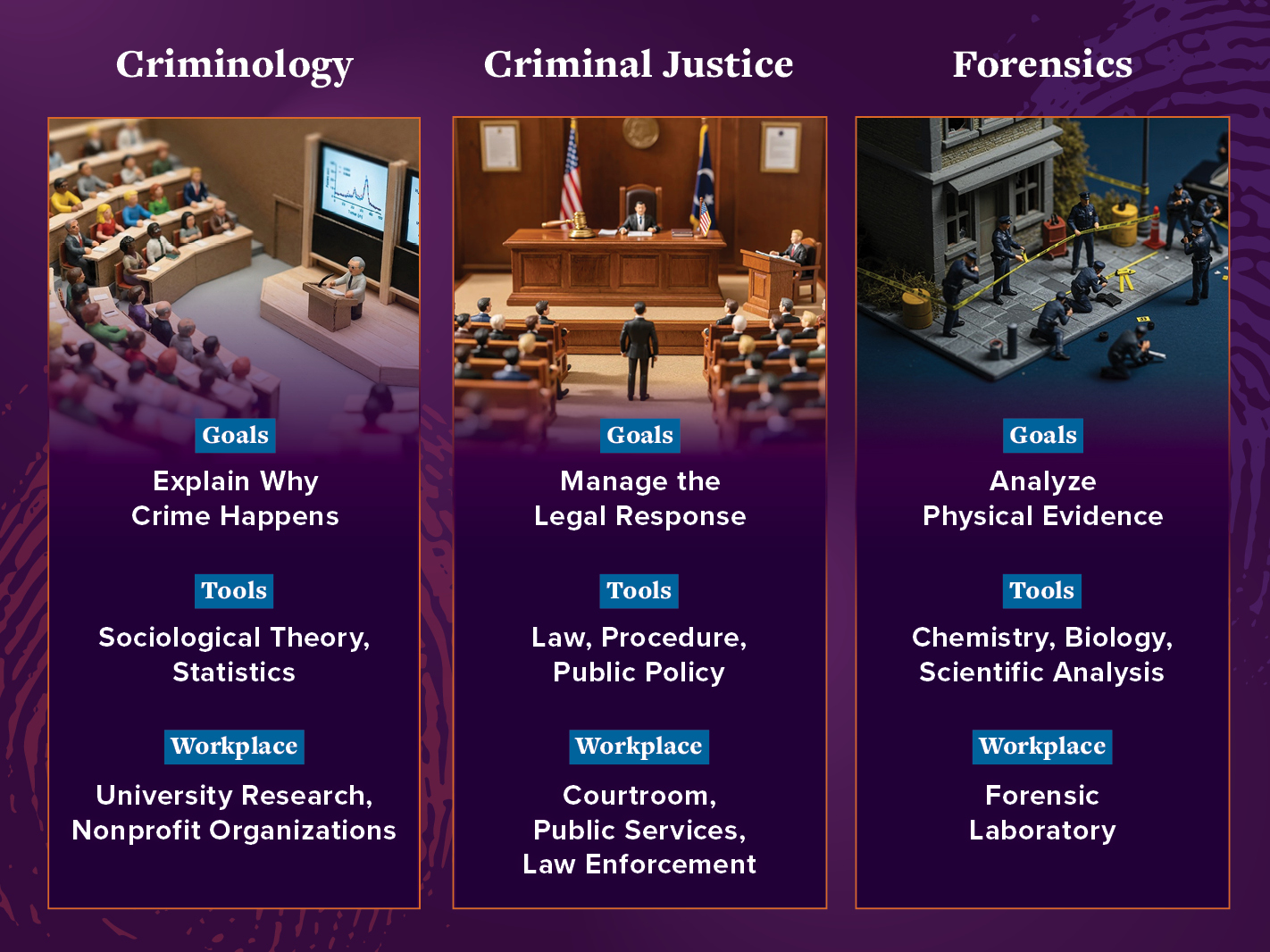
Essentially, if you’re analyzing DNA from blood spatter, you’re a forensic specialist. If you’re arresting the suspect, you work in criminal justice. If you’re researching why that specific neighborhood has seen a 10% spike in homicide, you’re a criminologist.
Start Your Career in Public Service at Excelsior
Anyone starting their career in public service needs empathy, attention to detail, and a nuanced understanding of people, processes, and politics.
While criminology, criminal justice, and forensics are distinct disciplines, they are all committed to serving the public good, and they are each writing parts of the same story about crime and society. Excelsior University’s BS in Criminal Justice program curriculum incorporates elements of all three, with courses like Criminology, Statistics, Criminal Procedure and Evidence, and Criminal Justice Administration so you can build the well-rounded base of knowledge employers are looking for. Which crime prevention career path you decide to take depends on where you want to make a difference within that story.
How Nonprofits Can Build Cross-Cohort Credibility Without Losing Focus
Scott Dolan, executive dean of Excelsior University’s College of Liberal Arts and Sciences, contributed to a Forbes Nonprofit Council article titled “How Nonprofits Can Build Cross-Cohort Credibility Without Losing Focus.” Dolan discusses the importance of nonprofit leaders earning trust by listening to their communities and focusing on outcomes.
Dorothy Jean Tillman at Excelsior for Women’s History Month
As an Excelsior University alumna and one of the youngest doctoral graduates in the nation, Dorothy Jean Tillman, BS ’18, represents what’s possible when passion meets opportunity. Her journey from child prodigy to global advocate for STEAM education inspires students of all ages to pursue their dreams, making her an inspired choice of keynote speaker for Excelsior’s 2026 Women’s History Month celebration.
Tillman shared her impressive academic journey in a special event titled “Leading the Change,” moderated by Daniel Pascoe Aguilar, Excelsior’s chief diversity officer and founding director of the Center for Social Justice. She credited a strong network of family, mentors, and community for helping her navigate challenges and discussed her focus on mental health well-being. Through her metaphor of “watering your garden,” she shared the importance of investing time and energy into the people, habits, and goals that help you succeed, rather than focusing on being distracted by external pressures.
Tillman also spoke about her work in expanding access to STEAM learning opportunities, stressing the importance of representation and inclusion of women and underrepresented groups. In the spirit of Women’s History Month, Tillman honored the trailblazers who came before her while encouraging the next generation to push boundaries, reminding the audience that achievement is most meaningful when it is used to uplift others and contributes to positive change.
Who Is Dorothy Jean Tillman?
Dorothy Jean Tillman began her higher education journey at just 10 years old, earning an associate degree from the College of Lake County. She went on to earn a Bachelor of Science in Liberal Arts from Excelsior University in 2018 at age 12. By 14, she had earned a master’s degree from Unity College, and at 17, she made national headlines as the youngest graduate of Arizona State University’s Doctor of Behavioral Health program.
Tillman’s doctoral research focused on reducing the stigma around college students accessing mental health services. Despite her impressive academic achievements, Tillman has described herself as “just a Gen Zer,” balancing her work with hobbies like dancing, painting, and spending time with friends.
The DorothyJeanius STEAM Leadership Institute
Tillman founded the DorothyJeanius STEAM Leadership Institute to create pathways for underrepresented students to succeed in science, technology, engineering, arts, and mathematics. Since its launch, the institute has reached thousands of young learners through workshops, camps, and hands-on programming. It has distributed more than 3,500 at-home STEAM kits and engaged more than 5,000 participants globally.
The institute encourages students to discover their interests across disciplines. Impressively, 97% of participants have gone on to pursue STEAM-related degrees. Tillman’s work has extended internationally, including initiatives in South Africa, and she has also advised the Ghanaian government in STEAM efforts.
Showing Love for Her Alma Mater
Tillman credited Excelsior for the “invaluable support” she received and for being a key part of her success. “From my early days as a student, Excelsior nurtured my growth and encouraged me to push boundaries, ensuring that I had the tools and resources to succeed,” she said in her “Leading the Change” conversation with Aguilar. “I was profoundly grateful for the encouragement and mentorship that shaped my path, reminding me that true leadership involved not only personal achievement but also the responsibility to uplift others. So, sharing my story today is an opportunity to pay it forward.”
Tillman’s experience highlights how flexible, student-centered education can empower learners to achieve their goals, no matter their starting point. There is no single path to success, but with the right support and determination, extraordinary outcomes are possible.
Excelsior University approved to launch its first doctoral program
ALBANY, N.Y. – Excelsior University has been approved by the New York State Education Department (NYSED) to offer its first-ever doctoral program. Opening to enrollment this fall, Excelsior’s Doctor of Business Administration (DBA) program is designed to elevate the leadership skills of experienced professionals by pairing online coursework with immersive in-person residencies.
Founded in 1971 with a mission to provide educational opportunities and access to learners of all backgrounds, Excelsior has helped more than 200,000 students earn associate, bachelor’s, and master’s degrees. NYSED’s approval for Excelsior to launch its first doctoral program marks a historic moment for the University, reflecting the expansion of academic scope symbolized by the institution’s 2022 transition from Excelsior College to Excelsior University.
“Approval from the New York State Education Department to offer our first doctoral degree program is a milestone for Excelsior and the learners we serve,” said Excelsior University Provost and Chief Academic Officer Chris Cassirer. “Beginning with the DBA, students can now find a clear pathway from pre-degree certificates through a doctoral degree in business at Excelsior. The DBA is the first of many new terminal degree offerings we plan to introduce in the years ahead, truly establishing Excelsior as a home for life-long learning.”
The DBA program is designed for professionals seeking to strengthen their strategic leadership, research, and consulting skills. The program will be delivered online with two brief, impactful in-person residencies. The hybrid format provides flexibility while ensuring valuable face-to-face networking, mentoring, and research support opportunities. The program equips students with advanced knowledge of business theories, research methods, and evidence-based practices, preparing them to become leaders in their fields.
“As Excelsior’s first doctoral program, the DBA represents a bold step forward for Excelsior University,” said Brian Allen, dean of Excelsior University’s School of Business. “The program builds on our foundational commitment to practice-ready education, combining the best of online and in-person learning to help leaders develop the skills they need to thrive as leaders in an ever-evolving business environment.”
The DBA will open to applications on August 24, 2026. Interested students can complete an inquiry form to learn more at excelsior.edu.
Media Contact Excelsior University:
Jason Bonafide, jbonafide@excelsior.edu, 518-608-8446
ABOUT EXCELSIOR UNIVERSITY
Excelsior University is an accredited, not-for-profit online institution focused on helping adults complete their degrees and advance their careers. Excelsior contributes to the development of a diverse, educated, and career-ready society by valuing lifelong learning with an emphasis on serving individuals historically underrepresented in higher education. Founded in 1971, Excelsior meets students where they are — academically and geographically — removing obstacles to the educational goals of adults pursuing continuing education and degree completion. Our pillars include innovation, flexibility, academic excellence, and integrity.
Excelsior is a not-for-profit university with a main campus in Albany, New York, and an educational site in St. Petersburg, Florida. Excelsior University’s academic programs are registered by the New York State Education Department, with additional licensing for Florida-based programs.
Licensed by the Commission for Independent Education, Florida Department of Education (License No. 12928). Additional information regarding this institution may be obtained by contacting the Commission at 325 West Gaines Street, Suite 1414, Tallahassee, FL 323099-0400, toll-free number: (888)-224-6684.
Why You Should Earn a Psychology Degree
Psychology is the study of how people think, feel, and behave—both individually and in groups. While many people associate it with clinical work like therapy, that’s only one of many career paths. With a psychology degree, graduates can work in fields such as business, education, health care, research, and human services.
The Benefits of Getting a Psychology Degree
Earning a psychology degree equips you with a deep understanding of human behavior and the skills to make a meaningful impact in many settings. You can develop expertise in areas such as mental health and well-being, research, communication, and problem-solving. These skills can be applied to helping individuals manage stress and overcome challenges, contributing to research and innovation, or supporting organizations in improving workplace performance. Here are some additional benefits of earning a psychology degree.
Gain Diverse Career Opportunities
With a psychology degree, you can specialize in a career in psychology that matches your interests. You can pursue roles in clinical practice, counseling, education, research, or more. Alternatively, research psychologists study human behavior and mental processes to help advance science.
Beyond traditional psychology roles, though, a psychology degree also prepares you for careers in fields like marketing, human resources, and business. In marketing, you can apply your understanding of human behavior to investigate consumer trends and create marketing campaigns. In human resources, psychology graduates can help in recruiting and training employees. Other career paths may include roles in sales, customer experience, community outreach, or nonprofit work. These are fields where strong communication, empathy, and analytical skills are necessary.
Explore the Human Condition
Psychologists study the workings of the human mind to gain insight into why people act the way they do, as well as to promote well-being and positive change. This understanding of the human condition is also valuable in many other occupations. Professionals in health care, social work, education, criminal justice, marketing, user experience (UX) design, and public relations all rely on insights into human behavior to do their work. Professionals with a psychology degree have a deep knowledge of how people think and interact. They can improve patient care, support communities, design innovative products, shape public messaging, or inform policy decisions.
Make a Difference in People’s Lives
Many people enjoy careers where they can make a positive impact on others, and psychology is an excellent field for doing just that. Because it focuses on thoughts, emotions, and behavior, some graduates pursue roles as counselors, social workers, therapists, and other health professionals. At the same time, making a positive impact can also happen outside a therapy setting. Psychology graduates can apply their knowledge in nonclinical roles such as human resources, where they support employee well-being and workplace culture; marketing and communications, where they better understand and connect with audiences; and UX design, where they create more intuitive and accessible products. Others work in fields like education, criminal justice, public health, and community outreach.
Can You Find an In-Demand Job with a Psychology Degree?
Many careers in psychology have strong job outlooks, making them a solid choice for students seeking in-demand roles. According to the U.S. Bureau of Labor Statistics, employment of psychologists is projected to grow 6% between 2024 and 2034—faster than the average for all occupations. At the same time, a psychology degree can also lead to strong job opportunities outside of traditional psychology careers. Graduates are well-positioned for roles in human resources, marketing and market research, UX design, sales, project management, public relations, case management, and community outreach.
Start Your Psychology Education with Excelsior
If you’re interested in studying the human mind or helping others improve their lives, Excelsior University’s Bachelor of Science in Psychology program might be the right choice for you. After earning a psychology degree from Excelsior, you’ll have a solid understanding of core psychology concepts, human development, cognition, memory, intelligence, personality theories, and psychological disorders, positioning you for a wide range of careers. If you choose to become a psychologist, pursuing counseling or research roles, for instance, your next step after earning your bachelor’s degree is graduate school, as you’ll likely need a master’s or doctorate. However, fields like human resources, marketing, education, and more are open to graduates with a psychology degree, with many entry-level positions only requiring a bachelor’s.
Psychology degrees are among the most versatile you can earn. With so many paths to pursue, it’s not hard to find one that’s right for you. And with Excelsior’s flexible online courses and robust support resources, you can earn your degree without disrupting your busy life. Contact an admissions representative today to learn more!
Technician vs. Technologist vs. Engineer: Different Roles in Electrical Engineering
In the field of electrical engineering technology (EET), job titles like technician, technologist, and engineer are often used interchangeably—but they reflect different levels of education, responsibility, and career paths. Understanding these differences helps people looking to enter the industry to confidently pursue a career that aligns with their skills, goals, and credentials. Here, we’ll examine the responsibilities, education requirements, and skill sets associated with all three roles, plus a few examples of real-world job titles.
What Does an Electrical Technician Do?
EET technicians focus on the hands-on installation, testing, maintenance, and troubleshooting of electrical systems and equipment.
- Typical education: Technician roles usually require at least an associate degree or certificate in electrical or electronics technology. Many employers prefer a BS in Electrical Engineering Technology.
- Skill set: In this role, you’ll need strong practical skills, including competence with tools, diagnostic equipment, and wiring.
- Examples of EET technician positions: Electrical technicians, field service technicians, and maintenance technicians are common roles that employers are looking for.
What Is a Technologist?
EET technologists apply engineering principles to solve practical problems, bridge the gap between technicians and engineers, and often supervise or manage technical teams.
- Typical education: Roles for EET technologists usually call for a bachelor’s degree in electrical engineering technology.
- Skill set: Technologists require skills in systems-level thinking, applied design, data analysis, and project management.
- Examples of EET technologist positions: Electrical technologist, test technologist, systems integrator, and automation and controls engineer are typical titles you’ll see in job postings.
What Does an Electrical Engineer Do?
Electrical engineers design new systems or technologies, perform advanced analysis, and often work in R&D or conceptual development roles.
- Typical education: To become an engineer, you’ll need a bachelor’s or advanced degree in engineering (preferably in electrical engineering). This role sometimes requires licensure as a Professional Engineer (PE).
- Skill set: Theoretical modeling, innovation, and systems design are examples of skills you need as an EE.
- Examples of electrical engineer positions: Electrical engineer, design engineer, and systems engineer are common job titles you might have as an EE.
Start Your Career in Electrical Engineering Technology with Excelsior
At Excelsior University, we help students understand the differences between roles in EET so they can pursue the education path that best aligns with their goals. For those interested in technician-level roles, courses such as Blueprint Reading, Personal Protection Equipment for Electrical Work, and Electrical Theory build a solid foundation. And our ABET-accredited Bachelor of Science in Electrical Engineering Technology program prepares students for technologist roles with an emphasis on applied knowledge, simulations, and real-world scenarios, such as power systems, electronics, control systems, and communications.
Although Excelsior’s BS in Electrical Engineering Technology program is not designed to lead directly to PE licensure in most states, graduates can still grow into engineering roles over time, especially through experience, certifications, or graduate education. Students can qualify to take the Fundamentals of Engineering (FE) exam during their senior year or after graduation, and after six years of industry experience, they can take the PE exam.
At Excelsior, we believe in career readiness, lifelong learning, and upward mobility. Many students start as technicians, earn their degree online while working, and move into technologist or even engineering-related positions over time. Through a combination of flexible courses, robust support, and experienced faculty, Excelsior University has been helping students of all ages and backgrounds achieve their goals for more than 50 years. If you’re ready to start or advance your career in electrical engineering technology, learn why you belong at Excelsior.
How to ATS-Proof Your Resume
If you’ve been applying for jobs and not hearing back, your resume may not be making it past the first review. In many cases, that review happens before a hiring manager ever sees your name. Understanding how applicant tracking systems work is one of the most important resume tips you can apply. When you know how your resume is being evaluated, you can present your experience clearly, use language intentionally, and position yourself more strategically.
What Is an ATS?
An ATS, or applicant tracking system, is software employers use to collect, organize, and sort job applications. Instead of manually reviewing every resume from the start, organizations rely on these systems to manage volume efficiently. Although applicant tracking systems were once more common among large corporations, organizations of many sizes now use them. Their purpose is not necessarily to eliminate candidates immediately, but to categorize applications and highlight those that most closely align with the job description.
What Do Applicant Tracking Systems Look For?
Although each ATS is different, most are programmed to scan resumes for alignment with the job posting. They recognize structured sections, specific terminology, and consistent formatting.
This means clarity matters. The way you label sections, describe responsibilities, and present skills influences how your information is categorized within the system.
Most applicant tracking systems look for:
- Skills that match the job description
- Relevant terminology used in the posting
- Job titles and level of responsibility
- Education, certifications, and credentials
- Clear section headings, such as Work Experience and Education
- Accurate spelling and consistent formatting
Keywords should only be used when they reflect real experience. The strongest resumes use language to validate what you have actually done, not to suggest qualifications that are not there.
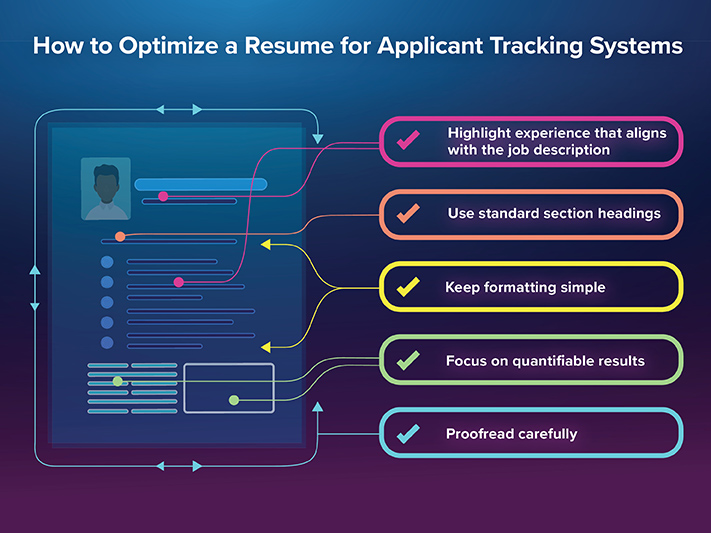
5 ATS-Friendly Resume Tips to Help You Stand Out
Optimizing your resume does not require complicated design. In fact, simplicity works in your favor. These resume tips focus on alignment, structure, and accuracy so your qualifications are recognized by both applicant tracking systems and hiring managers.
Resume Tip 1: Align with the Job Description
Review the job posting carefully and identify the skills and responsibilities that genuinely match your background. Use the same terminology when it accurately reflects your experience. If you have led projects, say that. If you have not, do not force language into your resume. Tools like Jobscan can help you see where your resume aligns, but no tool replaces thinking carefully about your experience and tailoring your resume with intention.
Resume Tip 2: Use Standard Section Headings
Applicant tracking systems are designed to recognize common headings such as Work Experience, Education, and Skills. Creative titles may confuse the system and cause information to be miscategorized. Keeping your structure straightforward ensures your resume is parsed correctly and organized in a way a hiring manager can easily review.
Resume Tip 3: Keep Formatting Simple
Avoid text boxes, graphics, multiple columns, and unusual fonts. Many ATS platforms cannot read complex designs accurately. A clean single-column format with standard bullet points improves readability and helps ensure that your information is captured correctly.
Resume Tip 4: Focus on Results
Instead of listing responsibilities alone, highlight measurable outcomes. Quantifiable results such as improved efficiency, increased enrollment, or reduced processing time demonstrate impact. Results strengthen your resume for both applicant tracking systems and hiring managers because they show evidence, not just activity.
Resume Tip 5: Proofread Carefully
Spelling errors and inconsistent terminology can prevent important skills from being recognized. Review your resume thoroughly before submitting it. Reading it aloud or asking a trusted colleague to review it can help catch mistakes that software and hiring managers will notice.
3 Pitfalls to Avoid
Just as important as knowing what to include is understanding what can weaken a resume. These common mistakes can limit how effectively your application performs within an applicant tracking system.
Pitfall 1: Using Graphics or Images
Visual elements such as logos, icons, or charts may look polished, but most applicant tracking systems cannot interpret them. If critical information is embedded in a graphic, it may not be processed at all. Keep essential content in text format.
Pitfall 2: Overusing Keywords
Including keywords without demonstrated experience can create problems later in the hiring process. Repetition alone does not strengthen your application. Use terminology strategically and only when it accurately reflects your background.
Pitfall 3: Ignoring Instructions
Employers may specify preferred file types or formatting guidelines. Failing to follow directions can create unnecessary barriers. Review application instructions carefully before submitting your resume.
Your Resume Is Only One Part of the Strategy
Optimizing your resume for an ATS is important, but it isn’t the only factor in securing an interview. Networking, thoughtful follow-up, and connecting with professionals inside an organization can increase your chances. When possible, consider identifying someone within the company who can offer insight into the role. Your resume opens the door; professional outreach and relationship building often help you move through it.
Start Your (Next) Career with Excelsior
A strong resume matters, but expanding your knowledge and skills can also increase your opportunities. For more than 50 years, Excelsior University has helped working adults earn degrees through flexible programs designed to fit real life.
Whether you’re looking to start a career in a new field or strengthen your position in your current one, Excelsior offers more than 40 flexible, career-focused programs. Students have access to comprehensive Career Readiness resources that support resume development, interview preparation, and professional growth.
Whether you’re considering going back to school or exploring different areas of study, the right education can strengthen your qualifications and position you more competitively in today’s job market.
Ever Upward: Brian Pervis and the Power of Teaching
During his capstone project in his master’s program, Brian Pervis realized something important: Education, when done well, has a lasting impact on direct practice. “That’s when I realized I wanted to teach,” he says. “Not just content—but confidence, competence, and critical thinking.”
In January 2022, Pervis joined Excelsior University as a part-time faculty member, then transitioned to full-time teaching, and now serves as a department chair in the School of Nursing. Now in his fifth year, he oversees several important associate nursing courses that hundreds of students take each year.
Pervis earned his Associate of Science in Nursing in 2009 and passed the NCLEX-RN to become a registered nurse on his first attempt. Leveraging transfer credit from his associate degree, he also earned a Bachelor of Science in Liberal Arts with Excelsior in 2009, followed by a Master of Science in Nursing Education in 2011. The journey to becoming a department chair began more than 20 years ago when he became an emergency medical technician at his mother’s suggestion.
Called to Education
He enjoyed the fast-paced atmosphere of being an EMT and helping others, but he wanted to pursue a different career. So, he became a licensed practical nurse in 2001 and began working for various health care networks in New Haven, Connecticut. Still, the urge to learn and grow nagged at Pervis. A visiting representative of Excelsior University—then College—to Pervis’ workplace convinced him to “give it a shot.” Three degrees later, Pervis not only supervises but also teaches several nursing courses, like NUR 104 and NUR 105.
“The part that I like about teaching … is the students,” he says. “They’re trying to get better and better themselves—LPN students that are going up to become RNs … [and then] going further to get their Bachelor of Science in Nursing. We’re also seeing paramedics that are transitioning to becoming nurses.” He adds that it becomes personal when students reach out to thank him for his mentorship and teaching.
That connection is especially evident during Commencement ceremonies, which Pervis describes as his favorite moments of the year. In a mostly asynchronous learning environment, Commencement is where virtual relationships become personal. “When you see students, they say, ‘Hey, you’re Dr. Pervis.’ It’s that personal connection. And they’re so thankful. They’re so grateful,” he says.
Having attended multiple Commencement ceremonies as a student, he also understands the excitement. “It gives me butterflies,” he admits. “I know what they’re going through. I know how meaningful this is.”
Adult learners, Pervis also notes, often juggle work, family, and school, so he says it’s important to believe you can get to that finishing line. In fact, he says, dedication is a defining trait of successful Excelsior students. He tells his own: “Be dedicated to your studies. Don’t take the shortcut. Take the long way. … Students who are truly dedicated, that show up every day, they put the work in—you’re going to leave Excelsior better than [how] you came in.”
Meeting Students Where They Are
Pervis’ deep understanding of the adult learning experience has helped him reimagine how clinical and laboratory skills are taught in the distance-learning model. For instance, in the nursing lab courses, students demonstrate skills such as head-to-toe assessments or IV administration by recording themselves practicing on consenting family members or friends. Faculty members then provide detailed feedback aligned with structured rubrics.
“We don’t see too many people doing that right now because it meets the student where they’re at,” explains Pervis. “It allows the students [to perform] in the comfort of their home.”
Pervis’ commitment to teaching also shapes how he views higher education’s future. For instance, the use of artificial intelligence continues to expand, and today’s students must learn how to responsibly interact with it. “It’s more about responsible AI use because health care systems are using AI,” Pervis says. “And if we don’t adapt to that, our students are going to be behind. So we have to kind of understand that and kind of gear ourselves towards that.”
Needing to adapt is why Pervis believes lifelong learning is essential, not optional. “We have to get better. We have to adapt to the changes. So, you have to be a lifelong learner.”
Preparing the Next Generation of Nurses
Believing in lifelong learning means putting ideas into action, and Pervis takes that message straight to students. Recently, Camille Dumont, associate director for Career Readiness at Excelsior University, featured Pervis in a Career Café—an interactive webinar connecting students and alumni with career resources and professionals across industries.
During the session, Pervis challenged attendees to think intentionally about their futures. “What kind of nurse do you want to be remembered as?” he asked. “Do you want to be this nurse or that kind of nurse? So, just answer that question. It’s going to help you determine your career path.”
Pervis talked about how nursing careers are layered and that growth requires planning, humility, resilience, and a commitment to lifelong learning. He touched on how depth matters more than speed; it’s important not to rush your development. Pervis also discussed how success in nursing also means building your reputation thoughtfully, exploring entrepreneurship strategically, and protecting your well-being.
Pervis reminds students that learning is not confined to degrees earned or titles achieved. It is a mindset and a belief that growth is always possible. And with education, you can transform not only your career but also lives. “[Students] are going to be the future leaders. My job is going to be gone,” he reflects. “So, dedicate yourself to your studies and everything that you’re doing. … You can make an impact on education, society, and your family—and just change it right the way you want to see it be changed.”
