College Implements Initiatives to Support Veterans Pursuing a Bachelor’s Degree in Nursing
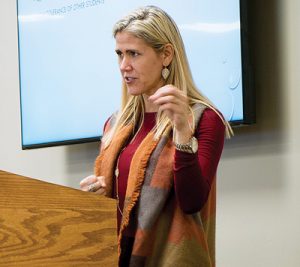
Instructional faculty member Susan Piper looked pained as she discussed issues concerning veterans during a presentation at Excelsior College in February 2018. The issues hit close to home. As a soldier and a nurse, she had seen firsthand how PTSD had affected her husband, a soldier who had returned from Iraq in November 2006. The issues also hit close to work. As an educator of adults returning to college, many of whom are servicemembers and veterans, she sees how their personal challenges extend to the classroom. In her presentation to Excelsior College faculty and staff, Piper shared both her personal and her classroom experiences to highlight the critical importance of being attuned to the needs of veterans and how that awareness can make for a better learning experience.
Piper’s presentation was one part of a larger, multi-faceted effort at Excelsior College to better support veteran and military students. In July 2014, Excelsior College was awarded a three-year, $1,019,181 grant from the Health Resources and Services Administration to assist qualified veterans with earning a bachelor’s degree in nursing and transitioning to the civilian workplace. In July 2017, the College received an additional year of funding to complete project initiatives and evaluation efforts. By then, the initiatives focused not only on promoting student success through changes to the curriculum, but also on helping faculty and staff develop their awareness of veteran students. Known as Mission: Transition, the focused efforts reinforced the College’s military- and veteran-friendly reputation.
Of Excelsior’s more than 29,000 enrolled students, 34 percent are military servicemembers and 12 percent are veterans. Mission: Transition made it possible to help instructional faculty better understand the experiences of this student population and what they bring to the online classroom by funding the production of a tutorial that was offered as a faculty development opportunity. Created through a collaboration between the School of Nursing and Excelsior’s Center for Military and Veteran Education, FAC 120 Military Culture addresses nuances of military culture and the associated impact on the lives of students with military backgrounds. After it was offered to nursing faculty leadership and instructional faculty, the tutorial was opened to faculty leadership and instructional faculty in other disciplines, as well as to some academic advisors.
“FAC 120 served as a cultural immersion where faculty learned to view their own world as ‘other’ as the first step in reaching out to veteran students,” says Patricia Cannistraci, assistant dean in the School of Nursing. While the bachelor’s degree in nursing program has several faculty members who are veterans [see sidebar on page 18], other programs with enrolled veterans do not. A survey of participants who completed FAC 120 shows they were more familiar with the experiences of military and veteran students after taking the course. While gains in knowledge and understanding were reflected collegewide, the largest gains were reported by faculty affiliated with the technology programs, who typically have backgrounds in industries rather than the military. “Nearly every faculty member who completed FAC 120 reported having a better understanding of the circumstances of students with military experience as a result of taking the course,” says Barbara Storandt, principal consultant at ALTA Solutions Group LLC, who serves as the external evaluator of Excelsior’s work related to the grant.
In one of the first grant-funded initiatives, Susan Piper participated in a digital storytelling project and recorded her personal account of recognizing her husband’s PTSD [see sidebar below]. The video was incorporated into NUR 448 Community Health Nursing and into a presentation for a faculty workshop on recognizing the signs of PTSD. The workshop also provided faculty members with strategies for working with veteran students, such as establishing a personal connection and promoting goal setting with short- and long-term planning. Piper also discussed strategies for working with military and veteran students when she visited the College in February and gave examples from her teaching experience at Hopkinsville Community College in Kentucky.
Developing a better understanding of military students is a recurring theme in accomplishments attributed to the grant or inspired by the grant. Mission: Transition funded revisions to the bachelor’s degree nursing curriculum so that course content increased awareness of the health care needs of servicemembers, veterans, and their families. Course assignments provide veterans with opportunities to reflect on their military health care experiences and relate them to the course work. A new elective, NUR 340 Caring for Our Nation’s Heroes and Their Families, gives nursing students the opportunity to learn more about the diverse health care needs of military service members, veterans, and their families. Students learn about military and veteran culture, health care systems and resources for servicemembers and veterans, and the military family. The course also explores veteran-centric health-related topics such as post-traumatic stress disorder, transition issues, poly-trauma, homelessness, women’s veteran health issues, LGBT topics, and applicable theories.
The inclusive learning environment resulting from Mission: Transition initiatives benefits all students. “Not only did it assist our veteran student population in attaining their bachelor’s degrees in nursing, it also improved nursing care for military patients and their families by educating all our students about the needs of our wounded warriors,” says Mary Lee Pollard, dean of the School of Nursing.
With the support of the grant, the College looked at how it can meet the needs of veteran students and the effect of relationship building on a student’s success. Excelsior College was the only online institution among the colleges and universities that received the HRSA grant through the Nurse Education, Practice, and Retention: Veterans’ Bachelor of Science Degree in Nursing program. The grant provided Excelsior College with a unique opportunity to test hypotheses about the level of support veteran students need and better ways to support them as they pursue a bachelor’s degree in nursing.
For the first three years of the grant, veteran students were assigned to a dedicated academic advisor and a faculty nurse mentor to further personalize the student’s experience and strengthen connections. The faculty member provided veteran students with academic coaching and mentoring, particularly as students took their first academic course and acclimated to the online classroom. After evaluation, which included interviews with students, the College found its veteran student population did not require mentorship that varied from what’s offered to the typical Excelsior student. The College discontinued the grant-funded nurse mentor position when the initial funding ended in June 2017. Veteran students, as do all students, receive support from academic advisors through the Office of Student Success Services.
According to survey results, veteran students respond positively to the services offered to them at Excelsior College. “They really needed to know that they are part of a veteran-oriented institution,” says Storandt, and adds that Excelsior’s culture of valuing veteran service is clearly conveyed to and understood by veteran students.
Making the transition from a traditional classroom setting to online learning can be challenging for students, and even a “mind-blower,” according to one veteran student in the bachelor’s degree in nursing program. The student was among those surveyed to assess the grant’s impact. After the student identified as a veteran, the support kicked in right away. “It was like a connection that was right there, readily accessible. I felt at home, not so much back in the military, but at home in the sense that I was able to reach out to people that were in civilian life with me and understood where we were, what we’re doing.”
That experience is exactly what Excelsior seeks to provide veterans. The grant enabled the College to foster a deeper understanding of the veteran experience across the college, and to connect with other higher education institutions that serve similar populations. “It put Excelsior College in touch with 30 other colleges and universities across the country doing similar work with veteran students, allowing us all to share our stories and experiences for the benefit of students,” says Barbara Pieper, who was the principal investigator for the grant. She served as the associate dean for bachelor’s and master’s degree programs in the School of Nursing until her appointment as dean of the School of Health Sciences in spring 2017. “I believe we had some unique program features to share with our colleagues. We were honored to participate.”
The collaboration with the other higher ed institutions contributed to the impact of the 2017 Annual Educational Institute, “Lessons from the Field: Innovations in Veteran Education, Transitions, and Care.” The daylong conference, funded by the grant, was organized by Excelsior College School of Nursing and Albany Medical Center. The College invited grantees to give papers or posters highlighting aspects of their Veteran Bachelor of Science in Nursing programs, says Pieper.
Faculty development opportunities, such as the FAC 120 course, the PTSD workshop, and the educational institute, were layered onto a military-friendly culture at Excelsior College that has existed for more than four decades. The grant essentially enhanced what was already there as far as awareness of the veteran experience and support for them as adult learners, according to several people involved in administering or evaluating the grant. “Any effort that went into a veteran-oriented program came out on the student side in some way,” says Storandt.
In the years since the College first received the grant, 179 veterans have enrolled in the Bachelor of Science in Nursing program [as of April 3, 2018]. The number of veteran students who earned a Bachelor of Science in Nursing during that same period totals 66. As recently enrolled students complete the program requirements, the number of veteran students earning a bachelor’s in nursing is expected to increase. Mission: Transition will have helped many of these students enter the workforce better prepared to meet the growing demand for bachelor’s-prepared registered nurses.
NURSING INSTRUCTOR TOMAS SERNA, A VETERAN, GIVES BACK
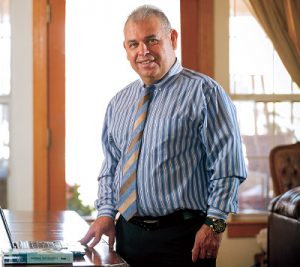
Tomas Serna may have left active duty in October 2016, but his life remains anything but calm. Nowadays, the former lieutenant colonel is teaching, coaching, and mentoring the next generation of nursing leaders — what he claims was the best choice he could have made.
Serna initially joined the Army in 1983 because his business degree gave him few job prospects. When he briefly left the Army eight years later, he attended college at the University of Texas at El Paso and attained his bachelor’s in nursing. “I chose nursing because it gave me better career opportunities,” he says. Now he works as an employee for the federal government. “I just changed uniforms and returned to work,” says Serna. “My military and my civilian life is pretty much interconnected. I would not change it. I would rather continue to serve than to work in a civilian hospital.”
Tomas Serna’s strong will and dedication to lead others to survive and succeed has led him to support his fellow veterans in transferring to the civilian life, as well as encouraging his own children in following their educational dreams.
Photo: Aaron Ingrao
It wasn’t easy to transition to civilian life, however. “I think the most difficult thing for me was losing control. As an Army officer, I had a lot of responsibility, but I also had a lot of respect. I could make things happen with a single order,” Serna explains. Understandably, now it’s not so much the case, and Serna says a certain level of diplomacy must be mastered in order to get things done.
That doesn’t take away from his love of teaching. Serna teaches NUR 338 Introduction to Nursing Informatics and NUR 456 Leadership and Management in Nursing at Excelsior. “I enjoy dedicated students. I can work with students who are committed to succeed in the course. I can help them become successful in the class. I look for those students who work hard,” he says. It runs in the family, too. One of Serna’s greatest personal achievements is raising two nurses — his son and daughter. He says he “provided effective teaching, coaching, and mentoring. I could not give the profession more than my own two children.” One of Serna’s greatest military achievements is that in 2004, he took 450 soldiers to Iraq and brought them all back safely. Both accomplishments are a testament to Serna’s strong will and dedication to lead others to thrive and succeed.
Serna’s advice extends far beyond the paternal. He encourages veterans to take advantage of every possible program available to them; for instance, the VA has many programs, including job placement opportunities. “The transition center can also help them [veterans] before they get out of the service,” Serna explains. “They need to find a way to transfer their military experience, education, and training to the civilian job force. They need to dress to impress.”
In addition to helping fellow veterans, Serna is a member of a variety of local community organizations. He is also a member of the Texas Nursing Association and the National Association of Hispanic Nurses. “We conduct bi-yearly health fairs, seminars and educational activities within the community. The goal is to promote the profession within the community,” he explains. As a former Army Nurse Corps officer, he is a member of the Army Nurse Corps Association. In this capacity, he helps mentor young officers. “Further,” continues Serna “as a certified medical-surgical nurse, I help our clinical nurse specialists develop and present in-services to help our young nurses attain medical-surgical certifications.”- by Jenna Kerwin
SUSAN PIPER: USING DIGITAL STORYTELLING TO HELP VICTIMS OF PTSD
Post-traumatic stress disorder can happen to anyone. Military servicemembers and veterans most often experience PTSD due to the shocking and dangerous combat events they have witnessed during times of service. Susan Piper, a psychiatric mental health nurse practitioner, knows firsthand the effects of PTSD since it took many years for her husband to admit he experienced symptoms of the disorder. Since then, Piper has been using digital storytelling to share his story with others in hopes that they might learn they aren’t alone and that help is available.
Piper, who hails from western Kentucky, comes from a large family of servicemembers. “I chose to join the military, and answer that call, because my family is a military family. My dad served, my brothers served, uncles, and aunt; from the Air Force, to the Army, to the National Guard,” says Piper. She has over 25 years of military service with most of that serving in the Army National Guard, and only moved into nursing eight years ago.
“The things that influenced me to become a nurse go way back,” Piper recalls. Her older sister was a nurse and after being a “classic, traditional” college student, she decided on nursing, too. “It was an overwhelming urge to want to help, to make a difference,” says Piper, who visited Excelsior in February.
What influenced her to become a psychiatric mental health nurse practitioner stems back to her military family. “What drove me to specialize in that particular area falls back to my passion related to my service as a military member myself, having a family that is full of servicemembers. I have watched, over the years, so many soldiers go to war, and then return home, and talk of the things they experienced,” she explains.
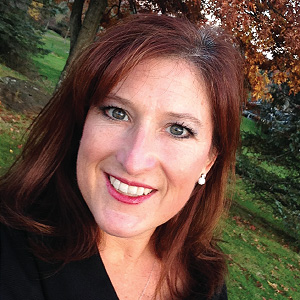
Susan Piper, an instructional faculty member for the School of Nursing, shares her experience with recognizing PTSD and teaching veteran students during a presentation at Excelsior College in February 2018.
Photo: Danny Santandrea
Her husband was one of these soldiers. In fact, Piper had been a nurse for 12 years when her husband finally admitted he had a problem. “I was a nurse in the military, I was a soldier, and was standing right beside him, and even though I saw these things happening, it even took me a little bit of time to say there was a problem,” she says.
As a nurse educator at Hopkinsville Community College, about 10 miles from Fort Campbell, Kentucky, Piper was used to teaching students who had served in the military or are currently still serving in the military, or who are military dependents. That’s when she had an idea to use her husband’s PTSD as a learning tool while teaching for Excelsior in 2016. Piper decided to create a video to further enhance material in the bachelor’s degree in nursing’s community health curriculum. The video was funded by the Veterans’ Bachelor of Science Degree in Nursing grant. “I decided to use the fact that my husband has PTSD in my digital story, and sharing that with my students, because I think it is important to make connections. When you make connections, learning occurs,” she says. Piper has taught NUR 212 Health Differences Across the Life Span 2, NUR 211 Health Differences Across the Life Span 1, and NUR 105 Essentials of Nursing Care Health Differences for Excelsior.
Piper describes digital storytelling as a method of using multimedia, such as photographs, music, videos, text, and sometimes even the spoken word, to share information—a story, an idea, or a thought. “Digital storytelling is a wonderful method to provide reflective thought, and that is important for all of us to do in some way,” she adds, explaining the process of reflective thought as being a method of analyzing a situation and then developing a course of action. “It’s a method of problem solving, if you will.”
For example, she says, “If I want to better myself, then I’m going to take a minute, every day, and reflect upon the day, and anything that may have caused me a problem. Or maybe it was something new that I’d been exposed to, then I’m going to think about that, and analyze how that impacted me. What have I gained from it? And then develop that plan, or course of action, or what am I going to do with this now that I’ve been exposed, or experienced it.”
There were several things Piper wanted people to take away from her digital story. “The first was related to the struggles that came with PTSD. The second was … that they’re not alone, that someone else has experienced this. I wanted my students, specifically my nursing students, to understand,” says Piper. “So, many things that I want[ed] for them to take away from my husband’s story of PTSD, and how I handled it, and the things that I went through … . And I guess one thing that, maybe as I spoke about it, a lot of times the military family is kind of forgotten about, and that would probably be one of the other things that I wanted to make sure that they took away. The soldier, the veteran, suffers, but the family suffers also. And the struggle touches many,” she adds. “But I also wanted them to know, related to that, they’re not alone, that there’s someone that could stand with them. That there’s help available.”
Digital storytelling is not only beneficial in the classroom, but it can be used therapeutically, also. That’s what Piper and her husband came away with — like a “weight had been lifted off their shoulders,” she says. Piper says, “I was very excited when he [her husband] was anxious to then share that himself. His friends, my friends, said it best. They said, ‘she’s not just telling your story, she’s telling our story.’ So that was exactly the response. That’s what I wanted. I wanted that connection.”
Piper has not assigned digital storytelling to any of her students, but she believes it can surely be utilized in the teaching process. She explains that any course that promotes critical thinking and problem solving (reflective thought) would be ideal for this sort of teaching. She is interested in using it in Hopkinsville’s mental health track. “I have recently taken on the responsibilities of our behavioral health nursing course, back at Hopkinsville Community College, and I think that as I make it my own, this is one of the things that I’m going to utilize … I’m hoping to use it in my mental health course. I think that I can embed it there, in some way. I believe that it will be very beneficial to these students.”
She also hopes to go back to her story to revise it. “At the end of that digital story, I talk about how I’m finishing my post-master’s, and starting my DNP. And now I’m looking at my two-year anniversary of being a certified mental health nurse practitioner, and in May I graduate with my DNP.” Piper’s capstone project focused on veterans, particularly access to mental health related to the veterans at Hopkinsville. It is her dream to make a greater difference at the government level, but for now she is happy she has made a difference with her digital story. “I said, well, even if I just impact one person, that’s one person … I can walk away OK. But I can’t walk away, no, I’ve got to do more,” she says.
Piper says personal connections and being aware are the most important things in understanding, but also in learning. They are building blocks for developing trust. She says, “Awareness is key, whether it’s awareness of issues, awareness of signs and symptoms, awareness of what you can actually then do to help or compensate, or awareness of resources that may be available in your area. So, to me, that [awareness] is key. That’s how we best can make a difference.” – by Jenna Kerwin